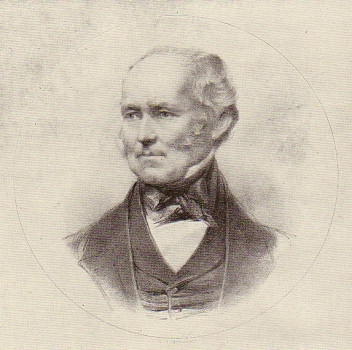
A Blupete Biography Page


SAMUEL CUNARD
(1787-1865) [Time Line]


  • Introduction
  • Samuel Cunard's Forefathers
  • Early Life
  • Samuel And Susan
  • Civic-Mindedness
  • Whaling
  • Far-Flung Business
  • Steamships
  • Tea And Banks
  • The Last Years
  • Conclusions
  • Dates & Events During Cunard's Life
  • NotesAuthorities


  • [TOC]
    Introduction

    Samuel Cunard lived through very important years when the world was transformed due to the railroad, the steamboat and the electric telegraph: inventions which changed the whole pattern of transportation and communication. Cunard was one of the major transformers in the dawning of this new age. One might think he happened to be simply at the right place at the right time. That may be true but he happened also to be the right person.

    "... a man of keen perception and sound judgment. Cool, calculating and long sighted his whole mind was given to the carrying out of any project he had in hand, and every legitimate means used to effect his object. And hence his general success."1
    After my study of Cunard, I thought of what William Hazlitt wrote:
    "There is nothing more to be esteemed than a manly firmness and decision of character. I like a person who knows his own mind and sticks to it; who sees at once what is to be done in given circumstances and does it. He does not beat about the bush for difficulties or excuses, but goes the shortest and most effectual way to work to attain his own ends or to accomplish a useful object. If he can serve you, he will do so; if he cannot, he will say so without keeping you in needless suspense, or laying you under pretended obligations. ... There is stuff in him, and it is of the right practicable sort. ... [He gives no thought as to whether he be] a friend or a foe, a knave or a fool; but thinks that life is short, and that there is no time to play fantastic tricks in it, to tamper with principles, or trifle with individual feelings."2
    [TOC]
    Samuel Cunard's Forefathers

    Cunard's ancestors were Quakers3 that came to America in 1683. They settled at a place along the Delaware River near present day Philadelphia. The family was headed by Thomas Cunard (Thones Kunders). Thomas found the means with his sons to buy "a ship," and together, they went into the shipping business. Through the years they made a success of it. Then, in 1775, the American Revolution unfolded. Certain of the Cunards, like many Americans, were not on the side of the revolutionaries. With the signing of the The Paris Peace Treaty (1783) by which the hostilities between Great Britain and her colonies were brought to an end, those loyal to the British crown, most all of whom were successful in commerce or had a position in government, knew that all was lost and they had to leave. That same year the Cunard family sailed from New York to the eastern British colonies. They came together with a great number of "Loyalists" in a fleet consisting of twenty ships.4

    (An interesting story might now be told: Part of this group that shipped out from New York was the family of Thomas Murphy, a ship builder of Charleston, South Carolina. Indeed, Murphy had built ships for the Cunard family in the pre-revolutionary days. Well, Murphy had an unattached daughter, Margaret, aged 21, "a tall, spirited girl with dark eyes." Abraham Cunard, an unattached male of 27, also was on one of the ships of the fleet that brought that brought the Loyalists to Saint John, New Brunswick in 1783. The two eventually married.)

    While a certain branch of the Cunard family that fled the United States settled on land near Saint John, Abraham Cunard (1756-1824) set out for Halifax where he took up work as a carpenter. Having earned a reputation as a good carpenter, Abraham was eventually hired to work at the government lumberyard, a place which rendered great service to naval ships in supplying masts, spars and squared timber.

    Kay Grant gave this description of Abraham Cunard:

    "A sober, thrifty, respected by everyone, he stuck to his job at the lumberyard and in time rose to a position of some importance. With a staff of assistants, he handled all the requisitions for trimmed lumber. Specifications for any government building project, including ships, had to be submitted to his department."
    Abraham and Margaret (1758-1821) had nine children, two girls and seven boys. The first child was Mary, born in 1784 (d.1811). Samuel came along next, in 1787.

    [TOC]
    Early Life

    Samuel Cunard grew up in Halifax. The family's home was located on a lane which was to become known as Brunswick street. It was between the naval station and the town.5 His father, Abraham, had bought a strip of land of ten acres which ran steeply down to the Halifax Harbour.6 So, young Samuel had a wonderful view from his backyard. The view showed the goings and comings of large and small sailing vessels plying the harbour, together with all the activities along the harbour occasioned by the arrival and departure of these vessels; it was an age where most everything that had to go any distance went by water.

    As a boy it started -- this insatiable appetite for commercial activity. He ran errants such as carrying letters across town for a small fee, or to go to the local farms beyond the town's edge for vegetables. He saved his pennies in a sock.7 He would frequent the wharfs of Halifax especially if ship captains were auctioning off their cargoes. He was quick, as he was throughout all his life, to spot a bargain. On the docks he picked up small lots of stuff such as coffee and spices; in turn he would go door to door to sell his finds.

    The best of Samuel's early education came from his parents, particularly his father. However, Samuel did attend Grammar School for a few years. By seventeen Samuel had completed his formal education and joined his father, where, there, in the King's Lumberyard, under his father's tutelage, he learned how to draft designs, to copy prints, to check specifications for the masts, spars, and timbers that were to go into ships of war.

    After working with his father for a period of time, learning all he could, Samuel took a ship for Boston. At Boston he spent three years working in a ship broker's office. It was then, back to Halifax for him. (It strikes one that Samuel's father knew the potential that existed in his son and paid careful attention to his education, a very practical education that would serve Samuel Cunard throughout all his life.)

    So, there was Samuel Cunard at about 21 years old, ready to take on the world. This was 1808. His father at the age of 52, had left the lumberyard; he was however, not yet ready to retire. Abraham built a wharf on the harbour at the foot of his land. Father and son then went into the shipping business. They started with a small coaster, a schooner, Margaret. Soon there was a second vessel, the Nancy, a privateer's prize. When the War of 1812 came along (United States v. Great Britain) opportunities grew. Though they were at war, each country understood the importance of maintaining trade for goods that were needed in times of peace or of war. Persons of good reputations were given trading permits; the firm of A. Cunard & Son were given permits which allowed the Cunards to increase their volume both in cargoes and in ships. In a time of war, if not generally, then certainly in strategic ports such as Halifax, ships came up regularly for sale, captured enemy ships of all kinds. In 1813 the Cunards acquired, at a prize sale, a square rigged (read big ship) called the White Oak. Though the White Oak could carry cargo, and did, she was also fitted out so that she could carry passengers. The Cunards decided to get into transatlantic shipping carrying both cargo and passengers to England. The commercial success of the White Oak led to the purchase of another large vessel which was sent off to the West Indies with lumber and fish, to return with molasses and sugar.

    [TOC]
    Samuel and Susan

    Susan Duffus (1795-1828) was the daughter of an influential merchant at Halifax, William Duffus.8 In the summer of 1814, Samuel and Susan became engaged and on February 4th, 1815 the pair were married.9 Susan was of great assistance to her husband, if, in nothing else, then in the art of hospitality which she had learned. Grant wrote:

    "Her house soon became a family gathering place, a second home for her five brothers and sisters and for the Cunard boys. Members of the Murphy family of Charlottetown would sail around to Halifax for a 'winter visit' of six months or more, and the Cunard cousins in Saint John would do the same."
    "The Cunard boys," of course were Sam's brothers: William10 (1789-1823), Edward (1798-1851), Joseph (1799-1865), John11 (1800-44), Thomas (d.1828) and Henry (1804-85). Grant observed that Samuel gradually took over "the education and upbringing of his brothers." According to Grant, William Duffus became a bankrupt, and after trying to get his business started up again, his warehouse burnt down. Samuel Cunard "took the Duffuses under protection and welcomed the added responsibility." We should say that "Grandmother Duffus" continued on for a good number of years and was very much in charge of domestic matters; her children and her grandchildren always consulted her; she was always ready to give practical advise.

    The family attended St. George's Church (the Round Church) on Brunswick St. Though we note that certain of the daughters were married at St. Paul's.

    The Samuel and Susan Cunard had nine children.12 Sam's father, Abraham retired in 1820 to a farm purchased at Rawdon.13 It will be recalled that Abraham's wife, Margaret, was a Murphy and her family occupied a farm at Rawdon. The pair did not last long at Rawdon: Margaret died in 1821, Abraham in 1824; both were buried in the graveyard at the church at Rawdon, St. Paul's. The name of the family company's name was changed to S. Cunard & Co. Samuel was unquestionably in charge, however, his brothers had roles to play. Edward and Joseph were full partners, with Henry and Thomas holding more junior positions. John was the captain of the company brig, Mary Ann.

    A sad time for both the Duffus family and the Cunard family, was the occurrence of the death of Sam's young wife, Susan; she died on February 2nd, 1828, days after she gave birth to her youngest child, Elizabeth. Susan Cunard is buried in the Old Burying ground at Halifax.

    [TOC]
    Civic-Mindedness

    Samuel Cunard was public-spirited. He immersed himself in municipal affairs, as did most all the upstanding men of the age did -- without charge, I am sure. There are numerous examples of Cunard's involvement in such matters. For a period of time, during the winters, soup-kitchens were set up to serve the poor. This was certainly the case when Dalhousie14 was the Lieutenant-governor of Nova Scotia, 1816-19. During that time, Cunard was one of the trustees of a fund set up by the government to supply soup-kitchens. Another example would be his involvement with the Sun Fire Company to which he became president in 1821. During these years, at Halifax, there were a number of such companies dedicated to saving the town should a fire break out. "The members of these fraternities equipped themselves with leather caps and canvas buckets bearing their club's insignia, and whenever a fire broke out -- which was often ... they grabbed their caps and buckets and rushed off to put it out."

    In addition to the civic pursuits just mention, Cunard was involved in the setting up and of the maintaining of Public Libraries, so too of the Mechanics Institute at Halifax.15 He was also a Commissioner of Lighthouses, a position he held for 20 years. In 1846, Cunard was elected a Fellow of the Royal Geographical Society. Throughout his life, Cunard continued to be of service to his community both in Nova Scotia and in England. It is interesting to read, that, notwithstanding all the civic matters in which he was involved, Cunard disliked public appearances.16

    Sam Cunard's dislike for public appearances would account for his poor showing when he ran for election to the Legislative Assembly in 1826; he was not successful. He more easily impressed those in commercial and political power rather than the average voter. In 1830, Cunard was appointed a member of His Majesty's Council.

    Samuel Cunard had the good practice of responding, usually in person, to any good business proposition. For example, when there was a chance for a postal contract with the British authority, he would go to London, while those at home, such as Enos Collins, would send a letter of interest. The result was that Cunard received most of the contracts that came up. So, certain of the business class were not complimentary to Cunard, who seemed to get so many nods from the leaders in London. The more difficult thing for the broader population is that Cunard got international deals together, and, Halifax (though he tried) was not at the center of the deal. The newspapers spread the word that as for the British Postal Service, Halifax was "merely the touching place for the Cunard steamers, while Boston was selected as the stopping place."17 So, not at all times, was Samuel Cunard appreciated by the citizens of Halifax.

    John G.Longley, in his work, described Samuel Cunard's character:

    "Despite having only a modest education, Cunard possessed natural business talents, quick perceptions, shrewed judgment, and an easy manner, which easily made him friends."18
    Then there was Sam's brother, Joseph: He was twelve years younger than Sam. Joe, I think around the time of their father's death, 1824, together with a younger brother were sent to run the Cunard lumbering and milling operations which they had at the mouth of the Miramichi River in the province of New Brunswick. This operation became increasingly more important to the Cunards. Sam and Joe, while brothers, were quite different as individuals, especially when it came to business dealings. The principal problem for Joe, was his propensity to run up debt.

    Joseph had taken to spending winters in England, just as his older brother, Sam did; both taking members of their family with them. It would appear that Sam's time in England was spent more productively than the time that Joe spent. In the spring of 1848, Joe returned from England; but this time, he left his wife and children in England, at Liverpool. On returning to the Miramichi (Chatham) he found that there were rumours running wild that Cunard's operation on the Miramichi was in serious financial difficulties19; the letters from creditors Joe found at his office showed it to be true. No time was lost; he fled the territory back to Liverpool, never to return.20 Joseph died in 1865 at Liverpool. He had disgraced the Cunard name, but Samuel eventually made good for his brother's every debt, though it took 24 years to do so.21

    [TOC]
    Whaling

    In 1817, A. Cunard & Son outfitted a brig, Rachel, and sent her north on a voyage to the Strait of Belle Isle. She was after whales but the catch was not so good, in any event, she was caught in a storm and wrecked off the coast of Newfoundland. Determined, as he was throughout his life, Cunard went at it again, the very next year. He sent out, with a government subsidy, the brig, Prince of Waterloo. This second vessel went south to the more traditional whaling grounds; she returned after a year and a half with barely enough barrels of oil to cover the cost of the voyage. Not ready to put his dream aside, Cunard sent the Prince of Waterloo out once again, c. 1820, this time north, back to the Strait of Belle Isle; the Prince of Waterloo did no better than she did in her previous trip.

    Cunard let the years go by, but he still was of the view that he could successfully prosecute the whale fishery. In 1837, the Halifax Whaling Co. was incorporated by statute. While other mercantile firms participated, the principal shareholders were the Cunard brothers. The project was supported by the government which offered a bounty on certain terms. Though I am not aware of the exact times, the first whaling-vessel under sail sent out by the new company was the Pacific. She went into the southern Pacific and came back home with a full cargo. Since the Pacific was the first to return, of a number of whaling ships that the government had encouraged, she received a bounty. Even before the company's ship, the Pacific, came back to Halifax, Cunard, using his own resources, sent out another Whaler, the Susan and Sarah. I have nothing that would enlighten us as to what happened to the Susan and Sarah. We might suppose that her trip was marginally successful, as two more whaling-vessels were send out: the Rose and the Samuel Cunard.22 The Rose, in time, came back with a full cargo and sent out again. As for the Samuel Cunard: the crew deserted her some where in New Zealand "and her captain, in a fit of drunken despondency, had jumped overboard and drowned."

    [TOC]
    Far-Flung Business

    The years between 1793 and 1815, were war years. The French under Napoleon were generally successful in the battlefields of Europe, at least up to the last of it. At sea, the British Navy was in charge. France was beaten in the economic war before she was beaten in the fields at Waterloo. Because the British were in charge of the sea lanes after 1805 (Trafalgar), they were automatically in charge of international commerce. A ticket of British Registry, in addition to the right to fly The Red Ensign (The Red Duster), is a ticket that would get the ship's captain a quick clearance if stopped by a British war ship on the high seas, and an equally quick clearance in most ports of the world. Through the war years Halifax was a British port.

    Thus it can be seen why shipping lines located at Halifax did very well during the war years. With the end of war and the resultant reduction of naval ships to but a few, it was necessary for commercial operators to look around and change with the times. Some of them did not; some of them did. Samuel Cunard treated the prospect of change as an opportunity -- a governing trait of the man which led him to have a very successful and a very interesting life. He hunted up some new business: that of carrying the mail for the British government. He sailed to England and personally paid visits to the right persons. He secured a contract to run the mail to and from Bermuda on a set schedule, once a month, a service that was commenced in the autumn of 181523; it was the Cunard's first Royal Mail contract. The following year the contract was expanded to include Boston.24

    After securing a contract to deliver the mail to Boston, c. 1816, the Cunards could count six vessels in their fleet consisting of three schooners, two sloops and a brig.

    That Samuel Cunard was so successful, and so early in his life, should not be surprising given his attitude towards those he employed. He was of the view that the effectiveness of employees came about because of direct care given from the top. An example can be seen from a letter written by Samuel to Henry Poole, the mine manager at the Bridgeport Mine at Cape Breton.25

    "Be up in the morning as early as the workmen, and show them that you are on the alert -- all things find their way to your employees and if you are attentive, it will in the end be to your advantage."26
    The Mary Ann, the company brig captained by Sam's brother, John, made regular runs to and from the West Indies. The usual cargo was normally aboard. Going south, the vessels carried, if not a full load, then a sizable cargo of lumber, always an item in demand in the southern islands. Cunard's lumber came from the Miramichi, a river that flowed east and into the Gulf Of St Lawrence and which drains a great wide territory in the center of the province of New Brunswick. Cunard acquired timber rights to large sections of the King's Woods south of the Miramichi and established headquarters at Chatham. Across the river, at Douglastown, was the competition. Both Joseph and Henry were sent up to manage this important operation which extended from the woods to the docks and included the cutting, the transportation and the milling of the logs. The sawn wood was then loaded on Cunard ships headed for various ports in the world. As it happened, nature took care of the competition. In 1825 a great forest fire came down out of the north but was stopped by the wide Miramichi. On one side of the Miramichi, all was a disaster; the other side was untouched and business carried on as usual for the Cunards.27

    As we have seen Samuel Cunard immersed himself not only in his various business ventures but also in municipal affairs. He could not have achieved such a level of activity, which took him away from home for periods of time, without help from his wife, Susan. Susan Cunard's

    "whole life revolved around her home and family. When her husband was at home, she presided at diner parties and took part with him in the social life of the town; when he was away, often for months at a time, she had her children and a very large circle of friends and relatives to keep her occupied. She passed her own religious training on to her children. As in most Christian homes of the period, there were daily prayers and readings from the Bible, and church every Sunday, without fail."
    Cunard made many trips to England. His contacts there grew and required face to face meetings, especially at London. By the 1830s, he was spending every winter there.28 He would bring his daughters with him, usually two at a time. His brother, Joe, would come down to Halifax and just after Christmas the Cunard party would sail for England. By April Joe would return; Sam and the girls in June.

    [TOC]
    Steamships

    The subject of steamships, their development and use in the early years, is a subject that is generally taken up in my larger work, the third book in my series on the History of Nova Scotia. I take up here Cunard's involvement in the development and use of steamships; he made a very significant contribution and did so at Halifax.

    When we think of the Royal William, we think of the first transatlantic voyage of a steamship.29 A typical entry, "The Royal William sailed for London from Quebec on August 5th, 1833, and arrived at Gravesend on September 16th following a passage of over 40 days." No mention of Cunard, nor of Halifax. It was owned by a company, the Quebec and Halifax Steam Navigation Company which was set up in 1825. Three of its investors, however, were Cunard brothers. She was built at Quebec where most of the investors in the company were located. It was intended that she should make regular runs between Quebec and Halifax. Launched during April, she first arrived at Halifax, docking at Cunard's Wharf30, on August 31st, 1831. While at his wharf, Cunard boarded the Royal William; he asked questions and took notes. She had a length of 160 feet had a width of 44 feet and a draft of about 18 feet; she was a side-wheeler with two engines of eighty horsepower each; she was however a fully rigged sailing ship. She could carry 80 passengers and had a crew of 36. During the year of 1831, she made three runs which included stops at both the Miramichi (lumber) and Pictou (coal). Big problems came calling in 1832. Cholera had broken out and she spent most of her time in quarantine. Laid up for the winter, it would appear that no appropriate steps were taken so to winterize her; the consequences were that a number of bursted pipes were found in the spring. All of this placed a financial burden on the company. In 1833, the Royal William was sold at London, England, to the Spanish Navy.31

    In 1838, while sailing to England, Judge Haliburton made observations which he likely passed on to his friend, Samuel Cunard, observations which confirmed in Cunard's mind that there was a great commercial future for steamships.

    "Already he had witnessed one proof of the power of steam. In 1838, in company with Haliburton, he was on his way to England on the Tyrian, one of the old ten-gun brigs which carried the mails, slow and uncomfortable at the best, unseaworthy death-traps in a storm. As she lay rolling in a flat calm with flapping sails, a few hundred miles from England, a smear appeared on the western horizon. The smear grew to a smudge, the smudge to the Sirius, a steamer which had successfully crossed the Atlantic, and was now on her return to England. The captain of the Tyrian determined to send his mails on board. Howe accompanied them, took a glass of champagne with the officers, and returned to the brig. Then the Sirius steamed off, leaving the Tyrian to whistle for a breeze. On their arrival in England, Howe and Haliburton succeeded in combining the chief British North American interests in a letter to the Colonial Office. That much-abused department showed sympathy and promptitude. Negotiations were entered into, contracts were let, and in 1840 the mails were carried from England to Halifax by the steamers of a company headed by Samuel Cunard, a prominent Halifax merchant, founder of the line which still bears his name. At once the distance from England to Nova Scotia was reduced from fifty days to twelve. Certainty replaced uncertainty; danger gave way to comparative security. It was the forging of a real link of Empire."32
    The very first steamship owned by the Cunard Line was the Unicorn. She was a three masted schooner built of wood at Greenock, Scotland. Powered by "two side lever engines," she had a length of 163 feet. Her boilers were supplied by fresh water thus eliminating the "salting up of the boiler" problem which plagued the earlier steamships such as the Royal William. ("Salting up" required regular cleaning of the boilers, even when underway.)

    It might be said that the big break came for Cunard when he won over the British Postal Service. He offered to establish a reliable and regular schedule for the pickup and delivery of mail destined for North America.33 To maintain such a schedule he would need large and fast steamships. He employed Robert Napier of the Glasgow firm of Wood and Napier; Napier was reputed to be the best marine engineer in Britain. This was going to be a pricey venture and capital would have to be raised, and Cunard decided to raise capital right in the city where the ships would be built, Glasgow. Of the £270,000 raised, £55,000 came from Cunard, the largest investor by far and away. After further negotiations with the postal authorities34 and with the ship builders at Glasgow, the keels of four steamships were laid down on the docks along the Clyde: the Britannia, the Acadia, the Caledonia and the Columbia.

    From his correspondence we see how Cunard was particular when it came to the building of his ships:

    "I shall want these vessels to be of the very best description, and to pass a thorough inspection and examination of the Admiralty. I want a plain and comfortable boat, not the least unnecessary expense for show. I prefer plain work in the cabin, and it will save a large amount in the cost."35
    The Britannia, the first of the Cunard steamers ready to go, was launched at Glasgow on February 5th, 1840. Her maiden voyage was between Liverpool and Halifax. She left on July 4th and arrived on July 17th. Up to this time, mail for the colonies was put on a packet which sailed from Falmouth (the "Falmouth Packet"). Liverpool was an up and rising shipping centre, and, being located on the western side of England, cut time away from the transatlantic passage.

    The Britannia was 207 feet long with a beam of 34 feet. She was a two-decker with one red funnel amidships and huge paddle wheels. She had a square stern, a clipper bow and a bronze figurehead. She was bark-rigged: fore and aft sails on the mizzenmast and squared rigged on the main and fore masts. She could carry 600 tons of coal to feed the three furnaces making steam that would drive her along at 8 1/2 knots. She carried ninety-three crew members and sixty passengers, including, on her maiden voyage, Cunard, his seventeen old daughter, Anne, and her sixteen year old friend, Laura Haliburton who in time married Anne's brother, William.36

    Halifax was not the terminus for the Britannia, it was Boston, though Cunard tried to convince that it should be Halifax. His idea was that he could transport the mail from England by a smaller steam vessel running from Halifax to Boston, leaving the larger Britannia to make an immediate run back to England.

    The Britannia left Boston on August 3rd. She arrived at Halifax next day. She stayed at Halifax only as long as it took: to take off the mail bags, for the disembarkment of passengers, refuel, embark passengers, and to take aboard the mail bags. Then it was off to England, so to meet Cunard's contractual obligation to arrive at a scheduled time. At this time, Cunard's smaller steamship, the Unicorn, was employed in running the mail and passengers from Halifax to Quebec.

    By the end of January, 1841, all four of Cunard's transatlantic steamers were in service, service to and from Europe, Boston and Halifax. There were competitors but fortune did not smile down on them as it did on Cunard. One competitor had but two steamships and one was lost at sea and could not recover from the loss. Another had its finances dry up. Not that Cunard did not have his reverses. After having the advantage a securing his business for three years running, Cunard, in 1843, experienced the loss of one of his steamers: the Columbia. She went aground on a ledge (Devil's Limb) near Seal Island on the southwestern point of peninsular Nova Scotia. The ship carried 85 passengers and 73 crew; there was no loss of life but the ship was wrecked. Vessels were sent down from Halifax by Cunard himself and the cargo of the Columbia -- timber, machinery and other goods, and, of course the mail bags -- were brought up to Halifax.37 The loss of the Columbia did not help those who promoted Halifax to be the principal port for the British mail. "One of the New York papers, the Herald -- the port of New York was also looking for business -- observed that maybe international steamers should avoid Nova Scotia, it being "450 miles of rock, ledge, shoals and fog."

    "When the new Cunard schedule started in 1848, Halifax had the best overseas communication in America with two steamers a week, one coming and one going alternately to Boston and New York. In addition, Cunard had extended the Halifax-Bermuda packet service to the West Indies and had replaced the sailing packets with steamers. They ran once a month, bringing passengers bound for Europe up from the islands and from South America to connect with the Atlantic steamers."38
    Before passing on, a few words about the Cunard Line: it continued as a private company owned by the Cunard family and others. It went public in 1880. In the succeeding years some very famous liners were launched by Cunard, including: Campania (1893), Lucania (1893), Lusitania (1907), Mauretania (1907) and Queen Mary (1934). In 1934, the Cunard Line amalgamated with its old rival, the White Star Line to become Cunard-White Star. By then no Cunard family member was active in the running of the company, indeed, not since 1922.

    [TOC]
    Tea And Banks

    Cunard, of course, had other business interests other than just the running of steamships across the Atlantic. An adjunct to this was the British mail contracts. There was his continuing trading activities, which, as we have seen, started out much before Cunard's involvement with steam.

    In 1824, by going directly to London and talking face to face with the right people, Cunard landed an exclusive distributorship of the India trade (tea) for North America. In the process, Cunard out-hustled the competition back at Halifax, including Enos Collins. Cunard's Halifax agency for the India trade was profitable; it was a monopoly that carried on until, in 1833, when the British put an end to the East India Company's monopoly on the eastern trade.39

    A select group of money lenders, including Samuel Cunard and Enos Collins, established the colony's first bank, the Halifax Banking Company (which evolved into one of the major banks of Canada, Imperial Bank of Canada), also known as Cogswell's Bank, Henry Cogswell being its first president. It advertised its opening on September 3rd, 1825, as a bank of issue and discount. It was a private company which issued notes that could be exchanged for gold or silver.40

    [TOC]
    The Last Years

    Cunard's last years were spent, pretty much, in England. He had homes in London, but at some point took a ten year lease on a place called Bush Hill House. At the time, the place was a country estate fit for an English gentleman and his family. It was located about eight miles north of London. In those days Bush Hill House consisted of entrance lodges, stables, gardens and a large park -- consisting all together of 74 acres. The place was usually full up with family members both those in residence and those on a visit from America. Samuel Cunard had a large number of children; they married and had large families themselves. At Bush Hill there were always children who were all welcomed by Grandfather Cunard. For example, by 1860, there were 36 children, a number of whom, at the same time, were to be found at Bush Hill House; there to ride the ponies and explore the great park in behind.

    As for business, Cunard, as the years advanced, was happy to leave the running of the companies to other members of the Cunard family, who, though, undoubtedly, would bring Sam into any discussions concerning major decisions. During the years from 1850 to the time of Cunard's death in 1865, the Cunard steamship line did well. It had competition, mainly from the Collins Line run by Edward Knight Collins out of New York. The Collins line had established a reputation for being fast, with orders to go full steam through storm or fog. Not only were the Collins steamships faster but they had more luxurious in appointments such as crimson velvet on the sofas and steam heat in the comparatively larger passenger compartments. Cunard, in running his steamers, stuck to his old ways including running the line in a profitable manner, while Collins lost money. The Collins Line went out of business in 1858.

    "The efforts of the Collins Line, although backed by lavish capital and unstinted support from the Government of the United States, ended in a complete collapse."41
    In 1859, six years before his death, Samuel Cunard was made a Baronet and thereafter known as Sir Samuel.42 At the last of it, with the ten year lease on Bush Hill House having expired, Cunard took up residence at 26 Prince's Gardens at London. By 1863, Samuel at the age of 76 gave the full reins of the Cunard operation over to his son, Edward, who had held down the Cunard interests at New York where he continued to make his home.43 On April 28th, 1865, Samuel Cunard died; he was buried at Brompton Cemetery, Kensington.

    [TOC]
    Conclusions

    John G. Langley set out how a merchant at Halifax wrote a letter of introduction to his brother, a barrister at London.

    "I like Cunard and hope you will call on him. He is the most liberal as well as the most extensively engaged in business of all our merchants ... he is, I think gentlemanly; he certainly is mild and pleasant in his manners, of an apparently equal temper and possesses a gentle and not unharmonious voice. In short, I look on him as a very good kind of man."44
    There is more than one reason why Samuel Cunard was so phenomenally successful in business. One of these reasons was that Samuel Cunard treated any prospect of change as an opportunity. If one aspect of his business was fading then he hunted up some new and different business. An example is how at the end of the Napoleonic Wars and the resultant downturn, he went over to London and competed for the mail carrying business, a competition he won by hard bargaining.

    His education prescribed by his father, the early training he had in the lumberyard office at Halifax, his three year apprenticeship at the offices of an international shipping firm located at Boston: all of this, combined with his natural talents, gave Samuel Cunard a great advantage to any enterprise, operation, or undertaking which he undertook. One of his great traits was his determination: Cunard showed this trait in all things he pursued. Another of Cunard's enduring qualities "was never to adopt new ideas until they had been thoroughly tested by someone else." As Langley wrote, "His method was straightforward and simple -- observation and careful assessment followed by action."

    Students would learn much by a study of the life and works of Samuel Cunard.

    "To use means to ends; to set causes in motion; to wield the machine of society; to subject the wills of others to your own; to manage abler men than yourself by means of that which is stronger in them than their wisdom, viz. their weakness and their folly; to calculate the resistance of ignorance and prejudice to your designs, and by obviating, to turn them to account; to foresee a long, obscure, and complicated train of events, of chances and openings of success; to unwind the web of others' policy and weave your own out of it; to judge of the effects of things, not in the abstract, but with reference to all their bearings, ramifications, and impediments; to understand character thoroughly; to see latent talent or lurking treachery; to know mankind for what they are, and use them as they deserve; to have a purpose steadily in view, and to effect it after removing every obstacle; to master others and be true to yourself, asks power and knowledge, both nerves and brain. ... Such is the sort of talent that may be shown and that has been possessed by the great leaders on the stage of the world."45

    -- End

    _______________________________

    Found this material Helpful?

    _______________________________
    [TOC]
    Dates & Events During Cunard's Life:

    1783
    §Samuel Cunard's Father comes to Nova Scotia as a Loyalist and settles at Halifax.
    1784
    §Samuel Cunard's sister, Mary, is born.
    1787
    §Samuel Cunard is born.
    1789
    §Samuel's brother, William, is born.
    1795
    §Susan Duffus, Samuel's wife, born.
    1798
    §Samuel's brother, Edward, is born.
    1799
    §Samuel's brother, Joseph, is born.
    1800
    §Samuel's brother, John, is born.
    §11 September, The corner stone of Government House at Halifax was laid by Sir John Wentworth. This Georgian stone house, Government House stands and is in use today, the pride of Halifax.
    1801
    §The very first nation wide census is carried out in Great Britain. Looks like there was also a count in Nova Scotia in this year, 1801. At Halifax there are about 1200 families and a 1,000 houses. The total count at Halifax was 6627: 6334, Whites; 293, Blacks. The population of Cape Breton was 2513. The major concentrations were at Sydney (801), Louisburg (192) and Arichat 1520).
    1802
    §March, A resolution is passed by the House granting fifty pounds to anyone keeping a packet in service between Liverpool (Nova Scotia) and Halifax for a year.
    1803
    §The wealth of Nova Scotia was being exported at the turn of the century using wooden sailing ships which were built by her people. "It was estimated that fifty vessels, ranging from 100 to 1000 tons each, would sail from the district this year. Some carried timber to the mother country -- others, fish, oil, cattle and lumber, to the West Indies and to Newfoundland." (Murdoch.)
    §King's opens at Windsor.
    1804
    §July 2nd, A petition is received at Halifax for Jas. Ratchford and Jas. Noble Shannon, asking for a continuance of the £50 grant to help them maintain their packet service between Parrsborough and Windsor.
    §Nova Scotia continued to export timber and gypsum. In addition, not surprising given all the granite she possesses, Nova Scotia was also exporting grindstones to the states. Fish and oil was sent abroad. Agricultural "skill and attention," however, was lacking. (Murdoch.)
    §The Code Napoleon, that "Draconian work" and leveler of all class distinctions is promulgated in 1804.
    §In 1805, Trevithick adapts the Watt engine to a vehicle, and the locomotive comes into being. By the middle of the century a network of railways had spread all over Europe. (Watt, in fact, described the steam locomotive in his patent dated 1784.)
    §December 13th, Joe Howe is born.
    §Samuel's brother, Henry, is born.
    1805
    §October 21st, Nelson's victory at Trafalgar, by it both the French and Spanish navies were annihilated; and, the danger of any invasion of England pretty much melted away.
    §"28 Dec'r. The committee of supply voted £12,000 for civil list, £6,000 for roads and bridges, £2,000 agriculture, £3,000 fisheries, £2,500 for the new Government House, £500 bounties to seamen to enlist in H. M. service, conditioned that no inhabitant or fisherman be impressed." (Murdoch.)
    1807
    §Robert Fulton's Clermont proves the practicality of steam power for river craft.
    §August 31st, Halifax, "This morning the two seaman, who were taken from on board the Frigate Chesapeake in conformity to the sentence passed upon them last week, was inflicted, one of them undergoing the flogging thro the fleet died at nine o'clock the other was hanged on board the Halifax Sloop-of-war." (John Liddell, a merchant at Halifax, in his diary.)
    1808
    §Retiring from his job at the Naval Dockyard, Abraham Cunard, together with his son, Samuel, goes into business, Cunard & Son.
    §British Navy, world wide: "In October, 1804, there were in commission 103 ships of the line, 24 fifty-gun vessels, 135 frigates, and 398 sloops -- total 660. In March, 1806, there were 721 ships in commission, of which 128 were of the line. On January 1, 1808, there were 795 in commission, 144 being ships of the line. Many of these were taken from the French ..." (John Ashton.)
    §New army uniforms made their appearance at Halifax: "... cocked hats, pigtails, breeches and gaiters disappeared, and in their place troops wore shakos, short haircuts, red tunics, and trousers." (Porter.)
    §In support of a Spanish rising, in July, Arthur Wellesley (later to become known as the Duke of Wellington) leads the first small British force of 9000 men into the Peninsula of Spain; a gate into the hostile fortress of Napoleonic Europe. This was the first time that British troops were to fight in Europe, since 1793, the beginning of the Napoleonic wars. Britain, up to 1808, fought the French on the seas and by sending money to her European allies.
    1809
    §September 18th, The six mutinous seamen of the Columbine are "hung in gibbets on Mauger's beach."
    §Horse racing is carried on by the officers of the garrison; the Rockingham Club holds diners. As the artist, Benjamin Robert Haydon (1786-1846) was to write in his autobiography: "Wherever the British settle, wherever they colonise, they carry and will ever carry trial by jury, horse-racing and portrait-painting."
    §October 23rd, The 50th anniversary of the reign of King George the 3rd, His Jubilee, was celebrated at Halifax with "great ceremony."
    §November 23rd, Monday, Edward Jordan is hung on the beach near Freshwater Bridge; "hung in chains" on Black Rock Point. Jordon was convicted of piracy and murder on board the Three Sisters, September 13th, 1809.
    1810
    §July, The Bank of England at London fails followed by another in Exeter and a third in Salisbury. Merchants started to refuse bank notes in payment and the want of confidence was spreading rapidly. "In August another London bank failed, this time one of the old-established houses, bringing down a number of country banks in its train. ... The war, the commercial embargoes, the heavy taxes, the new machinery, and the paper money were all blamed for the distress of the people." (Spater .)
    1811
    §With his father, George III, seriously ill, the Duke of Wales (1762-1830) took over as the Prince Regent. On his father's death, in 1820, the Prince Regent became George IV.
    §The Bill allowing £15,000 to be spent on roads and bridges was passed by the house, but returned by the Council. Same old problem, the rural areas, well represented in the house, want roads; and the Council, the members of which represent the interests of those in Halifax, do not.
    §August 13th, "The corner stone of the Provincial Building was laid yesterday by His Excellency Sir Geo. Prevost." (Liddell.)
    §"On 16 October, General Sir John Coape Sherbrooke, K.B., arrived with his lady and family at Halifax, after 37 days passage from Portsmouth, in H.M.S. Manilla [36 guns]. At 10, A.M., Lady Sherbrooke and her sister landed, and went to Government House. His excellency landed at 11, at the king's slip, and was sworn in at the Council chamber." (Murdoch.)
    §"At this time, government and all other bills drawn on England could not be disposed of at less than 15 to 20 per cent." (Murdoch.)
    1812
    §War of 1812, United States v. Great Britain. On 18 June, 1812, President Madison and the American Congress declared war on Britain. It was a war, historians will agree, that was caused by the British orders in council forbidding neutral trade with French-occupied Europe and the British impressment of sailors on American ships.
    §Notwithstanding that there were naval battles going on, off the eastern coast, the Nova Scotian sailing vessels, the traders, were making their runs to the eastern coast of the United States, and, apparently, were being welcomed there.
    §"It was at this time the custom for the admiral to leave Halifax in the latter end of November or in the beginning of December, and, with the whole of the squadron, to proceed to the Bermudas, where he usually remained until the beginning of June, in the ensuing year." (Murdoch.)
    §During the early 1800s the major centers of boat building were to be found at Pictou, Lunenburg, Yarmouth, Cornwallis and Liverpool. The tonnage built dramatically rose in the years 1811 and 1812, the impetus likely being the privateering opportunities created by the War of 1812.
    1813
    §Great Britain and the United States have been, at this point, in January of 1813, six months at war: Nova Scotia is British territory.
    §"13 Jan'y. 21 American prizes were condemned in the vice admiralty court at Halifax." (Murdoch.) And, by order of the Court of Vice Admiralty, on 7 April, at 12:00 noon, some 30 odd "ships and vessels, with their cargoes" were sold by auction at Halifax.
    §April 27th, American forces raid York (Toronto) looting and burning buildings, including the governor's house and the provincial legislative building.
    §May 5th, "The February packet has not arrived in Halifax, although it reached Bermuda at least a month ago. It is of great detriment to His Majesty's service and to the inhabitants of Nova Scotia having no communication with England during the winter. Sir George Prevost's (now in charge in Upper Canada) dispatches are still awaiting transport."
    §June 6th, "Arrived [at Halifax] HMS Shannon Capt Broke with the US Frigate Chesapeake Capt Lawrence her prize." (John Liddell.)
    §June 27th, "The American privateer Young Teazer, having been chased into Mahone Bay, one of the crew blew her up, six only out of thirty-six saved; another account says six out of one hundred." (Haliburton.)
    §17 September, Admiral Sir John Borlase (1753-1822) brings his fleet into Halifax after an eight days voyage from the Chesapeake. This was a large and heavily armed British fleet, in addition to the large crews these sailing vessels had aboard battalions of marines.
    §Commerce in the colony continues, it seems to be based on the export of boards, planks, staves, dry fish, smoked herrings and fish oil.
    §November, The 18 gun, H.M.S. Sloop, Atalante, on coming into Halifax Harbour ran up on "The Sisters" off the eastern ledge off Sambro Island. Though she sunk within minutes, all hands were able to get off and brought safely into Halifax Harbour.
    1814
    §August, The British sack Washington and attempt to do the same at Baltimore. The land force was under the direction of Major-general Robert Ross (who died in the effort and was buried at Halifax).
    §August, The British, under Sherbrooke, sailed from Halifax and take Castine, Maine.
    §December 24th, Treaty of Ghent signed and with it, the war with the United States came to an end.
    1815
    §February 4th, Samuel and Susan are married.
    §March 3rd, Treaty of Ghent (it had been signed December 24th, 1814) was published in a Halifax newspaper. §June 18th, The Battle of Waterloo. Not until August did the citizens of Halifax get any details of the battle.
    §In a further chapter in the history of the "Corn Laws" (they had been around in one form or another since the Middle Ages) the British parliament passed the Act of 1815 which imposed, -- much to the satisfaction of British farmland owners -- a ban on all corn imports, this with a view to getting the home prices up.
    §Halifax Steamboat Co. incorporated by statute.
    §The Cunards obtain their first Royal Mail contract to carry the mail to Bermuda.
    §Samuel's son, Edward (Ned), is born.
    1816
    §The strength of the navy fell from 100,000 in 1815 to 35,000 in 1816.
    §In February, there was established a scheduled run, twice a week, by stage-coach, Windsor/Halifax.
    §The Cunards extend their Royal Mail contract to run mail to Boston.
    §June 27th, 1816, Sir John Sherbrooke embarked for Canada.
    §In England, "gold was declared to be the sole standard and full legal tender, and a new coin, known as the sovereign ... was put into circulation."
    §Construction begins on Erie Canal, designed to connect the Great Lakes and the Hudson River (and thus the Atlantic Ocean).
    §October 24th, Earl of Dalhousie and his family arrive at Halifax in H.M. frigate Forth. That autumn Dalhousie was sworn in as Lieutenant Governor.
    §Due to the discoveries of Volta, there comes into being the Voltaic battery.
    1817
    §Samuel's daughter, Margaret Ann, is born.
    §Alexander Keith (1795-1873) comes to Nova Scotia seeking his fortune.
    1818
    §On 27 May the Regent in London declared that Halifax and Saint John were to be free ports. On August 13th, at Halifax the Lieutenant Governor proclaimed it to be a free port.
    §An act passed "to prohibit corporate bodies issuing paper money, -- [and] an act for £15,000 in province notes, of £5, £2, and £1."
    1819
    §February 11th, The Eleventh Assembly of the Nova Scotia Legislature convened. It met, for the first time, at the new legislative chambers, one made of stone, Province House, which had been nine years in the building and situated at the center of the Town of Halifax.
    §July: The American steam ship Savannah crosses the Atlantic in 26 days.
    §November 11th, Naval Hospital, near Dockyard, Halifax, destroyed by fire.
    § Halifax Insurance Co. incorporated by statute.
    1820
    §Sam's father and mother, Abraham and Margaret retire to a farm purchased at Rawdon.
    §January 29, 1820: George III died, George IV (1762-1830) takes the throne, due to his father's derangement he had been the Prince Regent since 1810. A proclamation was made at Halifax on 7th of April.
    §During February, England issues gold ingots ("Ricardos"), freely exchangeable with its paper money. By the following year (1821) England was fully on the gold exchange.
    §June 1st, 1820, Sir James Kempt, after a 42 day passage from England, arrived at Halifax and, next day, is sworn in as Lieutenant Governor.
    §On Friday, the 9 June, Bishop Burke, attended by his clergy, laid the corner stone of the present St. Mary's cathedral in Halifax."
    §Wednesday, September 6th: "A fair and cattle show were held on Camp Hill, on the Halifax Common ... The judges of the cattle were John Albro, William Young, John Starr, Peter McNab, and Frederick Major." Sir James Kempt attended and distributed money prizes.
    §In referring to Yellow fever, or Yellow Jack and how it would run through a ship's crew reference need be but made to the 26-gun Tamar which arrived at Halifax from Jamaica with scarcely enough men to bring her into harbour; her captain, Arthur Snow, and 75 of her crew having died during the voyage."
    § By an act of the legislature, the province issues notes to the extent of £20,000 in denominations of £2 and £1."
    1821
    §January 20th, "The harbour of Halifax frozen over almost to the light house, the ice of sufficient solidity to bear sleighs, skaters, &c. and continued so for several days." The navigation was completely stopped for several weeks.
    §Samuel's daughter, Sarah Jane, is born.
    §Samuel's mother, Margaret dies.
    §Cunard becomes the president of the Sun Fire Company.
    §Passenger service was established using a steamer between Dover and Calais, which, in favourable weather, reduced the travelling time across the channel to three or four hours.
    1822
    §The full unfavorable effects of the war coming to an end made themselves felt, the country was "thoroughly paralyzed." The garrisons and the fleets were reduced and the circumstances of all those that serviced them were correspondingly reduced; businesses stagnated; and the value of real estate went down.
    §Halifax: On account of the fire hazard, wooden buildings are subject to height restrictions.
    1823
    §Wax (candle light) and not gas is being burnt for illumination.
    §Samuel's daughter, Anne Elizabeth, is born.
    §November, Samuel's brother, William, dies in the wreck of the Wyton off Cape North, Cape Breton Island.
    1824
    §New industries were envisioned: railway, gas, steamship, iron, and coal; companies were being organized for them all, most legitimate, not all. London was now experiencing a bull market which ran from summer 1824 to autumn 1825. Speculators elbowed in with dreams for sale; a credit crunch and, in turn, an economic disaster followed.
    §Samuel's father, Abraham dies.
    §The company's name is changed to S. Cunard & Co.
    §By an act of the legislature, a company was incorporated for the making of the Shubenacadie canal. Samuel Cunard was to be its vice-president.
    1825
    §Samuel's son, William, is born.
    §There was a bank crisis in England which came in November. "Over sixty country banks and six London houses failed."
    §The Halifax Banking Company is Incorporated by Samuel Cunard and Enos Collins and others.
    §A voyage was made by sea from Falmouth to Calcutta in 103 days, 64 of which were under steam.
    §Annapolis Iron Co. incorporated by Statute.
    1826
    §A China tea clipper, the Countess of Harcourt arrives`at Halifax with 6,517 chests of tea unloaded at their agent's dock, Cunard's Wharf.
    1827
    §The steam boat, St. John, was "running between St. John, Eastport, Digby and Annapolis."
    §Iron mining and smelting took place at Moose River, by the Annapolis Basin; the "pig iron" was being brought to Halifax.
    §June 4th: Arrived at Pictou, the brig, Margaret Pelkington. She was "loaded to the gunnels with mining experts and machinery, including the knocked down components of steam hoisting and pumping engines." By September, the "first coal was raised from a newly opened, 212-ft pit. On 7 December a 20-horsepower steam engine, probably the first in Canada, started to pump water and hoist coal at the mine; its 75-ft stack became a local landmark."
    §Measles, small pox and typhus are brought into the communities as a result of passenger vessels. During the first ten months of 1827 there was 811 deaths at Halifax attributed to small pox.
    §The first allied peace keeping mission, with Admiral Sir Edward Codrington in charge, sailed into Navarino Bay, Turkey, and, on the 20th of October, 1827, the Battle of Navarino ensued, which, while lasting only four hours, took the lives of 8,000 Turks and Egyptians; the allies lost only 178 men; this was to be the last of the great sea battles between the square sailed fighting ships.
    §November 15th, it was determined that in the future the "Falmouth [England] packet would proceed to Halifax direct, with the mails."
    §Samuel's daughter, Isabella, is born.
    1828
    §Samuel's daughter, Elizabeth, is born.
    §February 2nd, Susan Cunard, Sam's wife, days after she gave birth, dies.
    §Samuel's brother, Thomas, dies.
    §In London an exhibition specifically devoted to machinery is held. "The export of machinery except under license was forbidden until 1843 ..."
    §"A stage coach commences to run between Halifax and Annapolis, three times a week." (Haliburton.)
    § The present day Citadel, the fourth fortification since Halifax's founding in 1749, on a hill in the middle of Halifax, first begins to take shape.
    1829
    §Joseph Howe publishes at Halifax Haliburton's History of Nova Scotia.
    1830
    §January 1st, The Sir Charles Ogle started her runs between Halifax and Dartmouth. She was built at Dartmouth at Alexander's yard; its keel having been laid on April 18, 1829. It was named after the admiral in charge at Halifax. It takes the credit of being the first steamship built in Nova Scotia. She served for 60 years being retired in 1890.
    §George IV dies and William IV, the popular sailor king takes the throne.
    §The election in Nova Scotia in 1830, known as "The Brandy Election," has been marked as "the beginning of the end for the oligarchy in post-Loyalist Nova Scotia." (Cuthbertson.)
    §Samuel Morse, a Massachusetts portrait painter, devised a workable code.
    1831
    §August 31st, The steamship, Royal William first arrives at Halifax, docking at Cunard's Wharf.
    §November 28th, Seal Island Lighthouse begins operation.
    §December 31st, Bank of Nova Scotia organized at Merchants' Exchange Coffee House.
    1832
    §May 30th, Halifax receives word of the passing at London of the Reform Bill with great rejoicing. The changes brought about "formed the first breach in a time-honoured system, and that their tendency was to shift the balance of political power from the landed aristocracy to the industrial and commercial classes, which had been born of the far-reaching changes of the Industrial Revolution."
    1833
    §June 20th, Maid of the Mist steamboat made first trip from St. John to Windsor, thereafter a weekly service.
    §August 5th, Royal William sails for London from Pictou and arrives at Gravesend, England on September 16th.
    1834
    §The Dartmouth Chocolate works was started up by Henry Yeomans Mott, in 1844 his son organized the company known as John P. Mott & Co., a pioneer chocolate maker.
    §Nova Scotia grindstones become a major product for the American product: 10,300, in 1831; 30,671, in 1834.
    1837
    §With the death of William IV on June 20, 1837, the young Queen Victoria took the English throne and the Victorian period began and lasted into the next century, a period that was marked by peace and prosperity.
    §Halifax Whaling Co. Incorporated by statute. While other mercantile firms participated, the principle shareholders were the Cunard brothers.
    1838
    §James Hall Nasmyth (1808-90) invents the steam hammer.
    §Nova Scotia Whaling Co. Incorporated by statute.
    1839
    §September 19th, Albion Mines Railroad, Nova Scotia's first steam railway, opened between Stellarton and Pictou Harbour, a distance of six miles. In Great Britain, by 1843 there was 2,000 miles; by 1848, 5,000. "The posting inns and postilions disappeared, and with them went the public mail-coach, and the heavy family coach" of the aristocratic households.
    1840
    §The introduction of the penny post in England.
    §Halifax Gas Light and Water Co. incorporated by statute.
    §June 1st, Unicorn, first Cunard ship, arrives at Halifax.
    §July 17th, The Britannia arrives at Halifax having made makes her maiden voyage from Liverpool, having left Liverpool on July 4th.
    §September 1st, Samuel's daughter, Sarah Jane, marries Gilbert William Francklyn, a colonel in the 37th Reg.
    1841
    §January, all four of Cunard's transatlantic steamers are in service, service to and from Europe, Boston and Halifax.
    §An Act to abolish certain types of punishment: "Pillory, Cutting off the Ears and Whipping."
    1842
    §January 11th, Gas lighting first used in Halifax.
    §January 20th, Charles Dickens and his wife Catherine arrive at Halifax on the Cunard steamship, Britannia. After a short visit they went on to Boston in the company of Sam Cunard.
    §Cunard suffers from cash flow problems. He sold off part of his large real estate holdings, including the farm at Rawdon which he had bought for his parents when they were alive, and including acreage on Prince Edward Island. It was at this time that a substantial loan was made by the Bank Of Nova Scotia, one that saved the Cunard Company.
    1843
    §Cunard experiences the loss of one of his steamers, the Columbia. She went aground near Seal Island, Nova Scotia.
    §Amos Seaman builds the 1st steam mill at Minudie (near Cumberland Basin).
    1846
    §In this period, in Great Britain: "Four-fifths of the revenue came from the customs and excise."
    1847
    §Andrew Downs (1811-1892) begins building his menagerie with five acres at Halifax, which, by 1863, grew into the 100 acre, "Downs' Zoological Gardens," the very first zoo in North America. (The New Regent Park Zoo, London was around in the 1820s.)
    §Nova Scotia Electric Telegraph Co. incorporated by statute.
    §Nova Scotia mostly imported her wanted goods from Great Britain (£331,000) and from the US (£309,000). Nova Scotia exported her goods back to Great Britain (£72,000) and the United States (£475,000). Also her exports (fish & lumber) were much desired in the West Indies: £202,000 to be compared to £29,000 which came in from the West Indies.
    1848
    §By this year the Cunard schedule meant that Halifax had the best overseas communication in America with two steamers a week, one coming and one going alternately to Boston and New York.
    1850
    §The Humbolt, a steamer owed by the New York and Havre Line, was wrecked off the mouth of Halifax Harbour.
    1851
    §Samuel's brother, Edward, dies.
    §The first undersea cable was laid between Calais and Dover. Reuters News Service was founded in this year.
    §September 1st, first postage stamps went on sale in Nova Scotia.
    §September 12th, first telegraphic message sent from Halifax to Quebec.
    §The Great Exhibition was held at Hyde Park.
    1852
    §By an act of the legislature Cornwallis Steam Saw Mill and Manufacturing was incorporated.
    1853
    §The American Commodore, Matthew Perry, brought his fleet of ships into the port of Yedo (Japan). Two of his ships were steam driven, a completely new invention to the Japanese.
    1854
    §June 13th, Work begins with a sod turning at Richmond on the Halifax-Windsor-Truro railroad line.
    §February, The first of the British troops who were to fight in the Crimean War sailed, in Cunard liners converted to troop carriers, from England for Malta.
    §A mixture of liquid hydrocarbons, resulting from the distillation of petroleum as may be obtained from coal and bituminous shale, is discovered by a Nova Scotian, Abraham Gesner; it in short time became extensively used as a lamp-oil. On June 27th, 1854, Gesner receives his patent on the product from U.S. patent Office.
    1855
    §February 8th, The first section of Halifax-Windsor-Truro railway line opened.
    §September, The Russian fort at Sevastopol falls to the allies bringing an end to the Crimean War. A peace treaty was signed in Paris on March 30, 1856.
    1856
    §British legislation is brought in to allow for incorporated companies, limited liability. Earlier, in 1844, a registry of joint stock companies was set up; but the shareholders liability was not limited to the invested capital of the shareholder up to 1856.
    1857
    §Henry Bessemer, an Englishman, receives his patent for his process of converting pig-iron into steel.
    1858
    §June 3rd, Windsor branch of the Nova Scotia Railroad opened.
    §December 15th, Halifax to Truro railroad opened.
    1860
    §January 1st, The decimal system of accounting became law in Nova Scotia. The law passed in order to provide uniform currency for Canada. The denominations were to be the dollar/cent. Pounds, shillings, and pence were no longer accepted as an alternative method of accounting.
    §Steamships of wood with paddle wheels which came into being early in the century, by this year, 1860, had been replaced by steel hulls with screw propulsion. Indeed, it was in this year that the British launched their first iron-hulled war ship, the Warrier. "... the transition from sail to steam, from wood to iron and shot to shell ..." "The race between ordnance and armour plate had begun."
    1861
    §January 12th, Disastrous fire on George and Prince Streets and Bedford Row, Halifax. This was the third big fire in downtown Halifax: 1857, 1859 & 1861. D. C. Harvey observed that this was to change the look considerably not just because major building had burnt to the ground but it led to the use of brick and stone thereafter in the building of new buildings.
    1862
    §Samuel's daughter, Anne Elizabeth, dies.
    1863
    §John Forbes, a native Nova Scotian invents the "spring skates" and the Starr Manufacturing Company of Dartmouth goes into production.
    §Nova Scotia Ice Company incorporated.
    §Halifax Skating Rink Company incorporated.
    1864
    §May 2nd, Merchants' Bank of Halifax opened (later Royal Bank of Canada).
    1865
    §April 28th, Samuel Cunard dies.
    §The first telegraph line is laid across the ocean floor from England to America. A new cable ship was employed, the largest ship afloat, the Great Eastern. Actually, the first cable was laid in 1858, but it did not work due to insulation problems.
    §"... in 1865 the steam tonnage added to Lloyd's register for the first time exceeded that of sailing ships." Woodward continued in a footnote and points out that sailing vessels still hauled a lot of cargo. "Steam has ousted sail for passenger and mail traffic, but sail could compete successfully in the carriage of bulky commodities (including coal for steamships) over long distances."
    _______________________________
    [TOC]
    Notes

    [1] Lynch, p. 194.

    [2] William Hazlitt, "On Effeminacy of Character."

    [3] Russ Lownds wrote, with particularity, that Thones Kunders "was a prosperous dyer in Crefeld, Germany." And, that this family of Quakers had fled from either Worcestershire or Wales to Germany. The common information from the sources checked is that the Cunard family came to America in 1683.

    [4] "... the final evacuation of New York by the British forces in 1783, brought to our town over 25,000 persons. Halifax at the close of the year, was so crowded, etc." [NSHS, vol. 12 (1905) p. 78. See my earlier work.]

    [5] Due to his industry and foresight, Abraham made a good living, not only from the regular wages as a master carpenter at His Majesty's Dockyard, but also as a private contractor: he built houses for people. One of these people was the Lieutenant-governor, John Sherbrooke. (Langley, Steam Lion, p. 12.) His connections with such people as Sherbrooke were to serve the futures of both Abraham Cunard and his son, Samuel, very well.

    [6] Abraham Payne gave details as to this property's location, but, given the development of this area over the years, difficult these days to follow. It was located, in 1905, in behind 257 Brunswick St., near Lockman St. and a little north of Proctor's Lane. (P. 75.) Incidentally, Abraham had a penchant for buying land in the province, vast stretches of it. In 1797 or 1799, he bought 1,000 acres near Pugwash; in 1810, 2,800 acres near Tatamagouche. (Langley, Steam Lion, p. 14).

    [7] One should not think that goods were much exchanged on credit. A merchant carried his coin with him, in a leather sock. If the merchant was out in the street, then his servant or a pair of them followed along behind with stout sticks ready to hammer anyone that made a sudden move towards their master.

    [8] Abraham Payne gave the name of John Duffus? (P. 78.)

    [9] From Kay Grant, we read (p. 33) that the wedding took place on a Saturday and at dawn on Monday morning Samuel was on the dock supervising the unloading one of his vessels just in from Jamaica. Grant wrote the marriage took place in the drawing room of the Duffus mansion; Langley wrote at St. Paul's by Rev. Robert Stanser.

    [10] William Cunard's death was a tragedy, a blow to the family. He died in the wreck of the Wyton off Cape North, Cape Breton Island, November, 1823. (Langley, Steam Lion, p. 100.)

    [11] John Cunard "spent most of his life at sea as the captain of various family vessels ..." He was buried in the Old Dutch Churchyard on Brunswick Street. (Langley, Steam Lion, p 106.)

    [12] The children of Samuel and Susan Cunard were: Edward (Ned) (b.1815; descendants), Mary (1817-85; m.; no descendants), Susie (1819-29), Margaret Ann (1820-1901; m. Captain Mellish; descendants), Sarah Jane (b.1821; m. a Francklyn; descendants), Anne Elizabeth (1823-62; m. Lieutenant Allen from England; descendants), William (1825-1906; descendants), Isabella (1827-94; m. a Holden from England; descendants), and Elizabeth (1828-89; m. a Wilson from England; no descendants). A note on Sarah Jane: She married Gilbert William Francklyn, a colonel in the 37th Reg. The wedding took place on September 1st, 1840. Samuel Cunard gave to the couple a house called "Emscote" which over looked the Northwest Arm at Halifax. A note on William: He married Laura (1824-1910) Charlotte Haliburton (the judge's daughter). William and Laura built a home near the Francklyns which was called "Oaklands." Langley wrote (p. 108) that the "gatehouse of the original estate still exists and can be seen behind the stone pillars that lead into the property at the corner of Robie Street and Oakland Road." It was then, in the early 1850s, when "Oaklands" was built, that Samuel and his youngest daughter, Elizabeth, took up permanent residence in England. It is reported that William was the last Cunard to leave Halifax; he left for England on his father's death in 1865. (Langley, Steam Lion, p. 119.)

    [13] Langley set out a picture of the farm house in his article at p. 100.

    [14] " ... a life long friendship developed between the Dalhousies and the young Cunards." (Grant, pp. 39-40.)].

    [15] Mechanics' Institutes were formed to provide adult education, particularly in technical subjects, to working men. Mechanics' Institutes were first set up in Great Britain and spread to the colonies. Local businessmen were of the view that they would ultimately benefit from having more knowledgeable and skilled employees. "The Mechanics' Institutes were used as 'libraries' for the adult working class, and provided them with an alternative pastime to gambling and drinking in pubs." (http://en.wikipedia.org) In 1848, the lieutenant-governor of Nova Scotia, Sir John Harvey, reported that: "A Mechanics Institute has been sustained in Halifax since 1831 at which gratuitous lectures on scientific and other subjects are given throughout six months of the year."." (As found in "Report of the Boards of Trustees of the Public Archives of Nova Scotia, 1947," p. 32.

    [16] Grant, p. 62.

    [17] As quoted by Grant without giving a direct source, p. 119.

    [18] Steam Lion, p. 61.

    [19] Samuel Cunard, himself, was not free of financial difficulties. For instance, in 1842, Samuel suffered from cash flow problems. The value of his assets exceeded his liabilities and he had to carry out a liquidation to save the company; he sold off part of his large real estate holdings, including the farm at Rawdon which he had bought for his parents when they were alive, and acreage on Prince Edward Island. It was at this time that a substantial loan was made by the Bank Of Nova Scotia one that saved the Cunard Company. (Langley, NSHS, pp. 102-3.) An interesting note is that "Cunard eventually owned one-seventh of the landmass of Prince Edward Island." Langley continued and wrote that Cunard's estate, after 1865, sold all of the Cunard lands in Prince Edward Island to its government. (Steam Lion, p. 124.)

    [20] Grant sets out an interesting episode in her work, p. 140-2. Joe Cunard nearly missed being lynched by the people around the Miramichi. He lived the balance of his life in England (Liverpool) and continued to be connected to his family, though Sam's feeling towards his brother was cool and progressively so as the years went by.

    [21] Langley, NSHS, p. 101.

    [22] The Samuel Cunard (303 tons) was a full rigged ship which was built in 1827 at Big Bras d'Or. It was built by Samuel Cunard's brother-in-law, William Duffus. The Rose (416 tons) was built at Brighthelmsea, England, in 1826.

    [23] A little bit about early mail delivery: Prior to the establishment of a transatlantic mail service provided by Cunard, c. 1840, sending mail overseas was expensive. The ship letter rate was one shilling for a single sheet, two shillings for a double. Thus, every transatlantic traveler had his pockets and luggage stuffed with "home letters" handed to him by friends, which the traveler either delivered by hand or sent on by post at the end of the voyage. (Grant, p. 109.)

    [24] At this time Boston was yet a small town. Cunard was very much appreciated by Bostonians. In preparation for the regular mail run to Boston, Cunard built a new wharf and warehouse there, at a cost of £10,000, a very large sum of money in those days. (MacMechan, p. 207.) Langley wrote that it was in 1819 that Cunard contracted to carry the mail between Halifax and Boston, and, St. John's and Bermuda. (NSHS, p. 99.)

    [25] Cunard's extensive business involvement included mining. He was appointed agent for the General Mining Association. The G.M.A., a British operation, monopolized the mines and minerals in Nova Scotia for a thirty year period (c.1827-57) after which the mineral rights were returned back to the province of Nova Scotia. I deal with the G.M.A. in my larger work.

    [26] The letter, at least in part, was set out by Langley. (Steam Lion, p. 63.) Most of the letters and other documents collected up at his warehouse on Lower Water Street were, unfortunately, burnt when the building was demolished in 1917. (There is a picture of the office and warehouse of S. Cunard & Co. taken in 1917, a copy of which can be found in the article written by Abraham Payne, tipped in at p. 78.) Samuel Cunard was described as being "brisk of step, brim-full of energy and always on the alert." And of "quiet manners and not overflowing speech." (Payne, p. 88.)

    [27] At some point Joseph came to head up the Miramichi operations. Though considered different in critical ways, Joe was as ambitious and dynamic as his brother, Samuel. "He owned a packing plant for fish, brickworks, stores. He built the first steam sawmill in the province and a gristmill." (Grant, p. 77.)

    [28] MacMechan wrote that it was in 1848 that Cunard took up his permanent residence in England, though he continued to pay visits back to Halifax, indeed, he paid a visit to Halifax just a year before his death in 1865. (P. 209.)

    [29] Some would claim that the first transatlantic voyage of a steamship was the Savannah in 1819. But, as Abraham Payne points out "her adjustable paddles were only used for eighty hours in the passage of thirty days, between Savannah and Liverpool. (P. 80.)

    [30] There is a picture of the office and warehouse on Upper Water Street (nos. 189-193) with the caption that it was built about 1823; it was demolished in 1917. The picture is to be found in Abraham Payne's article, p. 78.

    [31] See the account in Grant, p. 75 and in Langley, Steam Lion, pp. 49-59.

    [32] Grant, The Tribune, pp. 93-4. Now Grant's account would imply Cunard was aboard the Tyrian. But Longley (Steam Lion, pp. 66-8) wrote there was only three aboard: Haliburton, Howe, and another friend of Cunard's, Charles Fairbanks.

    [33] A sweetener, as far as the British government was concerned, was that Cunard would lend his steamships to the government in the event that Great Britain went to war. Fourteen years later the Crimean War broke out and Cunard, without any hesitation, converted his entire fleet of fourteen steamers so the British could ship supplies and troops to the Crimea in 1854. (Langley, Steam Lion, p. 112.)

    [34] We see where Payne wrote: "Not a single steamship owner in Great Britain tendered." (P. 81.)

    [35] As set out in Langley's Steam Lion, p. 78.

    [36] Grant, pp. 108-9. Only in 1852 did Cunard build his first iron-hull, screw-driven vessel, Andes. Generally, by 1860, steamships of wood with paddle wheels had been replaced by steel hulls with screw propulsion.

    [37] Unlike its competition, the Cunard Line, "always conservative," had a record of safety and it "had never lost a passenger or a letter." (Grant, p. 178.)

    [38] Grant, p. 138.

    [39] Grant, 59. Up to this year, 1833, the East India Company "brought British goods to India, exchanged them for silver, and, with the silver, obtained Chinese silks and tea for the home market." (Woodward, p. 296.) The China trade consisted of more than just silk and tea: there was the opium trade. Due to this trade, there developed problems between the Chinese and the British which resulted in two Opium Wars: the First (1834–1843) and the Second (1856-1860).

    [40] More can be learned of the set up of the Halifax Banking Company, such as an expanded list of the incorporators. See Lynch, pp. 182-3.

    [41] Payne, p. 86.

    [42] Edward Cunard was not at the head of the firm for long, as he died just four years after his father, in 1869. At that time all of his eight children were at school in England. Edward's coffin was placed in the McEvers vault located in the Trinity churchyard, New York. (Grant, p. 177.)

    [43] Baronet: "A titled order, the lowest that is hereditary, ranking next below a baron, having precedence of all orders of knighthood, except that of the Garter. A baronet is a commoner, the principle of the order being to give rank, precedence, and title without privilege." (OED)

    [44] As set out in Langley's work, Steam Lion, p. 131.

    [45] William Hazlitt, "On Thought and Action."

    _______________________________
    [TOC]
    Authorities

    >>Ashton, John, The Dawn of the XIXth Century in England, (London: T. Fisher Unwin, 5th ed., 1906)
    >>Ashton, T. S., An Economic History of England: The 18th Century (London: Methuen, 1955)
    >>Akins, "History of Halifax City," NSHS, #8
    >>Grant, Wm. Lawson, The Tribune of Nova Scotia; Part of the series, The Chronicles of Canada, (Toronto: Glasgow, Brook; 1921)
    >>Grant, Kay, Samuel Cunard: Pioneer of the Atlantic Steamship, (London: Abelard-Schuman, 1967)
    >>Haliburton, History of Nova Scotia, (Halifax: Joseph Howe, 1829)
    >>Langley, Samuel Cunard 1787-1865 NSHS, Journal #8 (2005)
    >>Langley, Steam Lion: A Biography Of Samuel Cunard (Halifax: Nimbus, 2006)
    >>Liddell, Glimpses of Nova Scotia, (Halifax: PANS, No. #12, 1957)
    >>Lownds, Samuel Cunard (Maritime Museum of the Atlantic, 1987)
    >>Lynch, "Early Reminiscences of Halifax," NSHS, vol. 16 (1912)
    >>MacMechan, "The Rise of Samuel Cunard," Dal. Review, Vol. 9 (1929), No. 2
    >>Murdoch, History of Nova Scotia, (Halifax: James Barnes, 1865)
    >>Payne, "Life of Sir Samuel Cunard," NSHS; Vol #19, (1918)
    >>Porter, Overture to Victoria (Toronto: Longmans, Green, 1961)
    >>Spater, William Cobbett: The Poor Man's Friend (Cambridge University Press, 1982)
    >>Trevelyan, English Social History (Toronto: Longmans & Green, 1946)
    >>Woodward, The Age of Reform: 1815-1870 (1938)(Oxford: Clarendon Press, 2nd ed., 1962)
    >>"Report of the Boards of Trustees of the Public Archives of Nova Scotia, 1947," (Halifax: King's Printer, 1948)

    _______________________________

    Found this material Helpful?

    Google
     
    Web www.blupete.com
    _______________________________
    [Up]
    [Biographies: 1600-1700 List]
    [Biographies: 1700-1763 List]
    [Biographies: 1764-1800 List]
    [Biographies: 1800-1867 List]
    [Introduction -- Book 1 (1500-1763)]
    [Introduction -- Book 2 (1760-1815)]
    [History Jump Page]
    [Home]

    Peter Landry
    (2009)