
A Blupete Biography Page

Samuel Taylor Coleridge (1772-1834):
-- "Wrecked in a Mist of Opium."1

"In height he might seem to be about five feet eight (he was, in reality, about an inch and a-half taller, but his figure was of an order which drowns the height); his person was broad and full, and tended to corpulence; his complexion was fair; though not what painters technically style fair, because it was associated with black hair; his eyes were large, and soft in their expression; and it was from the peculiar appearance of haze or dreaminess which mixed with their light that I recognised my object. This was Coleridge."2

[TABLE OF CONTENTS]

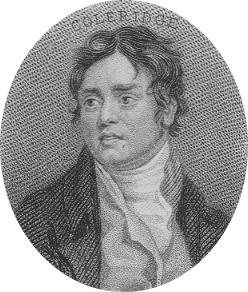
Portrait of Coleridge
TABLE OF CONTENTS.
No. 1 Early Days (1772-1794): No. 2 Pantisocracy:
No. 3 Interrupted Plans: The Fricker Sisters: No. 4 Wordsworth and Germany (1797-1800):
No. 5 The Lake District (1799-1806): No. 6 Opium Use:
No. 7 Coleridge's Writings: No. 8 Coleridge's Philosophy:
No. 9 Years of Bondage (1808-1816): No. 10 Conclusions:
No. 11 Quotes. No. 12 Dates.
No. 13 Notes.


[TOP]
[TOC]
Early Days:-

Samuel Taylor Coleridge was the youngest son of the Reverend John Coleridge, the vicar of Ottery St. Mary, a parish in the southern quarter of Devonshire.3 Coleridge's father had been married twice; by his first wife he had three children and by his second wife he had ten. De Quincey recalls -- a situation which might explain much about Coleridge's principal difficulty in life, his addiction to opium -- that Coleridge was persecuted by his mother. How this persecution manifested itself, is something that we do not know. This so-called persecution may have been, indeed, but the memory of a correction or chastisement given to a child by a mother occupied in the business of ministering to several young children all at the same time, a correction or chastisement which was misinterpreted by a young mind, overly sensitive. In any event, "STC" -- as he often referred to himself, "ess-tee-see," was sent off to Dame School (an elementary school) and kept there until 1778. His father, at STC's age ten years, suddenly collapsed and died. A local judge, who had known his father, took a particular interest in the young Coleridge and arranged for him to be interviewed for a position at a prestigious preparatory school in London known as Christ's Hospital. He was thus to become a "Blue coat boy." (The well recognized uniform of the boys from Christ's Hospital was a long blue habit and yellow stockings.) "The discipline at Christ's Hospital in those days was ultra-Spartan, the mood monastic. All domestic ties were to be put aside."4 It was here, at Christ's Hospital, that Coleridge was to first meet as a fellow student, Charles Lamb.

In October of 1791, Coleridge was installed at Cambridge (Jesus College) as a sizar.5 I am not in a position to give details of Coleridge's first two years at Cambridge, hopefully it will be sufficient to write that his heart was not in his studies; further, he ran up bills both with his tutors and with the townspeople. His mounting debts and his looming academic failure were to take a toll on Coleridge, not the least of which was his increasing use of opium to which we will refer, anon. Things became so distressing for Coleridge that he took longer and longer leaves of Cambridge, usually to go to London for the high life. His family was to hear of his situation, his brother in particular, and a sum of money was gathered up and sent off to young Coleridge; the principal purpose of which was to pay off the bills that he had run up with his tutors (it would not appear they had much knowledge of the bills which Coleridge had run up in the various shops about town). With money in his pocket, instead of settling up with his creditors; Coleridge took himself off to London, once again, a place Coleridge or no man could tire of. With his money gone, he returned to Cambridge in a situation which was but worse. Creditors pressed him but he had no one to whom he could turn, certainly he thought he had exhausted the patience of his family. During December of 1793, England and France then being at war, Coleridge ran off; and using a fictitious name signed up with the 15th, or King's Regiment, of Light Dragoons. What possessed Coleridge to become a cavalry soldier, is hard to say; he likely lied about his knowledge of horses; in any event his officers were soon to know about Coleridge's inexperience in equestrian matters. He proved to be a flop in the army as much as he was a flop at university. He was soon to be more miserable than ever and contrived to get an indirect message to his brother. Arrangements were made: Coleridge, with some difficulty, was bought out of the army; his bills were paid off (I suppose directly this time); and he was delivered back to Cambridge a much chastened man: "rescued, admonished, forgiven, and turned over a new leaf."6

Coleridge's return to Cambridge occurred in April of 1794. During this second stint at Cambridge, Coleridge is seen to be more industrious -- not in pursuing the regular courses; but rather, as so many young men were doing at the time, imbibing revolutionary ideas. These young men, as young men always have, talked long and hard about how society in its existing formation was rotten and dreamt how things might be changed. It was during these times, in June of 1794, that Coleridge was to meet Robert Southey. Southey was enrolled at Oxford and Coleridge was visiting with a fellow student from Cambridge. The two hit it off; and, together with other fellow students were soon dreaming of a new society which they hoped they themselves might set up: a pantisocracy.


[TOP]
[TOC]
Pantisocracy:-

A pantisocracy, as was dreamt up by Coleridge and Southey, is a societal setup based on the doctrine of aspheterism, viz., that there ought to be no private property. The pantisocrats were devotees of William Godwin. Godwin had brought out his work Enquiry Concerning the Principles of Political Justice, or more simply, Political Justice in 1793. Godwin foresaw a time when "there will be no war, no crimes, no administration of justice, as it is called, and no government. Besides this, there would be neither disease, anguish, melancholy nor resentment. Every man will seek with ineffable ardour the good of all."

Professor C. H. Herford:

"... Godwin saw in government, in law, even in property, and in marriage, only restraints upon liberty and obstacles to progress. Yet Godwin was not, strictly speaking, an anarchist. He transfered the seat of government from thrones and parliament to the reason in the breast of every man. On the power of reason, working freely, to convince all the armed unreason of the world and to subdue all its teeming passion, he rested his boundless confidence in the 'perfectibility' of man' --."7
Thus Godwin believed it was impossible to be rationally persuaded and not act accordingly, and that therefore, man could live in harmony without law and institutions; he believed in the perfectibility of man. This, of course, is the pantisocracy which Coleridge and Southey felt they could take steps to create: it would be a society of men that would exclude the notion of property rights, that, in its place was to be "fraternal equality and a participatory government by all, for all." If, the schemers thought, "fear, selfishness, deceit and desultory hatred" could not be eliminated amongst themselves; then, by proper steps, it might be eliminated from their offspring. That being done everything would work just fine and the participates would then lead happy and productive lives. For pantisocracy to work, it was thought, it was necessary that things get started by a collection of individuals dedicated to its principles, isolated from those who might corrupt the system. It was determined that "twelve gentlemen of good education and liberal principles" should embark for America with twelve ladies; they determined, after a year's preparation, that they would set sail for America in April of 1795. Something was to get in the way of these dreams and plans: it was in the delightful forms of the Fricker sisters.


[TOP]
[TOC]
Interrupted Plans: The Fricker Sisters (1794-1796):-

We have seen where in June of 1794 where Coleridge and Southey had first met through the acquaintance of mutual friends. Coleridge had come over to Oxford on a visit from Cambridge and upon meeting, the two became fast friends. The intended visit of a couple of days turned into a visit of a couple of weeks as plans were laid for a pantisocracy. On parting the two determined that they would soon meet up again. Coleridge was to make a tour with his Cambridge friends to Wales, the object being to recruit a few new pantisocrats. Southey, with the same object, left for his native Bristol. By August, the two had met up at Bristol, and Southey was soon making the rounds in order to introduce his new Cambridge friend.8 One of the households visited was that of the Fricker family. This family was headed up by a widow who ran a dress shop in Bristol and consisted of three very attractive older girls, a younger girl and a younger boy.

Southey was already courting one of the Fricker sisters, Edith (1774-1837) and his friend Robert Lovell (1770-96) had, just that year, 1794, married, Mary (b.1771). The oldest, Sarah (1770-1845), and Coleridge were almost immediately attracted to one another; a match which Southey was to actively promote. The Fricker sisters were to be the ideal mates envisioned in a pantisocracy. Things were very pleasantly falling into place. Bristol was to be from where the pantisocratic plans were to be finalized and from where the founding members would board a sailing ship for America. An essential beginning was to find some money: none of these young people had any: maybe they could publish certain of their writings, maybe their poetry, maybe a play. In any event, though it would seem he had now formed the attention to make the Bristol area his home base, Coleridge was obliged to leave Bristol in order to take care of certain outstanding matters. So, we would have seen at the first of September in 1794, Coleridge leaving Bristol "to a flutter of Fricker handkerchiefs and the republican salutes of his fellow Pantisocrats."9 He was headed back to his studies at Cambridge via London. Once back in Cambridge a "period of frenetic indecision"10 was to ensue. He had made commitments to Southey and to Sarah Fricker, but once away from them he was not so sure he should follow through.

More than one of the pantisocrats were to have doubts about whether the envisioned community would ever come into being. Coleridge had his doubts; but really it was Southey who was the first to come out with it, and suggested, instead of going off to America, maybe they could find a farm in Wales and try to establish a community there. But Southey was to soon give up on the idea of pantisocracy all together. The plans of these young men did not much impress Southey's family; it was thought that Robert should go to the ministry, or, if not that, then he should read for the bar. In the meantime, it was suggested, that Robert should take a little time to think about things; he should go to Portugal and have an extended visit with an uncle. Southey agreed; he gave up his ideas of pantisocracy. This decision, however, did not entail giving up his idea of marrying Edith Fricker. The marriage of Robert Southey and Edith Fricker took place in November of 1795, with considerable secrecy, in the parish church of the Fricker family, St Mary Redcliff, Bristol; immediately after the ceremony Southey departed for Lisbon, alone. But I run ahead of my story.

Last we saw Coleridge, he had left Bristol in August of 1794 to go to Cambridge via London. Coleridge might have well carried on with his studies; but throughout the balance of the year (1794) and into the next, he was to spend as much time in London as anywhere else. It was during this time, it is speculated, that Coleridge was to first meet Wordsworth, in London; there thus began one of the most noteworthy literary collaborations, ever. Throughout these months letters were exchanged with Southey, and Coleridge was to learn that his fellow pantisocrat had lost his enthusiasm in respect to the plans that they had made to live together in a egalitarian colony. Coleridge returned to Bristol: he wanted to face Southey, and, I think, he needed to be with Sarah Fricker.11 When, he made his way back to Bristol, I do not know, likely in the early spring of 1795. The personalities of Coleridge and Southey were just too different and their friendship, a deteriorating one as can be seen through their correspondence that previous winter, came pretty much to an end as their arguments became "increasingly fierce and personalised."12

"For Coleridge this was a profound shock. He had lost the friend whom he had come to regard as his 'Sheet Anchor.' He wrote with sudden hysteria of Southey's "catalogue of lies," and his low, dirty, gutter-grubbing" compromise with the world. In fact it was this intense emotional clinging, as well as his 'indolence,' which finally repelled Southey and convinced him that Pantisocratic partnership -- even farming in Wales -- would never work."13
That October, the 4th, 1795, Coleridge married Sarah Fricker at the church of St Mary Redcliff, Bristol. Robert Southey was not present; nor was any of Coleridge's family, indeed, a year was to pass before Coleridge brought his wife to visit his family at Ottery.14 That fall they spent their first happy months in a cottage at Clevedon not far from their family and friends, just west of Bristol. In time, Coleridge was to make his excuses to Sarah on how he would have to spend time away from her (it was to become a regular scene between the two of them) as he had pressing literary business, elsewhere. Initially this literary business was to be conducted in Bristol, however, Coleridge did travel about, often giving talks -- making a little money there, a little money here. In such a way he was to come into contact with Tom Poole (1765-1837) who lived at Nether Stowey, a community just south of Bristol. Poole was a literary enthusiast who had inherited from his father a successful tannery business at Nether Stowey. Poole was a well respected member of the community.15 Poole was charmed by Coleridge.16 Hearing, I suppose, that the accommodations at Clevedon, a small cottage, was not now to Coleridge's liking, Poole proposed that he could lend to Coleridge and Sarah a cottage just beyond his garden gate. The invitation was taken up, and the Coleridges moved to Nether Stowey. This was to occur in December of 1796. Prior to that, during September of 1796, Sarah was to be delivered of her first child, a son, Hartley. With this event, given that their wives were sisters, it is seen that Southey and Coleridge were to partially makeup.

By this time, the close of 1796, the dreams of the pantisocrats had come to an end. They had resolved to pass their lives like regular people without troubling themselves any further about moving away to live on a collective commune. Brailsford in his work in the area was to make reference to this most famous literary tale:

"It is a tale which every student of literature has delighted to read, how Coleridge and Southey, bent on founding their Pantisocracy, on the banks of the Susquehana, came to Bristol to charter a ship, and whilst they waited, dimly aware that they lacked the funds for the adventure, anchored themselves in English homes by marrying the Fricker sisters."17

[TOP]
[TOC]
Wordsworth and Germany (1797-1800):-

This collaboration, that of Wordsworth and Coleridge, and the movements of these two poets, especially, are matters which I take up under my treatment of Wordsworth. They may have first met in London during the winter of 1794/1795, of that we cannot be sure; but we do know that in March of 1797, Wordsworth had traveled with his friend Basil Montagu to Bristol from Racedown (where, then, Wordsworth and his sister were living) and a visit was paid to Coleridge at Nether Stowey. In June of that year Coleridge had returned to Stowey from a visit which he had, in turn paid to the Wordsworths. Within days of that, Coleridge had set out once again to Racedown. On July 2nd, the Wordsworths, at the urging of Coleridge, left Racedown in order to come to Stowey to live. While spending a number of days in the cramped quarters of the Coleridge household, Wordsworth, again with the help of Tom Poole, before July was out, had made arrangements to rent a mansion (Alfoxden) located nearby to Coleridge.

Practically from their first meeting the two poets were discussing their views on poetry. The results of these discussions was momentous for English poetry, for, in 1798, there was published Lyrical Ballads, a volume of poetry to which they both had contributed. It opened with Coleridge's magical "Ancient Mariner" and ended with Wordsworth's "Tintern Abbey." It was to take some time before Lyrical Ballads was to come off the presses, indeed, at the time that happened, Coleridge and Wordsworth were in Germany. The book was not, by any means, an immediate hit with the public. One of Coleridge's biographer's, Molly Lefebure, writes: "The first reviews were unenthusiastic and sales were meagre. Wordsworth's poems, upon the whole, were not unkindly treated by the leading reviewers, but The Ancient Mariner was ill-received. Southey, in the Critical Review for October 1798 declared dourly: 'Genius has here been employed in producing a poem of little merit.'"18

There now comes a question to be asked, the answer to which requires me to make a short digression. How were Wordsworth and Coleridge, as full time poets, able to live? It was certainly not from the sales of their works, at least, not in these beginning years. Wordsworth, as we might see on the brief sketch that I had made of him, had very fortunately come into some money by way of an inheritance from a school friend, one that was to keep him going for a number of years. As for Coleridge: he had the good fortune of making the acquaintance of the Wedgwoods. The Wedgwood family, of course, was a family of potters; they had pursued the making of pottery as an art for a number of generations before the lives of the poets of which we write. Josiah Wedgwood (1730-1795) in his turn as the head potter in this old family business, in 1763, patented a cream coloured ware, Queen's ware, which became very popular. His designs became know as Wedgwood ware and included his well known blue with the raised designs in white. In 1769 Josiah built a plant at Hanley which was known as "Etruria." It would certainly seem that the family became very rich. Josiah had three sons: John, who became a banker; Josiah, who succeeded his father in the operation of the business; and Thomas, though a chronic invalid, was a dilettante, a supporter of the arts. What is known, is that both John and Tom Wedgwood were to visit the poets, and, in particular, were to spend five days at Alfoxden. They were not so impressed with Wordsworth, indeed they formed a very indifferent opinion of him; but, not so of Coleridge, of him, they were very much impressed.19 Recognizing that if Coleridge was to be kept at his literary work full time, it would be necessary that he should receive some financial help: the Wedgwoods determined to assist Coleridge in his artistic endeavours.

Coleridge, now with a wife and child to support and another on the way, determined to go to work as a Unitarian minister; his first appointment was to be in Shrewsbury. He had actually started preaching in Shrewsbury when he received word, in January or February of 1798, from his friends back at Nether Stowey that the Wedgwoods had arranged a life annuity in the amount of £150 per year with no conditions.20 This generosity was to allow Coleridge to carry through with plans that he had earlier made to go and study in Germany. As it happened, the lease which the Wordsworths had for the Alfoxden mansion was up; so a determination was made that Wordsworth and Coleridge should both together go off to Germany. The following accounting was set forth in my biographical sketch on Wordsworth:

"Such a gift [the Wedgwood annuity] however was not to keep Coleridge at Nether Stowey, as he longed to travel to Germany for further studies. Doubtlessly these plans were discussed with the Wordsworths and a determination was made; all three would travel together to Germany, once the one year lease of Alfoxden was up, viz., the end of June, 1798. It was during this time, it hardly needs to be mentioned, that the two poets collaborated on their work, Lyrical Ballads, the manifesto of English Romanticism.
Before leaving for Germany, Wordsworth and Coleridge saw to the final arrangements in respect to the publication of Lyrical Ballads. These arrangements required, for the most part, their attendance at Bristol were a Bristol bookseller, Joseph Cottle (1770-1853) was putting the book through the presses. (They did, during that summer, make a trip to Wales at which time Wordsworth wrote one of his most popular poems, "Tintern Abbey," written on July 13th, 1798.) By late August the party headed for London there to make their final preparations for their trip to Germany. On September 16th, Dorothy and William, together with Coleridge and a friend of theirs, John Chester, set sail for Germany from Yarmouth arriving at Hamburg on the 19th."
I should mention that a few months before Coleridge set off for Germany, a second child was born to the Coleridges, a son, Berkeley, this was during May of 1798; thus, Coleridge was to leave behind, his wife and two small children (two year old, Hartley and the infant, Berkeley); just so, Coleridge could go study in Germany. Coleridge was to stay in Germany for almost a year coming back to England in July of 1799. He and the Wordsworths did not in fact stay together for long in Germany, the Wordsworths determined to go their separate way within days of their arrival and were to arrive back in England a few months later without Coleridge. While in Germany, Coleridge had acquired a tolerable sufficiency in the German language; indeed, he was to acquire a permanent bent for German philosophy and criticism. And, while writing his family at regular intervals with expressions of how he so missed them, Coleridge, given his gregariousness, made the rounds visiting all the fashionable places in Germany which included his attendances to a great number of dinners and balls. In his absence, his infant son, Berkeley, was to die. Leaving Germany during July of 1799, Coleridge returned to England. I am sure he must have gone down to Nether Stowey to see Sarah and his surviving son; but, soon, we see where Coleridge is off again; this time to find the Wordsworths who just then were staying at a farm in Yorkshire, Stockton-on-Tees. He arrived at the Hutchinson farm on October 26th, there, for the first time, to meet the Hutchinson sisters: Mary who was to become Wordsworth's wife, and Sara, the younger of the two, who was to become the object of Coleridge's attention for a considerable period of time.21 By December 19th, however, Coleridge was in London where he took lodgings (21, Buckingham Street). Things were now better with the Coleridges, as we see that Sarah and young Hartley were now with Coleridge at London: Sarah was soon pregnant again.22 In London, Coleridge turns to newspaper work; he writes for the Morning Post making contributions between December 7th, 1799 and April 21st, 1800. He seem then to have been on the political beat, as he was to attend at the House of Commons reporting the debates; he also went off to the theatre in the capacity of a drama critic. During this period, Coleridge was socializing both with the Godwins and the Lambs.


[TOP]
[TOC]
The Lake District (1799-1806):-

Coleridge was forever pulled to London, when he was not there; and forever pulled to the countryside when he was in London. This competition, this pull when at one place to go to another, was not unlike the relationship Coleridge had when it came to the women in his life. He would arrive, having longed to be at home with Sarah, and for days or weeks all would be well, sweetness and happiness; then, he would find himself dreaming of another; and soon again, he would be off on the top of a coach drawn by horses, soon again to be at another place, a move which would quell his longings -- but, only for a little while.23 He managed in 1800 for a short period of time to combine his two loves, but he never lived long in London with Sarah. Midway through 1800 while at London, Coleridge was struck, once again, with his memories of Wordsworth and of the Lake District24; he should return. Coleridge had traveled there with Wordsworth a few months after they had gotten back from Germany. Indeed, he was with Wordsworth when they had discovered Dove Cottage. The Lake District was where Wordsworth had spent his boyhood; Wordsworth was always talking about the lakes and the mountains, since first he and Coleridge met; and it was the previous autumn, 1799, that Coleridge and Wordsworth had walked west from the Hutchinson farm in the Yorkshire dales, having both just spent some pleasant time with the Hutchinson sisters, walked into the Lake District at a time when the surrounding woods were ablaze, to visit the places of Wordsworth's youth: Brampton, Windermere, Hawkshead, Rydal; and, of course, Grasmere. The day was "soft and grave" when they came to Grasmere, "a purple light lay on the waters, indescribably beautiful. Coleridge spoke of the two lakes as 'divine sisters' ... Coleridge was beginning to understand more fully the tyrannous sublimity of whose hauntings William so often had spoken, the imperious brooding and influences from sun and sky, water and mountain wind, that could make a man their slave."25 He left this scene for London, there, to stay with Sarah and their little boy throughout the winter, 1799/1800. He was to find out that Wordsworth and his sister had traveled to Grasmere that past December, there to take up their residence at Dove Cottage. By the spring of 1800, Coleridge could stand it no longer: he took himself to Grasmere.

At the first of March, Sarah, then three months pregnant, had left Coleridge in London intending with little Harley to visit friends at Kempsford. A month later, on April 6th, Coleridge arrived at Dove Cottage. Ostensibly, he had gone to assist Wordsworth in the putting together of the 2nd edition of Lyrical Ballads. At this time, too, at the Wordsworths' there was to be found Wordsworth's brother, and, at least, one of the Hutchinson sisters, Mary. By May 4th Coleridge left, in order to see the publishers at Bristol. That June, the 29th, Coleridge was back at the Wordsworths' arriving this time with Sarah and Hartley. On July the 23rd, the Coleridges took up residence at Greta Hall, Keswick.26 That September, a third child (it will be recalled that their second had died) was born to the Coleridges, a son, Derwent.27

The domestic regularity which seemed to prevail during the balance of 1800 and for most of 1801 was splintered again by disputes and mutual recriminations, such that, Coleridge felt obliged to escape by going to London, there to work for the Morning Post.28 It was during this time, in 1801, in London, Coleridge was to see much of Humphry Davy. In fact he made his first acquaintance of Davy back in 1799, at Bristol. It was when Davy was in charge of a laboratory, known as the Pneumatic Institution, which a Dr. Beddoes had set up.29 So, once again, we see Coleridge leading the life of a bachelor; his residence then was to be found at Number 10, King Street, Covent Garden. In March of 1802, Coleridge was to return to the north country, en route he was to pay a visit at the new Hutchinson farm at Gallow Hill, his objective being to spend some time with the sisters, Mary and Sara. Sarah Coleridge, when Coleridge was to finally make it back to her at Keswick, was not much impressed by Coleridge's diversions.30 That year, incidently, on October 4th, William Wordsworth was to marry Mary Hutchinson. The Wordsworths and Coleridge through these years, notwithstanding Coleridge's problems, were to get along famously. During August of 1803 the three of them (Wordsworth, his sister Dorothy and Coleridge) set off for a tour through Scotland. All went well for a couple of weeks, when Coleridge left his companions and returned on foot by himself to his home (Greta Hall) arriving there on September 15th. It seems that it was during this trip that Wordsworth let go at Coleridge for his opium habit.31 It was the first real rent in the Coleridge/Wordsworth friendship; it was downhill thereafter; by 1812 this rupture was to become "profound and complete."

Not too many months went by when Coleridge determined that he must leave his family, once again. He imagined he had health problems; and, I daresay, he did. To Coleridge, his health problems led to an increasing use of opium; however, when the matter is taken into full perspective it is to be seen that his health problems were due to his excessive use of opium -- we will deal with this matter more fully, shortly. On January 24th, 1804, Coleridge, having left Grasmere on the 14th, arrived in London.32 He had expressed to his family and friends that all he needed was a warmer climate for a few months and his health would thereby improve. In this regard, Coleridge was to accept a position as a secretary to Sir Alexander Ball (1757-1809), the Governor of Malta. On March 27th, he set off from London on the Portsmouth mail. Lamb was among a number that saw him off. He arrived at Malta on May 18th.33 Thus Coleridge was to be out of England (mostly in Malta) for better than two years.34 By the spring of 1806, Coleridge was touring Italy with a friend (Thomas Russell). During August, 1806, having fled from Italy in June before Napoleon's triumphant advance, Coleridge returns to England and "threw himself upon that universal refuge, the Lambs."35 So, in October of 1806, we would have seen, at Greta Hall, Sarah Coleridge and the children, all joyfully excited at the prospect of seeing Coleridge after his long absence. They were expecting a change in Coleridge; and, maybe, life as a real family would be finally established. Coleridge arrived and the joy and laughter was soon to give way to argument, temper and tears: Coleridge wanted a permanent separation.


[TOP]
[TOC]
Opium Use:-

Most people know little of Coleridge's writing. They will know of his The Rhyme of Ancient Mariner, and, maybe too, of his Christabel or of Kubla Khan; but for what Coleridge is most known, is -- well, he was a druggy. Coleridge took up the use of opium as a young man; it became a life long addiction. He was by all accounts a brilliant man, a delightful conversationalist; but Coleridge's career, his life, was ruined by the use of opium. His opium habit was a misery to him and to his friends. His addiction meant that "his existence became a never-ending squalor of procrastination, excuses, lies, debts, degradation, failure."36

Opium use in English society in the nineteenth century was completely acceptable when it was used at a time a person was in a painful circumstance, such as when suffering from a tooth ache. Most all households had a bottle of laudanum, viz., opium dissolved in alcohol. No one thought ill of a person for keeping such a remedy handy or using it on occasions. Opium and all of the concoctions made from it were unrestricted until 1868, when the first Pharmacy Act became law.37 The local chemists would prepare their own favourite medical potions, and there indeed was variety of ingredients; but always there was added a liberal dose of opium.

"There were nationally famous and long-established preparations like Dover's Powder, that mixture of ipecacuanha and powdered opium originally prescribed for gout ... An expanding variety of commercial preparations began to come on the market at mid-century [18th]. They were typified by the chlorodynes -- Collis Browne's, Towle's and Freeman's. The children's opiates like Godfrey's Cordial and Dalby's Carminative were long-established. They were everywhere to be bought. There were local preparations, too like Kendal Black Drop, popularly supposed to be four times the strength of laudanum -- and well known outside its own locality because Coleridge used it."38
An understanding of the wide spread use of opium will lead one to conclude that it was not the mere use of opium that lead to Coleridge's ruin but rather his extensive and continuous use of the stuff. Keats, Byron, Shelley, Scott: they all took it, laudanum, off and on.39 Bristol, at the close of the 18th century, was at the centre of a luminous drug circle revolving around a Dr. Beddoes, who had among his patients: Tom Wedgwood; James MacIntosh; Charles Lloyd; and, of course, Coleridge. De Quincey was as much known for his drug use as anyone else, but it did not take the same toll on his life as it did on Coleridge's. De Quincey freely made reference to his usage of drugs, and, in his Recollections, tells how Coleridge got hooked:
"... a toothache had obliged me [de Quincey] to take a few drops of laudanum. At what time or on what motive he had commenced the use of opium, he [Coleridge] did not say; but the peculiar emphasis on horror with which he warned me against forming a habit of the same kind, impressed upon my mind a feeling that he never hoped to liberate himself from the bondage my belief is that he never did."40

[TOP]
[TOC]
Coleridge's Writings:-

That Coleridge was able to produce such literary works as he did, notwithstanding his life's problems, was due to a natural talent that at times came to the surface of his drug induced hazes, a natural talent that was undoubtedly developed early during his days at Grammar School. He attended, as was initially described at Christ's Hospital. There was during Coleridge's time a Head Master by the name of the Reverend James Bowyer. Coleridge wrote of him in Biographia Literaria:

"He would often permit our exercises, under some pretext of want of time, to accumulate, till each lad had four or five to look over. Then placing the whole number abreast on his desk, he would ask the writer, why this or that sentence might not have found as appropriate a place under this or that other thesis: and if no satisfying answer could be returned, and two faults of the same kind were found in one exercise, the irrevocable verdict followed, the exercise was torn up, and another on the same subject to be produced, in addition to the tasks of the day. ... He sent us to the University excellent Latin and Greek scholars, and tolerable Hebraists. Yet our classical knowledge was the least of the good gifts, which we derived from his zealous and conscientious tutorage."41
Coleridge contribution, only contribution to Lyrical Ballads, was that work for which Coleridge will ever be remembered, The Rhyme of Ancient Mariner.42 By March of 1801, Coleridge had lost much of his confidence. In a letter to Godwin dated March 1801, Coleridge wrote: "The poet is dead in me, My imagination ... lies like the cold snuff on the circular rim of a candlestick." In July of 1802 he writes to Southey: "All my poetic genius ... is gone."43 Besides his Ancient Mariner, I suppose, the other works of which we must make note is Christabel and Kubla Khan. All of these works, poems, were on exotic or supernatural themes. I set forth a few lines for a taste:
Ancient Mariner:
The ship was cheered, the harbor cleared,
Merrily did we drop
Below the kirk, below the hill,
Below the lighthouse top, (pt. I, st. 6.) ...
The fair breeze blew, the white foam flew,
The furrows followed free;
We were the first that ever burst
Into that silent sea. (pt. II, st. 5.) ...
Water, water, everywhere,
Nor any drop to drink. (pt. II, st. 9.) ...
Alone, alone, all, all alone;
Alone on a wide, wide sea., (pt. IV, st. 3.) ...
Oh sleep! it is a gentle thing,
Beloved from pole to pole. (pt. V, st. 1.) ...
Like one that on a lonesome road
Doth walk in fear and dread,
And having once turned round walks on,
And turns no more his head;
Because he knows a frightful fiend
Doth close behind him tread. (pt. VI, st. 10.)

Kubla Khan:
In Xanadu did Kubla Khan
A stately pleasure dome decree:
Where Alph, the sacred river, ran
Through caverns measureless to man
Down to a sunless sea.
So twice five miles of fertile ground
With walls and towers were girdled round.

Christabel:
And the spring comes slowly up this way. (pt. I, l. 22.) ...
The one red leaf, the last of its clan,
That dances as often as dance it can. (pt. I, l. 49.) ...
And constancy lives in realms above;
And life is thorny; and youth is vain;
And to be wroth with one we love
Doth work like madness in the brain. (pt. II, l. 410)


[TOP]
[TOC]
Coleridge's Philosophy:-

Mill thought Coleridge to be one of "the two great seminal minds" of early nineteenth-century England, the other being Bentham; though, unlike Bentham, Coleridge "asserted the primacy of the transcendent imagination." William Hazlitt:

"All his [Coleridge's] ideas ... are like a river, flowing on forever, and still murmuring as it flows, discharging its waters and still replenished --
And so by many nooks it strays,
With willing sport to the wild ocean!"
44
The philosopher which had the greatest impact on Coleridge was David Hartley (1705-57). Hartley, an English philosopher, was educated at Jesus College, Cambridge, and became a fellow; it will be recalled that Coleridge went there during the years 1791-4. Berkeley also had a significant impact on Coleridge's thought, especially in the earlier years.45 At another point in his life, Coleridge delved into the philosophy of the Dutch philosopher, Spinoza.

"It was early in the year, 1801, that the intellect of Kant first took hold of him [Coleridge], as he significantly expresses it, with 'giant hands'."46 In Kant's system, as Shawcross explains,47 we are but only able to comprehend observable phenomena and this was but parts of an interconnected whole that cannot be comprehended by the human mind. As Coleridge put it: the universe of which we are conscious is but "merely a mass of little things." Now, I shall observe, by way of commentary, that this view, that we as humans are capable of only comprehending but parts of the universe, may be perfectly correct. The difficulty is met when we see people going about filling in the blanks out of their pure imaginations and thus to proceed to build "castles in the air" which the rest of us are unable to falsify (see Popper). As for Coleridge, it is almost needless to add, his imagination was fueled by opium.


[TOP]
[TOC]
Years of Bondage (1808-16):-

We may mark the time just after Coleridge came back from Germany as the time when Coleridge was to permanently separate from his wife and children. After that time he was to go back to Grasmere, but only for visits with his family, or, more likely, long stay-overs with the Wordsworths. In June of 1808, the Wordsworths had moved into their new home, Allan Bank, a much larger place than their previous abodes. One of the reasons that the Wordsworths had made the move is that they anticipated that Coleridge might come to live with them; and, apparently, he did. During the weekends, Allan Bank was to become a very busy abode, indeed. At times there was as many as seven children: three Coleridges (down on a visit with their father) and four Wordsworths. Sara Hutchinson, to whom Coleridge was particularly attracted, it would appear was at this time part of the Wordsworth household, her sister, Mary having married Wordsworth the previous year. Sara Hutchinson was to remark that when Coleridge played with the children, S.T.C. made "enough racket for twenty."48

It was during this period that Coleridge brought out a weekly paper, The Friend, the first of its number was dated June 1st, 1809; and the last, after 27, on March 15th, 1810. He apparently continued to work out of the Wordsworth residence and likely went up to Greta Hall, nine miles away or so, in order to pick up or deliver his three children. In February, Sara Hutchinson took her leave of the Wordsworth household at Allan Bank. That June, fond of his comforts (the Wordsworth household, apparently, was usually in a bit of a rough state, though it never bothered them), especially now since Sara Hutchinson had left, Coleridge took his leave of Allan Bank. He moved back in with his wife at Greta Hall, but this particular period of cohabitation lasted but five months.49 In October Coleridge was to take advantage of an offer coming from Basil Montagu and his wife who were just then visiting the Lake District. Seeing how unhappy Coleridge was, the Montagues offered to him a seat in their carriage and thus to come to London with them and once there to reside with them. Given the domestic habits of these two very different people (Montagu would not even countenance the use of wine at his table) the arrangement of Coleridge living with the Montagues in London did not last long; the Montagues and Coleridge parted company almost immediately. We know that on April 15, 1816, Coleridge was to move in with Dr. Gillman and to live in the Gillman household for the balance of his life. Prior to moving in with the Gillmans, between the years 1812-16, Coleridge, this eccentric man of genius, mostly resided with the Morgans, first near Bath then later at Calne, Wiltshire. He got on better with the Morgans, mainly because the Morgans were so patient with Coleridge; "it would probably be no exaggeration to say that without their devoted friendship and support he could not have survived."50

There is another thing to be said about the carriage trip that Coleridge took with Basil Montagu in the fall of 1810 en route to London. Though we will never know exactly what transpired, Coleridge in his conversations with Montagu determined that Wordsworth was bad-mouthing him (Coleridge) behind his back. Problems, as we have seen, started back in 1803 when the pair of them with Dorothy had made a trip to Scotland; now, in 1810, this rent turned into an open breach. Over the next two years, the quarrel between the two poets became a cause célèbre.51

All through these times Coleridge supported himself both by lecturing and writing. On April 15th, 1816, as already mentioned, Coleridge was to take up residence in Highgate, London, at the home of Dr. James Gillman. It was intended that Coleridge should receive extended medical help in respect to his long-standing opium addiction; it was to be a last ditch effort. Gillman, in exchange for the pleasure of his company -- Coleridge could be most charming and intellectually engaging -- was to somehow wean Coleridge off of his opium habit, well, if not off the drug altogether then, more likely, down to timed and manageable doses. The plan was that Coleridge was to stay with Gillman for a month; he stayed with Gillman until his death in 1834.52


[TOP]
[TOC]
Conclusions:-

In analyzing the character of Coleridge in the first part of his essay, "Mr. Coleridge," William Hazlitt, as he so often does, puts his finger immediately on the point. The point is that the making of a good work, does not depend on genius, but it most certainly depends on a disconnected consciousness focused on the job at hand. "It is hard to concentrate all our attention and efforts on one pursuit, except from ignorance of others; and without this concentration of our faculties no great progress can be made in any one thing." Hazlitt, in the latter part of his essay deals with this point in greater length applying it to Coleridge; Hazlitt in his brilliant fashion compares Coleridge to one of literary lights of the age, William Godwin.

"No two persons can be conceived more opposite in character or genius ... Mr. Godwin, with less natural capacity and with fewer acquired advantages, by concentrating his mind on some given object, and doing what he had to do with all his might, has accomplished much, and will leave more than one monument of a powerful intellect behind him; Mr. Coleridge, by dissipating his, and dallying with every subject by turns, has done little or nothing to justify to the world or to posterity the high opinion which all would have ever heard him converse, or known him intimately, with one accord entertain of him. Mr. Godwin's faculties have kept at home, and plied their task in the workshop of the brain, diligently and effectually: Mr. Coleridge's have gossiped away their time, and gadded about from house to house, as if life's business were to melt the hours in listless talk. Mr. Godwin is intent on a subject, only as it concerns himself and his reputation; he works it out as a matter of duty, and discards from his mind whatever does not forward his main object as impertinent and vain.
Mr. Coleridge, on the other hand, delights in nothing but episodes and digressions, neglects whatever he undertakes to perform, and can act only on spontaneous impulses without object or method. 'He cannot be constrained by mastery.' While he should be occupied with a given pursuit, he is thinking of a thousand other things: a thousand tastes, a thousand objects tempt him, and distract his mind, which keeps open house, and entertains all comers; and after being fatigued and amused with morning calls from idle visitors [he] finds the day consumed and its business unconcluded. Mr. Godwin, on the contrary, is somewhat exclusive and unsocial in his habits of mind, entertains no company but what he gives his whole time and attention to, and wisely writes over the doors of his understanding, his fancy, and his senses--'No admittance except on business.' He has none of that fastidious refinement and false delicacy, which might lead him to balance between the endless variety of modern attainments. He does not throw away his life (nor a single half hour of it) in adjusting the claims of different accomplishments, and in choosing between them or making himself master of them all. He sets about his task (whatever it may be), and goes through it with spirit and fortitude. He has the happiness to think an author the greatest character in the world, and himself the greatest author in it.
Mr. Coleridge, in writing an harmonious stanza, would stop to consider whether there was not more grace and beauty in a Pas de trois, and would not proceed till he had resolved this question by a chain of metaphysical reasoning without end. Not so Mr. Godwin. That is best to him, which he can do best. He does not waste himself in vain aspirations and effeminate sympathies. He is blind, deaf, insensible to all but the trump of Fame. Plays, operas, painting, music, ball-rooms, wealth, fashion, titles, lords, ladies, touch him not. All these are no more to him than to the magician in his cell, and he writes on to the end of the chapter through good report and evil report. Pingo in eternitatem is his motto. He neither envies nor admires what others are, but is contented to be what he is, and strives to do the utmost he can. Mr. Coleridge has flirted with the Muses as with a set of mistresses: Mr. Godwin has been married twice, to Reason and to Fancy, and has to boast no short-lived progeny by each."
53
Just after he first got to know Coleridge, during the winter of 1810, Henry Crabb Robertson wrote in his diary:
"It was after my first day's sitting with him that I wrote thus to my brother: He kept me on the stretch of attention and admiration from ½ past 3 till 12 o'clock. On politics, metaphysics and poetry, more especially on the Regency, Kant, and Shakespeare he was astonishingly eloquent. But I have made one remark on him: tho' he practises all sorts of delightful tricks and shews admirable skill in riding his hobbies, yet he may be easily unsaddled. I was surprised to find how easy it is to obtain from him concessions which lead to gross inconsistencies. Tho' an incomparable declaimer and speech-maker, he has neither the readiness nor the acuteness required by a colloquial disputant, so that with a sense of inferiority that makes me humble in his presence, I do not feel in the least afraid of him. Rough said yesterday that he is sure he would never have succeeded at the bar even as a speaker. - This I wrote after the first sight of him. I used afterwards to compare him as a disputant with a serpent - easy to kill if you assume the offensive, but if you let him attack, his bite is mortal. Some years after this, when I saw Mme de Staël in London, I asked her what she thought of him. That, she replied, he is very great in monologue, but he has no idea of dialogue."54
Robinson was to make this observation on Coleridge's lecturing technique, one that was more of a more general observation of Coleridge, viz., Coleridge had a splendid intellect but it was "vitiated by want of method and concentration."
"Colerige's lectures do high honour to him as a man of genius, but are discreditable to him (perhaps I might use without injustice a stronger word) as a man who has a duty to discharge; for either he wants judgment to know what he ought to introduce in his lectures, or is overpowered by very culpable indolence and will not qualify himself to do justice to his subject, his hearers or himself. His pretended lectures are unmethodical rhapsodies, moral, metaphysical and literary; abounding in brilliant thoughts, fine flashes of rhetoric, occasionally profound and salutary truths, but they are not a scientific or constructive course of reading on any one subject a man can wish to fix his attention on."55
Robinson compares Wordsworth to Coleridge:
"One I believe the greatest man now living in this country and the other a man of astonishing genius and talents, though not harmoniously blended as in his happier friend to form a great and good man."56
From de Quincey's Literary Reminiscences:
"Coleridge, as is notorious, whenever he happened to be in force, or even in artificial spirits, was even more than brilliant; to use a word too often abused and prostituted, he was even magnificent beyond all human standards; had a felicitous conversational specimen from him, was sometimes the most memorable chapter in a man's whole intellectual experience through life."57
Hazlitt:
"This gentleman [Coleridge] belongs to the class of eclectic philosophers; but whereas they professed to examine different systems, in order to select what was good in each, our perverse critic ransacks all past or present theories, to pick out their absurdities, and to abuse whatever is good in them. ... He refers the great excellence of the British Constitution to the prerogatives of the Crown, and conceives that the old French Constitution must have been admirably defended by the States-General, which never met, from the abuses of arbitrary power. He highly approves of ex-officio informations and special juries, as the great bulwarks of the liberty of the press; taxes he holds to be providential relief to the distresses of the people and war to be state of greater security than peace. He defines Jacobinism to be an abstract attachment to liberty, truth, and justice; and finding that this principle has been abused or carried to excess, he argues that Anti-jacobinism, or the abstract principles of despotism, superstition, and oppression, are the safe, sure and undeniable remedy for the former, and the only means of restoring liberty, truth, and justice in the world. ... He judges of men as he does of things. He would persuade you that Sir Isaac Newton was a money-scrivener, Voltaire dull, Bonaparte a poor creature, and the late Mr. Howard a misanthrope; while he plays a willing homage to the Illustrious Obscure, of whom he always carries a list in his pocket. He is at cross-purposes with himself as well as others, and discards his own caprices if ever he suspects there is the least ground for them. Doubt succeeds to doubt, clouds rolls over cloud, one paradox is driven out by another still greater, in endless succession. He is equally averse to the prejudices of the vulgar, the paradoxes of the learned, or the habitual convictions if his own mind. He moves in an unaccountable diagonal between truth and falsehood, sense and nonsense, sophistry and common-place, and only assents to any opinion when knows that all the reasons are against it. A matter of fact is abhorrent to his nature: the very air of truth repels him. He is only saved from the extremities of absurdity by combining them all in his own person. Two things are indispensable to him -- to set out from no premises, and to arrive at no conclusion. The consciousness of a single certainty would be an insupportable weight upon his mind. He slides out of a logical deduction by the help of metaphysics: and if the labyrinths of metaphysics did not afford him "ample scope and verge enough," he would resort to necromancy and the cabala. He only tolerates the science of astronomy for the sake of its connection with the dreams of judicial astrology, and escapes from the Principia of Newton to the jargon of Lily and Ashmole. All his notions are floating and unfixed, like what is feigned of the first form of things flying about in search of bodies to attach themselves to; but his ideas seek to avoid all contact with solid substances. Innumerable evanescent thoughts dance before him, and dazzle his sight, like insects in the evening sun. Truth is to him a ceaseless round of contradictions: he lives in the belief of a perpetual lie, and in affecting to think what he pretends to say. His mind is in a constant state of flux and reflux: he is like the Sea-horse in the Ocean; he is the Man in the Moon, the Wondering Jew. -- The reason of all this is that Mr. Coleridge has great powers of thought and fancy, without will or sense. He is without a strong feeling of the existence of any thing out of himself; and he has neither purposes nor passions of his own to make him wish it to be. All that he does or thinks is involuntary; even his perversity and self-will are so."58
We have seen where on April 15th, 1816, Coleridge moved into the London home of Dr. James Gillman; this was so that Gillman might help Coleridge with his long-standing opium addiction. With Gillmans' help Coleridge became, at least stabilized, such that he was finally able to get certain of his works into print.59 In 1816, Murray published three of Coleridge's works: Chrisabel, Kubla Khan, and The Pains of Sleep. It came out as one, a 64 page pamphlet. In 1817, Biographia Literaria was published. In 1825, his Aids to Reflection was to come out. New friends and old were to come to pay visits to Coleridge at the Gillman residence. It would not appear that he traveled much beyond where Dr. Gillman could keep an eye on him; though, in 1828, he, then age 56, did get together with Wordsworth and they both, together with Wordsworth's daughter, Dora, did a tour of the Rhine.60 By 1832, however, Coleridge's health was in a serious state; at that time Robinson made a note in his diary that Coleridge was "horribly bent and looked seventy years of age." On July 25th, 1834, Coleridge died.61 His Epitaph, which he wrote himself, reads as follows:
"Beneath this sod
A poet lies, or that which once seemed he
Oh, lift a thought in prayer for S.T.C.!
That he, who many a year, with toil of breath,
Found death in life, may here find life in death."
The image that we are left with, though possessed of a brilliant intellect, he was a person without a will who abandoned himself to his drug addiction at the expense of his family and friends; and, possibly the literary world, as, it is surmised that he wrote little of importance beyond his earlier works.
"His usual tearing high spirits, enormous charm, beautiful manners, inherent sweetness of nature goodness of heart, dazzling conversation, over-whelming intellectual capacity and vast erudition made it seem incredible that this gifted 'Heaven-eyed creature' should possess feet of a substance not so much resembling clay, as pulp."62
For people who write such things, they live their life almost to the end, then write their biography; in a sense, Coleridge first wrote his biography in the form of his epic poem, The Rhyme of Ancient Mariner, then he lived it.
"Alone, alone, all, all alone,
Alone on the wide wide sea!
And never a saint took pity on
My soul in agony.

The many men, so beautiful!
And they all dead did lie:
And a thousand thousand slimy things
Liv'd on; and so did I."
_______________________________

One of the biographies in a book

NOW AVAILABLE

The English Romantics


(For More)(Index In .pdf)
_______________________________
[TOP]
[TOC]
QUOTES:-

Elderly Women:-
  • "There are three classes of elderly women; first, that dear old soul; second, that old woman; third, that old witch."
    Epigram:-
  • "What is an epigram? A dwarfish whole,
    Its body brevity, and wit its soul. ("An Epigram," 1802.)
    History:-
  • "Aloof with hermit-eye I scan
    The present works of present man
    A wild and dreamlike trade of blood and guile,
    Too foolish for a tear, too wicked for a smile!"
    "Ode to Tranquillity" (1801), st. 4.
    Love:-
  • "All thoughts, all passions, all delights,
    Whatever stirs this mortal frame,
    All are but ministers of Love,
    And feed his sacred flame." ("Love," 1799.)
  • "The man's desire is for the woman; but the woman's desire is rarely other than for the desire of the man." (Table Talk, 1827.)
    Luck:-
  • "It often amuses me to hear men impute all their misfortunes to fate, luck, or destiny, whilst their successes or good fortune they ascribe to their own sagacity, cleverness or penetration."
    Mathematics:-
  • An idea, in the highest sense of that word, cannot be conveyed but by a symbol." (Biographia Literaria, 1817.)
    Politics:-
  • "In politics, what begins in fear usually ends in folly."
    Pride:-
  • "And the Devil did grin, for his darling sin.
    Is pride that apes humility."
    Recrimination:-
  • "Experience informs us that the first defense of weak minds is to recriminate." (Biographia Literaria, 1817.)
    Reform:-
  • "Every reform, however necessary, will by weak minds be carried to an excess, that itself will need reforming." (Biographia Literaria, 1817.)
    Sailing:-
  • "Strongly it bears us along in swelling and limitless billows, Nothing before and nothing behind but the sky and the ocean. ["The Homeric Hexameter" (translated from Schiller) (1799?).]
    Sleep:-
  • "Oh Sleep! it is a gentle thing,
    Beloved from pole to pole,
    To Mary Queen the praise be given!
    She sent the gentle sleep from Heaven,
    That slid into my soul."
    Truth:-
  • "Veracity does not consist in saying, but in the intention of communicating truth." (Biographia Literaria, 1817.)
  • "But whispering tongues can poison truth."
    Work:-
  • "Work without Hope draws nectar in a sieve,
    And Hope without an object cannot live." ("Work Without Hope," 1825.)
    Writers:-
  • "Until you understand a writer's ignorance, presume yourself ignorant of his understanding." (Biographia Literaria, 1817.)
  • "The faults of great writers are generally excellencies carried to excess."
  • _______________________________
    [TOP]
    [TOC]
    Dates & Events During Coleridge's Life:-

    1770:
  • Wordsworth is born.
    1772:
  • October 21st: Coleridge is born.
    1774:
  • Southey is born.
    1785:
  • De Quincey is born.
    1791:
  • Coleridge attends Cambridge (Jesus College).
    1792:
  • September massacres in Paris.
    1793:
  • January: Louis XVI is beheaded.
  • February 1st: France declares war on England.
  • Godwin's Political Justice appears.
  • Coleridge takes his leave of Cambridge distressed as he was from his debts and his looming academic failure.
    1794:
  • April 10th: Coleridge, with the help of his brother, gets his discharge from the Dragoons and returns to Cambridge to take up his studies once again.
  • June: Coleridge on a visit from Cambridge meets Robert Southey at Oxford. They lay their plans for a pantisocracy.
  • August 18th: Coleridge and Southey travel to Nether Stowey.
  • At the end of August Coleridge leaves Bristol to return to his studies at Cambridge via London. Once back in Cambridge a "period of frenetic indecision."
    1795:
  • Coleridge and Wordsworth meet in London?
  • October 4th: Coleridge marries Sarah Fricker at the church of St Mary Redcliff, Bristol. "Robert Southey was not present. He and S.T.C. were no longer on speaking terms."
  • November 14th: Southey marries Edith Fricker at the same church in which Coleridge made his vows, St Mary Redcliff, Bristol (it was the parish of the Fricker family).
  • Southey leaves for Portugal without his new wife in order to study with his uncle at Lisbon.
    1796:
  • September 19th: Sarah Coleridge delivers her first child, a son, Hartley. This event, given that their wives were sisters, brings Southey and Coleridge together.
  • December 30th: Coleridge with his family settles at Nether Stowey, a Somerset village, under the patronage of the local tanner and literary enthusiast, Tom Poole.
    1797:
  • February: Battle of Cape St. Vincent
  • March: Wordsworth travels with his friend Basil Montagu, on their way to Bristol from Racedown and visit Coleridge at Stowey.
  • Coleridge forms friendship with Wordsworth.
  • June 28th: Coleridge returns to Nether Stowey from a visit with the Wordsworths at Racedown, within days he sets out to go back to Racedown.
  • July 2nd: the Wordsworths, at the urging of Coleridge leave Racedown and come to Nether Stowey to live.
  • July: Wordsworth rents a mansion (Alfoxden), close by to Coleridge, at Nether Stowey.
  • John Thelwall (1764-1834) pays a visit to Coleridge at Nether Stowey.
  • Coleridge is writing "The Rime of the Ancient Mariner"; it is ready for publication on March 23rd, 1798.
    1798:
  • January: France is victorious, without an enemy on the continent, England withdrew her ships from the Mediterranean.
  • January 13th: Coleridge sets out for Shrewsbury, there to start his short lived career as a Unitarian minister.
  • The Wedgwoods give a life annuity to Coleridge of £150 per year with no conditions.
  • May 14: A second child for the Coleridges, a son, Berkeley.
  • June: William Hazlitt, a 20 year old walks from his home at Wem, Shropshire to Nether Stowey, Somersetshire, some 150 miles to meet his hero Coleridge (age 26) once again, and, for the first time, Wordsworth (age 28); he spends three weeks there.
  • June 26th: the Wordsworths, the lease being up and the landlord not willing to renew, vacate Alfoxden.
  • Coleridge with Wordsworth bring out Lyrical Ballads.
  • Malthus brings out his Essay on the Principle of Population.
  • August: Nelson destroyed Napoleon's fleet at the Battle of the Nile.
  • September 16th; Coleridge, John Chester and the Wordsworths set sail for Germany from Yarmouth arriving at Hamburg on the 19th. Within 10 days of their arrival the Wordsworths decided to separate from their companions.
    1799:
  • February 10th: while Coleridge was in Germany, his son, Berkeley was to die.
  • April: the Wordsworths return to England.
  • Leaving Germany during July of 1799, Coleridge returned to England.
  • October 26th: Coleridge arrives at the Hutchinson farm at Stockton-on-Tees, there, for the first time, to meet the Hutchinson sisters: Mary who was to become Wordsworth's wife, and Sara, the younger of the two, who was to become the object of Coleridge's attention for a considerable period of time.
  • October: Coleridge quits Stowey leaving Sarah and Hartley behind. He apparently spends some time with the Wordsworths in the north. By December 19th, however, he was in London with them.
  • Coleridge turns to newspaper work; he writes for the Morning Post making contributions between December 7th, 1799 and April 21st, 1800. He seem to be on the poltitical beat and he was attend at the House of Commons reporting the debates; he also went off to the theatre in the capacity of a drama critic. During this period, Coleridge was socializing both with the Godwins and the Lambs.
  • December 20th: the Wordsworths take up residence at "Dove Cottage," Grasmere.
    1800:
  • Napoleon, having managed to slip back from Egypt the previous autumn of 1799 is anointed the First Consul of France.
  • April: Nelson's captures the Danish fleet at Copenhagen which has the effect of breaking up the league (Prussia, Sweden, Denmark and Russia) that had been formed against England.
  • March 2nd: Sarah and Harley leave Coleridge to go to visit friends at Kempsford: Coleridge moves to 36 Chapel Street (with Lamb?).
  • April 6th: Coleridge arrives at Dove Cottage. He had gone to assist Wordsworth in the putting together of the 2nd ed. of Lyrical Ballads. At this time, too, at the Wordsworths' there was to be found his brother, John who there for a visit (from January to September); Mary Hutchinson was also there for a period of time. By May 4th Coleridge left, in order to see the publishers at Bristol.
  • June 29th: the Coleridges arrive at Grasmere.
  • July 23rd: the Coleridges take up residence at Greta Hall, Keswick.
  • September: a third child is born to the Coleridges, a son, Derwent.
    1801:
  • At this time Coleridge was leading the life of a bachelor in London.
    1802:
  • In 1802, the Treaty of Amiens is signed.
  • March: Coleridge returns to the north country, visiting, on route, Mary and Sara Hutchinson, a visit, at Gallow Hill, a visit which did not much impress Sarah Coleridge when she was to find out, apparently, directly from Coleridge when he finally arrived at Greta Hall.
  • October 4th: William Wordsworth marries Mary Hutchinson, at Brompton.
    1803:
  • Coleridge's Daughter Sarah is born.
  • August 14th: Coleridge sets off with Dorothy and William Wordsworth for a tour through Scotland. A disagreement, the first crack in a great breach which was to come about, occurs; Coleridge separates and returns home, alone.
  • September 7th: Southey comes to the Lake District to enter into residence at Greta Hall.
    1804:
  • January 24th: Coleridge, having left Grasmere on the 14th, arrives in London.
  • March 27th: Coleridge sets off from London and arrives at Malta on May 18th.
  • December 12th: War between Britain and Bonaparte-dominated Spain breaks out.
    1805:
  • The "Third Coalition" against France is formed: Russia and Austria throw in with Britain.
  • October 21st: Nelson's victory at Trafalgar.
  • At Austerlitz Napoleon lays low the combined armies of Russia and Austria and the "Third Coalition" is no more.
    1806:
  • On January 23rd: in Britain, Pitt dies; Fox takes over.
  • May 18th: Coleridge, still out of the country, is, at this point travelling with a friend is at Rome.
  • During August, having fled from Italy in June before Napoleon's triumphant advance, Coleridge returns to England.
  • October, end of: At Greta Hall, Sarah Coleridge and the children were all joyfully excited at the prospect of seeing Coleridge after his long absence. They were expecting that there would a change and life as a real family would be finally established. Coleridge arrived and the joy and laughter was soon to give way to argument, temper and tears: Coleridge wanted a permanent separation.
    1807:
  • November: De Quincey, who happened to be in Bristol, met, apparently for the first time, Coleridge. (De Quincey, 22 years of age was yet enrolled at Oxford; Coleridge was then 35.) Coleridge wanted to get his family up to the Lake District and de Quincey volunteered to escort them there by "post-chaise."
    1808:
  • February: Hearing that Coleridge was in a bad way, Wordsworth went off to London to see if he could help.
  • In support of a Spanish rising, in July, Arthur Wellesley (later to become known as the Duke of Wellington) leads the first small British force of 9000 men into the Peninsula of Spain; a gate into the hostile fortress of Napoleonic Europe.
  • June: the Wordsworths moved into their new home, Allan Bank, Grasmere. Coleridge and Sara Hutchinson now living with the Wordsworths.
    1809:
  • Coleridge brings out a weekly paper, The Friend, the first number of which came out on June 1st, 1809; and the last, after 27, on March 15th, 1810.
    1810:
  • George III ill; his son, the Duke of Wales (1762-1830) takes over as the Prince Regent; in 1820, on his father's death, he becomes George IV.
  • February: Sara Hutchinson leaves Allan Bank.
  • June: Coleridge, fond of his comforts and missing Sara Hutchinson takes his leave of Allan Bank and moves back in with his wife at Greta Hall: this cohabitation lasts about five months.
  • Leaving Greta Hall on October 18th, Coleridge goes to London, arriving on the 28th. There he strikes up a friendship with Crabb Robinson. This seems to coincide with a breach in the friendship that he had with Wordsworth. The quarrel between the two poets became a cause célèbre.
    1811:
  • January: Hunt brothers acquitted of seditious libel.
    1812:
  • May: Wordsworth is in London to see, with the help of Crabb Robinson, if he can patch things up with Coleridge.
  • May: Prime Minister Perceval, assassinated.
  • Coleridge pays, what, at this point, is a rare visit to Keswick.
  • Following his return from Greta Hall, Coleridge, in May and June, "lectured on drama at Willis' rooms, St James' Square."
  • On 18 June, 1812, President Madison and the American Congress declares war on Britain.
  • General election in Britain.
  • Liverpool becomes the English Prime Minister.
  • November 3rd, 1812 to January 26th, 1813: Coleridge delivers lectures at the Surrey Institution on Tuesday evenings.
    1813:
  • January 23rd to February 12th (20 days): Coleridge's drama, Remorse (previously named Osorio), has moderate success at Drury Lane.
  • It was during the winter that the news came of Napoleon's retreat from Moscow and his struggle to retain hold of central Europe.
  • In England 13 "Luddites" are hung at the York Assizes.
  • Southey becomes Poet Laureate and is so until 1843.
  • Oct. 28th - Nov. 23rd: At Bristol, Coleridge gives a repeat of his successful lectures which he had given in London (Royal Institution) on Shakespeare; twice weekly, Tuesdays and Thursdays.
    1814:
  • April: Paris is captured and Bonaparte abdicates
    1815:
  • June 18th: the Battle of Waterloo.
    1816:
  • April 15th: Coleridge takes up residence in Highgate, London at the home of Dr. James Gillman; Gillman helps Coleridge with his long-standing opium addiction. It was intended that Coleridge was to stay with the Gillmans for a month; he stayed with them until his death in 1834.
  • May 25th: Murray publishes Coleridge's works, Chrisabel, Kubla Khan, and The Pains of Sleep.
  • The war against the Radical Press in England heats up; Habeas Corpus Act is suspended for a whole year as a result of the Spa Fields Riot on December 16th, 1816.
    1817:
  • Coleridge publishes Biographia Literaria.
  • Coleridge Consults Crabb Robinson about "expediency of prosecuting for a libel on him in the Edinburgh Magazine [Blackwood's]".
    1818:
  • Unrest in England, with the Northern and Midland radicals causing sporadic violence and attacks on mills.
  • General election.
    1819:
  • "Peterloo," On August 16th, 1819, "an orderly and unarmed crowed of about 60,000 men, women and children" assemble in support of universal suffrage, in St. Peter's Fields, Manchester. They were there to hear the speaker, Radical Hunt. The magistrates, in a move to arrest the speaker, order the cavalry in: "eleven persons, including two women, were killed or died of their injuries; over a hundred were wounded by sabres and several hundred more injured by horse-hoofs or crushed in the stampede."
  • Keats writes Hyperion; Shelley, Promethus Unbound.
  • A Factory Bill prohibiting children under the age of nine to work in cotton mills is passed in 1819; this is the first of a series of parliamentary bills which were to be passed over the next forty years in a process of law reform which was first prompted by the writings of the legal philosopher, Jeremy Bentham.
    1820:
  • January 29: George III dies, George IV (1762-1830) takes the throne, due to his father's derangement he had been the Prince Regent since 1810.
  • General election in Britain.
  • Thistlewood's planned insurrection in February of 1820; hung May 1st.
  • In June Caroline returns to England and the Caroline Crisis ensues; it "swallowed up every other topic from June to November."
    1821:
  • The trial of the Queen, - the coronation - the death of queen Caroline - the second expedition of Parry to the Polar discoveries, and the insurrections in Greece, cover the columns of our periodicals in 1821.
  • February: Keats Dies.
  • The coronation of George IV takes place on July 19th.
  • Caroline dies on August 7th, 1821.
  • De Quincey published in the London Magazine his essay, Confessions of an English Opium Eater. in this essay, de Quincey casts Coleridge, also, as an Opium Eater; this was no revelation to Coleridge's family and close friends, but to put it out in the public press "exceedingly annoyed and distressed" them.
    1822:
  • July 8th, 1822: Shelley dies in Italy as a result of a sailing accident.
  • Castlereagh, in August of 1822, the pressures of government being apparently too much for him, commits suicide by slitting his throat. Castlereagh had done more than any other diplomat to bring about Napoleon's fall and to establish peace in Europe, but unfortunately he "had identified himself in his last years with the anti-Jacobin domestic policy in its final stage of decay." His death "was hailed by most of his poor fellow-countrymen with revengeful glee, which found voice in the horrible cheers that greeted his coffin as it passed into Westminster Abbey."
    1824:
  • At age 36, Byron dies at Missolonghi, Greece.
  • John Thurtell (1794-1824) at the conclusion of a famous English trial is hung at Hertford.
  • New industries were envisioned: railway, gas, steamship, iron, and coal; companies were being organized for them all, most legitimate, not all. London was now experiencing a bull market which ran from summer 1824 to autumn 1825. Speculators elbowed in with dreams for sale; a credit crunch and, in turn, an economic disaster followed.
    1825:
  • Economic crash in England.
  • Coleridge publishes Aids to Reflection.
    1827:
  • John Walker (1781-1859), a chemist, inventor, born Stockton-on-Tees, in 1827, invented the friction match; they were called "Congreves" (alluding to the Congreve's rocket), later named Luicifers, and, eventually, matches.
  • April: Liverpool has a stroke and Canning becomes Prime Minister, who in turn died in August of 1827; after which Wellington took over.
  • The first allied peace keeping mission, with Admiral Sir Edward Codrington in charge, sailed into Navrino Bay, Turkey, and, on the 20th of October 1827 the Battle of Navrino ensued, which, while lasting only four hours, took the lives of 8,000 Turks and Egyptians; the allies lost only 178 men; this was to be the last of the great sea battles between the square sailed fighting ships.
    1828:
  • In London a exhibition specifically devoted to machinery is held.
    1829:
  • Sir Robert Peel's police make their appearance in London; before this time public tranquillity was maintained by the military forces. With "Peelers" there now existed "an efficient civilian force, of non-partisan character, and armed only with staves.
    1830:
  • June 22: George IV dies and William IV, the popular sailor king takes the throne.
  • General election in Britain. The Duke's government is swept way and Earl Charles Grey (1764-1845) comes in; it was his task to frighten, persuade and cajole the King, the Lords and the borough-owners into giving up their power; he had only to point to the European continent.
    1832:
  • Coleridge's health is in a serious state; he is at Dr. Gillman's home at Highgate; he has regular visitors including Lamb and Robinson. Robinson observes that Coleridge was "horribly bent and looked seventy years of age."
  • The Reform Bill.
  • Bentham dies.
  • Scott dies.
  • Darwin sails on the Beagle.
    1834:
  • Coleridge dies.
  • Lamb dies.
    1843:
  • Southey dies and is buried at Keswick.
  • Wordsworth is appointed the poet laureate.
    1850:
  • Wordsworth dies.
  • _______________________________
    [TOP]
    [TOC]
    Notes:

    1 The expression, "wrecked in a mist of opium," is from Matthew Arnold's Essays in Criticism, second series, 1888.

    2 De Quincey, Recollections of the Lakes and the Lake Poets (Edinburgh: Adam Black, 1862) p. 52.

    3 "His father was described to me [de Quincey], by Coleridge himself, as a sort of Parson Adams, being distinguished by his erudition, his inexperience of the world, and his guileless simplicity." (Ibid., pp. 69,71.) Parson Adams, incidently, is a simple-minded country clergyman of the eighteenth century, as referred to in Henry Fielding’s, Joseph Andrews.

    4 "The years there had developed in him all the classical symptoms of what might be termed the English-school syndrome. In his worst nightmares he was to dream that he was back there; his outstanding memories of the place included savage floggings, semi-starvation, acute home-sickness, loneliness ..." [Molly Lefebure's A Bondage of Opium (New York: Stein & Day, 1974) at page 84.]

    5 In the University of Cambridge, and at Trinity College, Dublin, an undergraduate member admitted under this designation and receiving an allowance from the college to enable him to study was known as a sizar. Incidentally, Malthus, having become a fellow of the College in 1793, was to act at one point as a judge and sentencer of a junior student who had been absent without leave from the College; the young student was Coleridge, having entered the College in 1791. With this background, one might better appreciate Coleridge's comment on Malthus' second edition: "Verbiage and senseless repetition..." What is certain is that Coleridge was no friend of Malthus. [See Keynes, Essays in Biography (Toronto: MacMillan, 1933) at pp. 109-17.]

    6 A Bondage of Opium, op. cit., p. 120.

    7 The Age of Wordsworth (London: Bell, 1916) at pp. 7-8.

    8 Coleridge, Early Visions by Richard Holmes (New York: Viking, 1989) p. 69.

    9 A Bondage of Opium, op. cit., p. 146.

    10 Ibid., p. 152.

    11 Sarah was not to be Coleridge's first love. While at Cambridge he was to make the acquaintance of the Evans family; I think likely because he knew the son, Tom. Well, Tom had a sister, Mary, for whom Coleridge had developed quite a hankering; but things just didn't seem to work out between the pair of them. Coleridge was in love with Mary Evans but thought she was unresponsive. After going back to Bristol and getting himself engaged to Sarah Fricker, only then did he receive a letter from Mary saying she loved him, but by then it was too late -- hence his sad little poem, "On a Discovery Made Too Late," and his later remarks, whenever Bristol was mentioned, "And there I had the misfortune to meet my wife." Sarah, aged 21, little, blue eyed, plump, and fresh, was very much in love with Coleridge, and he tried to persuade himself he loved her. [Johnson, The Birth of the Modern (New York: HarperCollins, 1991) p. 513.] In 1795, Coleridge was to get the news that Mary had married another; and thus there is speculation that Coleridge married Sarah on the rebound.

    12 Coleridge, Early Visions, op. cit., p. 91

    13 Ibid., p. 100

    14 A Bondage of Opium, op. cit., p. 165; Coleridge, Early Visions, op. cit., p. 102.

    15 See de Quincey's Recollections of the Lakes and the Lake Poets, op. cit., at p. 41.

    16 Coleridge charmed people with his talk; he was a "brilliant conversationalist." It was one of the reasons, in later years that he was such a hit on the lecture circuit. Hazlitt was to express the view that Coleridge might have been a better author, if, he had taken more time with his writing rather than spending the time going about impressing people with his talk. He laid down his pen to talk, "and mortgages the admiration of posterity for the stare of an idler." ("Mr. Coleridge.")

    17 Shelley, Godwin, and Their Circle, 1913 (New York: Holt, nd) p. 52.

    18 A Bondage of Opium, op. cit., p. 270.

    19 Ibid., p. 250.

    20 Hazlitt was to write of this time, when in Shrewsbury Coleridge was to receive word of the Wedgwood gift: "My father was a Dissenting Minister, at Wem, in Shropshire; and in the year 1798 ... Mr Coleridge came to Shrewsbury, to succeed Mr Rowe in the spiritual charge of a Unitarian Congregation there. He did not come till late on the Saturday afternoon before he was to preach; and Mr Rowe, who himself went down to the coach, in a state of anxiety and expectation, to look for the arrival of his successor, could find no one at all answering the description but a round-faced man, in a short black coat (like a shooting-jacket) which hardly seemed to have been made for him, but who seemed to be talking at a great rate to his fellow-passengers. Mr Rowe had scarce returned to give an account of his disappointment when the round-faced man in black entered, and dissipated all doubts on the subject by beginning to talk. He did not cease while he stayed; nor has he since, that I know of. He held the good town of Shrewsbury in delightful suspense for three weeks that he remained there, 'fluttering the proud Salopians, like an eagle in a dove-cote' ..."
    "When I came down to breakfast, I found that he had just received a letter from his friend, T. Wedgwood, making him an offer of £150 a-year if he chose to waive his present pursuit [to be a minister in the Dissenting Church], and devote himself entirely to the study of poetry and philosophy. Coleridge seemed to make up his mind to close with this proposal in the act of tying on one of his shoes. ... being settled, the poet-preacher took leave, and I accompanied him six miles on the road. It was a fine morning in the middle of winter, and he talked the whole way." ("My First Acquaintance with Poets.")

    21 Dorothy Wordsworth: The Early Years, by Catherine Macdonald Maclean (New York, The Viking Press, 1932), p. 73.

    22 A Bondage of Opium, op. cit., p. 304.

    23 "... S.T.C. never ceased to pay tribute to her dedicated and tireless devotion as mother to his children and her exceedingly capable management of the always meagre financial resources. Her absolute purity of mind won enduring tribute from him, as did her discretion." Lefebure continues to make the observation that Sarah was "giddy, gad-fly, happy-go-lucky," which enchanted Coleridge at the first but was soon to wear thin. (A Bondage of Opium, op. cit., pp. 143-4.)

    24 The Lake District is a scenic mountain region situated in northwest England. The highpoint in the range is Scafell Pike, 3,210 ft (978 m). The district is an inland strip, about 30 miles (50 km) wide, and includes 15 lakes, among them Ullswater, Derwentwater and Windermere. (See map.)

    25 See Maclean, op. cit., pp. 75-6.

    26 There is a site on the Web -- http://www.visitcumbria.com/kes/gretahal.htm which I hope, on your reading, is still up. It gives an interesting blurb on "Greta Hall."

    27 Coleridge named his third son after the river, Derwent.

    28 A Bondage of Opium, op. cit., p. 349.

    29 Ibid., pp. 298, 350.

    30 Ibid., p. 350.

    31 "... all went well for a fortnight, when Coleridge made up his mind to leave his companions and their gig, and to return on foot by himself. Mr. Campbell supposes that he 'had found the close companionship incompatible with that free indulgence in narcotics which had become to him a necessity of pleasurable or even tolerable existence.' At any rate, after walking hundreds of miles on his own account, he was back at Greta Hall on 15 September." (Howe, The Life of William Hazlitt (Penguin, 1949) at pp. 95-6; also see, A Bondage of Opium, op. cit., at pp. 374-85.)

    32 It is to be noted, that the previous fall, September 7th, 1803, Southey had moved to the Lake District with his family to move into Greta Hall. It is to be remembered that Mrs Coleridge and Mrs Southey were sisters: Sarah and Edith. The Coleridges had moved into this large home at Keswick, Greta Hall, three years previously. Greta Hall was certainly big enough for both families, indeed, as pointed out in my biographical sketch of Southey, Greta Hall was big enough for three families: the Coleridges, the Southeys and the Lowells; most of the members of whom were to live together there at Greta Hall for a number of years. As we have seen, the three young friends (Southey, Coleridge and Lowell) had married three of the Fricker sisters. Coleridge was never to spend any great amounts of time there, indeed, in time he was to take up a permanent residence in London; and Lowell, as we have seen, died in 1795. Thus it was that the three sisters and their children were to live at Greta Hall with Southey as the male head of this collective.

    33 A Bondage of Opium, op. cit., pp. 402,421.

    34 "S.T.C. had dreamed of returning from Malta with his debts paid off, with copious material for journalism and literature, with recovered health and freed from drug slavery. Instead he had lost [a regular excuse for Coleridge when he missed a deadline] nine-tenths of his papers and manuscripts, had no more than two or three guineas in his pocket, no decent hat on his head, nor shoes to his feet. He was in worse health [due to his extensive use of opium while at Malta, alone, in his room] ... than when he left England. [And] He had no home to go to." (A Bondage of Opium, Ibid., p. 438.)

    35 The Life of William Hazlitt, op. cit., p. 113.

    36 Molly Lefebure's A Bondage of Opium, op. cit., p. 25.

    37 Virginia Berridge, Opium and the People, Opiate Use in Nineteenth-Century England (LONDON: Allen Lane, 1981) p. 29.

    38 Ibid., p. 24. Chlorodyne: "A drug, popular as a narcotic and anodyne, composed of chloroform, morphia, tincture of Indian hemp, prussic acid, and other substances."

    39 Ibid., pp. 56-7.

    40 Recollections of the Lakes and the Lake Poets, op. cit., p. 67.

    41 Biographia Literaria, it would appear, was Coleridge's only attempt at getting his prose into print. While he thought him a genius, Hazlitt thought little of Coleridge's writing: "If our author's poetry is inferior to his conversation, his prose is utterly abortive. Biographia Literaria is, principally, Coleridge's only work done in prose. It includes accounts of his literary life and also critical essays; it appeared in 1817. Coleridge's borrowings from German idealist philosophers, it was thought, bordered, at times, on plagiarism. It is said (A Bondage of Opium, op. cit., p. 488) that chapters 12 and 13, in Biographia Literaria, are "long, literally verbatim quoted passages from Schelling and Mass."

    42 Lefebure makes the point, op. cit., at p. 29 and then proceeds (p.29) to refer to Carlyle's view (The Life of Stirling) that Coleridge's contribution both in literature and philosophy was "small and sadly intermittent." It was Hazlitt's view that Ancient Mariner was the only work that expressed the "extraordinary powers" possessed by Coleridge. "His Ancient Mariner is his most remarkable performance, and the only one that I could point out to anyone as giving an adequate idea of his great natural powers." (Coleridge: From "Lectures on the English Poets.") Hazlitt's comments are consistent with the comments of others that Coleridge's best work was done in his early years. I think its fair to say that even Ancient Mariner was not well received at the time of its publication. Indeed, it seems, that Coleridge knew it and amused himself by inserting in the Morning Post the following lines: "To the author of the Ancient Mariner.
    Your poem must eternal be,
    Dear Sir! it cannot fail,
    For 'tis incomprehensible,
    And without head or tail. (Biographia Literaria.)
    The first edition of the Ancient Mariner took but five months to write, but Coleridge regularly reworked certain of its parts throughout the balance of his life. (A Bondage of Opium, op. cit., p. 264.)

    43 See Intro, Biographia Literaria (Oxford University Press, 1969) at fn, p. xxxvi.

    44 The Spirit of the Age, "Mr. Coleridge The quote is from Shakespeare's Two Gentlemen from Verona, Act 2, Sc. 7, line 34.

    45 Coleridge named his first and second sons "Hartley" and "Berkeley."

    46 J. Shawcross in his introduction to Oxford University Press' ed. (1969) Biographia Literaria at p. xli.

    47 Ibid. For a short and rather good exposition of Coleridge's philosophy see Johnson' book, The Birth of the Modern, Pages 825-30. Of course, any further research in this area ought to take into account John Stuart Mill's work, On Bentham and Coleridge.

    48 A Bondage of Opium, op. cit., pp. 459-60, 101.

    49 Ibid., p. 463.

    50 Ibid., p. 467. The opium-taking Coleridge "sponged on them and lied to them ... he insulted them; he fled from them; he returned to them. ... [He had to be] very hard to love; yet they continued to solace, comfort and support him."

    51 See, A Bondage of Opium, op. cit., pp. 463-5; and see Recollections of the Lakes and the Lake Poets, op. cit., p. 120.

    52 It is not thought that Gillman ever was to get Coleridge off of opium, but it was measured out to him so that he could carry on in life being reasonably productive and socially acceptable.

    53 From Hazlitt's The Spirit of the Age, "Mr. Coleridge."

    54 Edith Morley, The Life and Times of Henry Crabb Robinson (London: Dent, 1935), at pp. 64-5.

    55 Ibid., pp. 72-73.

    56 Ibid., at p. 74.

    57 Literary Reminiscences (Boston: Ticknor & Fields, 1865) p. 45.

    58 From Hazlitt's Political Essays, "Coleridge."

    59 It was Coleridge's daughter, virtually abandoned by her father, who is responsible for Coleridge's now lasting reputation. She sacrificed most of her life to compiling various books, including his Biographia Literaria, Table Talk, Collected Poems, Literary Remains, Constitution of Church and State, and Lectures on Shakespeare, from the primeval chaos of his unpublished papers, thus rescuing him from oblivion and, as it were, inventing Coleridge, the master of philosophy and prose. (Johnson, The Birth of the Modern, op. cit., p. 485.)

    60 Burra's biography, Wordsworth (London: Duckworth, 1936), chronology at p. 9.

    61 I see from Autobiography of Leigh Hunt (London: Smith, Elder & Co., 1870) p. 27, that Coleridge was buried in Highgate Churchyard.

    62 A Bondage of Opium, op. cit., p. 46.

    _______________________________

    Found this material Helpful?

    _______________________________

    Google
     
    Web www.blupete.com
    [UP]
    [BIOGRAPHIES JUMP PAGE]
    [HOME]

    2001-7

    Peter Landry