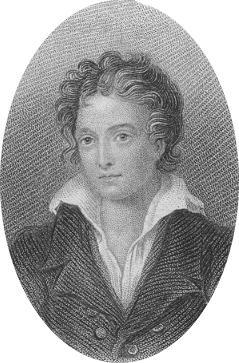
Percy Bysshe Shelley
(1792-1822):
"Hot Brained Dreamer."
"I had rather not have
my hopes and illusions
mocked by sad realities."1
[Table Of Contents]
|
|
|
[TOP]
[TOC]
No. 1 -- Introduction:-
Thorton Hunt, who as a young man was to meet Shelley, wrote:
"[Shelley was an heir] to fortune and title, while yet a boy he revolted against tyranny, dogma, and falsehood, so openly and uncompromisingly that his family disowned him as far as it might, society looked askance at him, and only they welcomed him who were at issue with the dominant idolatry of that period, now passed away. ... and refusing a family condonation, a seat in Parliament, and higher honours in prospect, he sought his life in poetry made real; wedding the daughter and intellectual heiress of Political Justice, and literally leading her clear mind into his own path of classic study and exalted speculation. As he advanced towards its midst he drew around him men older in years, more trained in the world; and more accustomed to embody their thoughts in definite aims, whether of social action or worldly success."2
In about the year 1816, Horace Smith paid a visit to the twenty-four year Shelley who was just then starting to make a reputation for himself. Smith described Shelley as follows:
"I beheld a fair, freckled, blue-eyed, light-haired, delicate-looking person, whose countenance was serious and thoughtful, whose stature would have been rather tall had he carried himself upright; whose earnest voice, though never loud, was somewhat unmusical. Manifest as it was that his preoccupied mind had no thought to spare for the modish adjustment of his fashionably made clothes, it was impossible to doubt even for a moment that you were gazing upon a gentleman, ... one that is gentle, generous, accomplished, brave."3
[TOP]
[TOC]
No. 2 -- Childhood:-
Sir Bysshe Shelley (1731-1815) was known as a rich old eccentric. He was one of three boys4 born in the American colonies, New Jersey. The family moved back to England, Sussex, when Bysshe was but a boy. Getting a good start from his family and marrying well, Bysshe became a rich and influential man. From his first marriage there was produced a son (Bysshe was married at least twice and had a number of offspring). This son was Timothy (1753-1844), our poet's father. Timothy went up to Oxford, where, in 1778, he was awarded his Bachelor's; in 1781, his Master's. After Oxford, Timothy studied law as a student at Lincoln's Inn. Shelley's biographer, Edmund Blunden, deduced that Timothy was "a steady, punctilious young man."5 In 1790, Timothy became the Member of Parliament for Horsham. In October of 1791, Timothy married Elizabeth Pilfold and the couple moved into one of the Shelley estates, that at Field Place, Warnham, located but 40 miles from London. On August 4th, 1792, there was born to the couple there first child, Percy Bysshe.6
Shelley, to use Blunden's words, was "brought up in the air of riches and responsibility and the confidence that wishes can be fulfilled ..."7 After attending a preparatory school (Sion House Academy), in 1804, he was enrolled at Eton. There, he received a sound training in the classics of ancient Greece and Rome. His belief "that wishes can be fulfilled" when fitted together with the grounding that he received in classical myth and mystery will give the reader an understanding of the poetry which Shelley wrote.8
[TOP]
[TOC]
No. 3 -- Oxford:-
In 1810, the father brought the son to his Alma Mater, Oxford. Timothy was pleased with the prospects of his eldest; he had no idea of the difficulties ahead. Blunden writes:
"Calling on the son of his old boarding-house-keeper, Mr. Shelley found that another son whom he had known was now in business as a bookseller; he marched off with Bysshe to the shop and ordered him to buy his books and stationary there. The handsome shop was almost opposite University College. To Henry Slatter and his partner he said, 'My son here has a literary turn; he is already an author, and do pray indulge him in his printing freaks.'"
Shelley was soon settled in at Oxford. His rooms were located "in the south-west corner of the principal quadrangle." A fellow student, Thomas Jefferson Hogg, of whom we shall shortly hear more, wrote of these rooms:
"Books, boots, papers, shoes, philosophical instruments [scientific, as we would now call them], clothes, pistols, linen, crockery, ammunition, and phials innumerable, with money, stockings, prints, crucibles, bags and boxes, were scattered on the floor and in every place ... An electrical machine, an air-pump, the galvanic trough, a solar microscope, and large glass jars and receivers, were conspicuous amidst the mass of matter."9
Of Shelley:
"His clothes were expensive ... but they were tumbled, rumpled, unbrushed. His gestures were abrupt, and sometimes violent, occasionally even awkward, yet more frequently gentle and graceful. ... His features, his whole face, and particularly his head, were, in fact, unusually small; yet the last appeared of a remarkable bulk, for his hair was long and bushy, and in fits of absence, and in the agonies (if I may use the word) of anxious thought, he often rubbed it fiercely with his hands, or passed his fingers quickly through his locks unconsciously, so that it was singularly wild and rough."10
Notwithstanding Shelley's possession of "philosophical instruments," in the days under review, it is not likely that Oxford was a place where intensive scientific investigation was carried out in respect to the natural world. It was still very much an educational institution under the strictures of religion. Every student, in order to gain admission, was obliged to sign the Thirty-nine Articles of the Church of England. Robert Southey observed that "Oxford is a school for divinity, and for nothing else."11 The religious propensity of the times, as was fully reflected at Oxford, proved to be the rock which Shelley ran up upon.12
Within months of his arrival at Oxford, during the Christmas vacation Shelley delivered to his printers "a short specimen of logic" which bore the title "The Necessity of Atheism." It was printed up as a pamphlet and nowhere did the writer's name appear. To write and publish such a work, denying the existence of God, at the first of the 19th century, was inevitably to bring on trouble. This was especially so, since, to make a lark out of it, Shelley sent a copy of the pamphlet to everybody who was anybody at Oxford. He also sent a copy to every bishop in England. Though by reading the work no one could tell who wrote it, apparently Shelley made no secret of its authorship to his friends; soon it got around to the administrators of the university that the work was that of young Shelley. On March 25th of that year (1811), a meeting of the overseers was convened and Shelley was asked to appear before them. Shelley was given the chance to deny that the work was his; he refused to give it or to answer any of the questions put to him. It was, as Blunden pointed out, a "conflict of traditions and tempers."13 A bitter decision was made there and then: Shelley was expelled from Oxford. Thomas Jefferson Hogg, Shelley's student friend, much to his credit, took sides and supported his friend. Hogg, knowing that Shelley was at the meeting, got a message through to the university officers that he wished to appear before them directly Shelley should leave the room. After being invited in, he then proceeded to tell the officers that should they expel Shelley, they should expel him as well. They obliged Hogg; both Hogg and Shelley were sent packing. The next day, Shelley and Hogg took the coach to London.
One can but imagine what the family thought about these developments. Their blond-haired boy expelled from Oxford? It most certainly must have been on account of the influence of his friends, bad friends, and, in particular, Mr. Hogg, who was now living with Shelley at London. A message was sent to Shelley. It offered condolences and a suggestion that he take some time off and go on a voyage through the Greek Islands, then, presumably after such a change and rest, he might once again take up his studies. There was, however, a condition, viz. that he could not take Mr. Hogg with him. Shelley refused the offer. Then his father suggested he should come home to Field Place and there he might be put into "the care and society" of a gentleman tutor, a person to be picked by his father. Shelley also refused this offer. Shelley was now fixed in his political belief that the power in the country lay in the hands of those who are most distinguished by birth, fortune, or of a privileged order such as those associated with the Church of England. Shelley had rebuked the latter and was expelled from Oxford; he now rebuked his family, one of high birth and good fortune. Shelley, having spurned his father's advances, was cast out of the family as he was out of Oxford; he was thereafter to be on his own. Shelley never was to change his political beliefs and was never to be reconciled to his family.
[TOP]
[TOC]
No. 4 -- Harriet:-
Harriet Westbrook was the daughter of a retired coffee house proprietor. Her family lived in London. Harriet attended the same school (at Clapham) as did certain of Shelley's sisters. No matter that Shelley was shut out of his father's house, his sisters would come to London to see their older brother, and, likely, during school holidays, they would go along to the Westbrooks. One of these intended visits, for what ever reason, did not come off; so, the sisters asked Shelley if he would bring a present to Harriet. Thus Shelley was to meet Harriet. The young couple were soon making plans for marriage. The two -- she was only sixteen and he nineteen -- with the help of an uncle, went off to Scotland. At Edinburgh, on August 28th, 1811, Shelley and Harriet were married.14 However pleased they were that their Harriet should be marrying into such a distinguished family, the Westbrooks, devote Methodists, were taken aback by Shelley's declared atheism. In the meantime, back at Field Place the family were now quite convinced that their first born had gone mad: communications between Shelley and the family were all relayed through the family lawyer.
Shelley was restless and infected with wanderlust; it came on immediately with his marriage and lasted throughout his life. It was impossible for him to settle down in any one place for long; he led a nomadic life. After leaving Edinburgh the couple spent time with his old university friend Hogg who was then at York.15 After a short stay at York they were off to Keswick and with some help from Southey they moved into rental accommodations. Then, in February 1812, it was off to Ireland. In Ireland he decided to help the Irish people. In another of his "printing freaks," Shelley wrote a piece, "Address to the Irish People" and made it into a pamphlet; he then proceeded to scatter 4,000 of them throughout Dublin. What the Irish people needed, so Shelley wrote, was "Catholic Emancipation" and "the restoration of the old liberties and happiness of Ireland." Leaving Ireland in April of 1812, the couple went back to England via Wales. By June, the couple were living at Lynmouth in a cottage with "roses on the walls, a thatched roof, a sea view [and] a screen of mountains."16 It was during this time that Shelley wrote Queen Mab.17 It would not appear that the couple remained long at Lynmouth, for, by November of 1812, following up on the letters he sent earlier in the year, Shelley was making extended visits to the Godwin household in London.
[TOP]
[TOC]
No. 5 -- Napoleonic Background:-
These were historically interesting times. In May of 1812, the British prime minister, Perceval was assassinated. Lord Liverpool succeeded him. Liverpool appointed Lord Castlereagh as the Foreign Secretary, and, as such, became the soul of the coalition against Napoleon who had been waging war on all of his European neighbours, including Great Britain, since 1793. In the early part of this 23 year long war with Napoleon, Britain's policy, up to 1801, "was twofold: it was a naval policy and a policy of subsidy."18 The money spent on her navy paid handsome dividends. Britain kept its position as an international trader and turned the island nation into a financial powerhouse. And though there were real worries that Napoleon might cross the channel19 and get at them, those worries floated away like a dream when Lord Nelson and his captains destroyed both the Spanish and French fleets at Trafalgar in 1805. However, in that same year, the Battle of Austerlitz took place (Austerlitz is a place located in modern day Czechoslovakia) which ended up with Napoleon having decisively defeated the armies of Russia and Austria, each with its emperor at its head. A decisive point in this long war with Napoleon came when, in support of a Spanish rising, in July of 1808, Arthur Wellesley (later to become known as the Duke of Wellington) led the first small British force of 9000 men into the Peninsula of Spain; a gateway into the hostile fortress of Napoleonic Europe. Up to this point all that Britain sent was money, and lots of it, to its allies such as Austria. In August of 1808, Wellesley defeated the French under Junot at Vimeiro. Finally, the people of Great Britain and those of Europe were to understand that the French armies of Napoleon were not invincible. Britain, in 1808, had established, however, but a toe hold on Napoleonic Europe; there were years of fighting to come. Indeed, it is one of the great questions of history as to whether Napoleon would have been ever overcome by his enemies had it not been his one great mistake -- invading the vast northern territory of Russia. By the winter of 1812/13, news came of Napoleon's retreat from Moscow and his struggle to retain hold of central Europe. During forty days in May and June of 1813, the British troops drove the French armies over the Pyrenees and out of Spain; after years of being the military might in Europe, Napoleon's back was broken. In April of 1814, Paris was captured; and the war, or so everybody thought, was at an end. Napoleon, like everything else he did in his life, was to leave the world stage with dramatic flare. With his capture, Napoleon was sent into exile on the island of Elba. On March 1st, 1815, Napoleon made his way from Elba to Paris and the "Hundred Days" began. Then, on June 18th, 1815, the Battle of Waterloo unfolded. Napoleon's defeat brought 23 years of war between Britain and France, to an end.
[TOP]
[TOC]
No. 6 -- Political Justice:-
One of the works in which the supporters of the populist movement of the 19th century grounded themselves was that written by William Godwin, Political Justice. The work was published in 1793. It was considered to be a major piece of sedition. It was an attack on the established institutions of the aristocracy, such as property and religion. Political Justice, however, was not to light any political fires in England. Just as Political Justice appeared, so too did the beginning of the Napoleonic Wars: war does not allow much scope to a nation to perfect its ideas of liberty. It was only after the war, after 1815, that the populist movement again begin to take hold.
It will be no surprise, given the course of his life thereafter, to learn that Shelley read Political Justice. Indeed, during his school days he became a Godwinian. Godwin, in his philosophy, followed along in the footsteps of Rousseau and the nostalgia for the simple and the primitive. Godwin could foresee for mankind a perfect equality and happiness; he believed in the perfectibility of man; he believed that it would be impossible to be rationally persuaded and not act accordingly, and that therefore, man ultimately could live in harmony without law and institutions. Such institutions as government, law, property and marriage -- were restraints upon liberty and obstacles to progress.
Shelley was to have a personal connection to Godwin; but, before we come to that, as necessary background, we make a note on Godwin's family. In 1796, Godwin was to meet Mary Wollstonecraft (1759-97). (Mary Wollstonecraft, in 1792, wrote "the first great feminist manifesto," Vindication of the Rights of Women.20) Finding that they had conceived a child together, Godwin, though no believer in the institution, took a practical route and wed Wollstonecraft during March of 1797. On August 30th, 1797, Mary was born; and, within two weeks of that, presumably of complications due to childbirth, Wollstonecraft was dead. Godwin was left with two small children on his hands, the infant Mary and Fanny Imlay (born 1794, a child which Mary Wollstonecraft had by Gilbert Imlay). In 1801, Godwin married a second time. His second wife was Mary Jane Clairmont who came to the marriage with two children, Charles and Jane (b.1798). Godwin and Clairmont went on to have one child together, William (b.1803).21
As we have already written, Shelley, when but a school boy, took a deep interest in Godwin's writing. A number of years passed, when, not even sure that his hero was alive, Shelley dispatched a letter to Godwin in January of 1812. Godwin got a reply off within days inquiring about his young admirer's background. Shelley was delighted that he had made this connection to Godwin and wrote a second letter. In this second letter, Shelley let slip that he was heir to an estate that, in time, would provide £6000 a year.22 This last little piece of information was of considerable interest to Godwin. Godwin was always hard up for cash and was ready to put the touch on anyone who he thought could make a small "loan" to him.23 It was plain that Godwin would be most delighted if Shelley could come up to London, Godwin would greet this rich young poet with open arms.
In the summer of 1813, Shelley saw to the private publication of Queen Mab. He continued his vagabond ways going from place to place to live, even though there was now a young child with whom to contend. (In June of 1813, Harriet gave birth to her first born, a girl, Eliza Ianthe.) During the months from July to October they stayed at Bracknell in Berkshire just west of London. In the fall of the year they determined to go to the Lake District; but, not finding suitable accommodations, went further north to Edinburgh. In December they (Shelley, Harriet and Eliza Ianthe) moved yet once again and by the end of 1813 they were living near Windsor. It might be interesting to speculate what transpired between Shelley, his bride, the bride's sister (the meddlesome Eliza) and the families (the Westbrooks and the Shelleys) during the winter of 1813/14. During this time the relationship between Shelley and his family turned around for the better. He and his father actually had a friendly meeting in London while the lawyers worked out a deal in respect to his inheritance.24 Apparently, one of the matters that put the families out of joint was the Scottish marriage. To put it right, and as part of a larger bargain which is suspected was struck between Shelley and the families, the couple were married once again on March 20th, 1814, in St. George's church, at London, Hanover. Part of the deal, too, it seems, was that the couple was finally to get rid of Harriet's sister, Eliza, for whom Shelley had no like, at all, and who had been chaperoning the couple since first Shelley met Harriet.25 Everything seem to be falling in place. Shelley and Harriet, it appeared, were headed for leading a normal life in harmony with their respective families. Enter Mary Godwin.
[TOP]
[TOC]
No. 7 -- Mary and Jane:-
We saw, during the early part of 1812, that the twenty year old Shelley was writing letters to Godwin, who, through his readings of Political Justice, had become, to Shelley, a monumental icon of human liberty. By November of 1812, Shelley had made his way to London to visit the 52 year old Godwin at his home. Thereafter, Shelley was making extended visits to the Godwin household. I do not know how frequently Shelley made visits, we might suppose not too frequently given that during this period, 1812-14, Shelley, Harriet and Eliza (Harriet's sister) were moving about a great deal. It was not until 1814, on June 18th, to be precise, that Shelley was to first lay eyes on Mary Godwin: she was then seventeen and he twenty-two. Shelley had showed up at Godwin's house to give to him the proceeds of a loan which Shelley had arranged (one of a number of transactions during which Godwin dunned money out of Shelley).26 Mary had just returned from Scotland where she had been attending school. He was immediately smitten with her -- "a dream from heaven." Harriet was just then some distance away, at Bath. Shelley during the balance of June and into July was escorting both Mary and her younger half-sister, Jane (or, Claire, as she came to be known) around various places including the grave site of Mary's illustrious mother, Mary Wollstonecraft. During this time Shelley wrote letters to Harriet and made no secret of his attraction to Mary. In July, on Shelley's suggestion, Harriet came up to London. Shelley brought Harriet to the Godwins so that she might meet everyone. The suggestion, which Harriet thought came from Mary (she blamed Mary), was that, forgetting about all the social implications of the arrangement, the three should just live together. The suggestion literally made Harriet sick.27
While Harriet was sick over Shelley's involvement with Mary Godwin, Mary was over the moon. Letting Harriet stew over the matter (she was then about four months pregnant), Shelley and Mary, together with Claire28, now that war in Europe had come to an end, determined to go to the continent. So off they went for a six week trip. They left, it would appear without taking their leave of anyone in particular. Shelley arranged for a carriage and the girls (Mary was seventeen, Claire was sixteen) slipped out of their parents' house and off they drove to Dover. After a windy trip over the channel they arrived at Calais. Through France they traveled and then on to Switzerland. From Switzerland Shelley wrote Harriet inviting her to come to Switzerland where he would find her a "sweet retreat among the mountains." By September the 13th the three were back in London. Shelley was without money and needed some so that he might rent a place for himself and the girls; he went to Harriet and she gave him £20 to tie him over.29
That November, 1814, Harriet gave birth to her second child, a son, Charles Bysshe. Though a week passed before Shelley was to hear the news, it was an event which drew him to Harriet's side. The meeting was unhappy. No doubt the older and scolding sister, Eliza, was hovering in the background.30 Shelley was soon back with Mary who then was but two months off from delivery her child by Shelley.31 The new year brought news of Shelley's grandfather's death. The rich and eccentric Sir Bysshe was eighty-four at his death. Though it is less than clear, Sir Bysshe's death brought Shelley that much closer to his inheritance. It was at this time that the lawyers were brought in so that the father might settle with the son. A deal was struck whereby Shelley was to give up his rights to the family estate in exchange for a tidy monthly sum to continue throughout his life. Harriet was to get £200 a year, and a further and immediate payment was made to get rid of her outstanding bills.32
So the year of 1815 passed, and in that year, for Shelley, three matters were put on a level footing: his separation with Harriet was formalized, his financial future was fixed, and his relationship with Mary was stabilized. The turmoil in Shelley's life had ebbed. It will be remembered, too, that in 1815, Napoleon was finally defeated and the long years of war came to an end. Unemployed ex-servicemen walked the streets. Markets slumped for lack of demand. Men in all walks of life began to agitate for political reform. Shelley who was now coming into his own as a poet, wrote Alastor, "a masterpiece in blank verse."33 The work, published in 1816, reflecting a more tempered view of things, condemned the self-satisfaction of the idealist who dreamt of the perfect society but who were powerless to change the conditions with which the poor and the disadvantaged were afflicted, seemingly, in all events.
[TOP]
[TOC]
No. 8 -- Last Years In England:-
In January of 1816 Mary gave birth to her second child, William. Within months of the birth of William, Shelley made a determination to go to Geneva, principally, it seems, so that he could meet a fellow poet Lord Byron who just that April, then out of favor with the public, had removed himself from England. Shelley, Mary and Claire34 set out for Switzerland that May. Byron and Shelley were to meet at Geneva for the first time. Though their characters and ideals were different, the two poets were attracted to one another and recognized each other's genius. Shelley admired Byron the poet, Byron liked Shelley the man.35 At the end of August, Shelley and his female companions left Geneva for England. Once back in England, Mary and Claire, together with the baby and a Swiss nurse went to stay at Bath. Shelley stayed on for a period of time at London as he had business to attend to in London36. At the end of September, Shelley was at Bath (5 Abby Churchyard) to be with Mary, the baby and Claire.
Shelley, in 1816, was to make friends with Leigh Hunt. Hunt, together with his brother, had established one of the most famous newspapers of the time, the Examiner. In the paper, Hunt was given to express his liberal views. Such expressions of liberalism was to get he and his brother into trouble with the government, which was more interested in prosecuting the war against Napoleon than with civil liberties at home. Both of the Hunt brothers were tried and found guilty "for a libel on the prince regent." They both received a two year term of imprisonment, 1813-15. "I first saw Shelley," Hunt explains in his Autobiography37, "during the early period of the Examiner, before its indictment on account of the Regent; but it was only for a few short visits, which did not produce intimacy. ... He was then a youth, not come to his full growth; very gentlemanly, earnestly gazing at every object that interested him, and quoting the Greek dramatists." Shelley, always a man to support a good cause, sent "a large sum of money" to Hunt at his home address, known as the "Vale of Health" at Hampstead: thereafter, "an affectionate correspondence began."38 On December 6th, 1816, Shelley arrived at Hunt's home at Hampstead and was ushered in as a member of the family. To Shelley, Hunt dispensed enthusiasm and encouragement and most importantly gave Shelley (he was to do the same for the young John Keats at the same time) access to the columns of the Examiner.
In the meantime, there, in the background, was Harriet and the two children, all of whom Shelley had effectively deserted.39 The loss to her was a great one and she suffered more than we will ever know. Thomas Love Peacock (1785-1866), a friend of Shelley's, was to write of Harriet:
"Her manners were good; and her whole aspect and demeanour such manifest emanations of pure and truthful nature, that to be once in her company was to know her thoroughly. She was fond of her husband, and accommodated herself in every way to his tastes. If they mixed in society, she adorned it; if they lived in retirement, she was satisfied; if they traveled, she enjoyed the change of scene."40
In December of 1816, Harriet's body was pulled out of a pond located in Hyde Park, "The Serpentine." On December the 30th, Shelley married Mary.41
Within days of Harriet's death the Westbrook family brought a petition before the court of Chancery which would effectively deprive Shelley of any say in respect to his two children, who were then three and half years old (Eliza Ianthe) and two (Charles Bysshe). Eliza Westbrook, Harriet's elder sister was undoubtedly the driving force behind the move to shut Shelley out. There were any number of stories, mostly true, which the court was to hear which went to the suitability of Shelley as a father. The children were made wards of the court and went to live with a mutually acceptable family, Dr. and Mrs. Hume.42 Shelley was given limited visitation rights but it would not appear that he exercised these rights to any great degree and not at all after he left for Italy in March of 1818.
In spite of these listed miseries, or maybe because of them, Shelley wrote poetry. He was now coming into his best years. In 1817, he wrote Rosalind and Helen and The Revolt of Islam and (in part) Prince Athanase. Shelley took a house43 in the new year (1817) so to be near his friend Leigh Hunt at the "Vale of Health," Hampstead. Hunt had just seen to the publication of his, "The Story of Rimini." Hunt's enemies (he had many due to his writings in the Examiner) criticized the poem's "idiosyncratic, colloquial style and the sympathetic treatment of incestuous adultery."
[TOP]
[TOC]
No. 9 -- Italy:-
There are a number of good reasons for Englishmen to go and live in Italy. There is the cheapness of living, the sunshine, and the classical culture. Avoidance of creditors has always been one of the chief reasons. Shelley's spending habits, marked by great generosity to his friends, was to get him into serious financial trouble.44 By 1817, his sources of credit dried up. Though it certainly seems that he had a substantial and regular income, it simply did not match his outgo. As the year closed, matters were in the extreme. Bailiffs were arriving to take inventory. Shelley, leaving Mary and the children in the big house they had rented, Great Marlow, started to hide out in various places throughout London.
In February of 1818, after packing up many of their possessions, the Shelleys moved out of their large house at Great Marlow and the premises handed over to new tenants. They spent the next few weeks in London making the rounds. On March 9th, the two children, six month old Clara and 26 month old William, together with Claire's child she had by Byron, 14 month old Allegra, were brought to St Giles-in-the-Fields, there to be christened; it was but a sop which the atheistic Shelley gave to the families.45 The following day, March 10th; Shelley, Mary, Claire, the children and servants made their way to Dover. Waiting a couple of days for the weather to clear they all boarded the Lady Castlereagh and were blown across the channel to Calais. Shelley had left England for good.
Traveling overland, via Lyons, they entered Italy at Susa and were soon at Milan. At Milan correspondence was entered into between Shelley and Byron who was then in Venice. Byron demanded that Allegra be delivered to him. Sad as it was for her mother, realizing that Allegra's future depended on satisfying Byron, Allegra46 was sent off to Venice with her nurse on April 28th. A couple of days later the Shelleys left for Pisa. Though intending to stay at Pisa47, the Shelleys were soon drawn to Venice, mainly for Claire's sake so that she might check up on Allegra.48 By September the Shelleys were occupying Byron's summer place at Este, he having moved to Venice for the winter season (Este is located just north of Venice). It is during this period of time that Clara, the one year old died. Shelley, now having reached the full height of his genius, was writing his best poetry, including: Lines among the Euganean Hills and the first act of Prometheus Unbound. In November, Shelley, ever so true to his vagabond ways, determined to live awhile at Naples; and, on the way, take in the sights of Rome49 and Pompeii. Come March, 1819, the Shelleys are on the move again -- they moved to Rome where they stayed to June 10th. While at Rome, Shelley writes the second and third acts of Prometheus Unbound. It was at this time, on June 6th, while at Rome, that William died. Alone now without children, leaving Rome, they traveled north to take up residence at Leghorn (Livorno), on the western coast not far from Pisa. Then in October, north again to Florence, there to take up residence at Palazzo Marino, 4395 Via Valfonda. Mary then gave birth, on November 12th, to Percy Florence. All along, Shelley was writing: A Philosophical View of Reform, The Mask of Anarchy, Peter Bell the Third, Ode to the West Wind and the third act of Prometheus Unbound.50
In January of 1820, the Shelleys moved to Pisa. Again, in June, they moved so in the hot weather to be nearer the sea coast, to Leghorn.51 In August they moved to San Giuliano, near Pisa. On October 31st, Shelley moved his household back to Pisa. During the year, Shelley continued to be productive and wrote The Witch of Atlas and Oedipus Tyrannus. That summer a book of his poems came out which included: "The Cloud," "The Skylark," "The Hymn of Pan," "Arethusa" and the "Song of Proserpine." In the new year, 1821, Lord Byron came to be part of the literary group around Shelley. Byron regularly entertained by throwing dinner parties that lasted to three in the morning. During the months of January and February, Shelley wrote Epipsychidion.52 On February 23rd, the young poet whom Shelley had befriended back in England, died at Rome.53 This event caused Shelley to write one of his finest poems, Adonais, an elegy on John Keats.54
That fall, in 1821, Shelley and Byron struck upon an idea that they could enter into a joint literary venture. They would, from Italy, launch a new magazine (The Liberal). The implementation of this plan (mainly promoted by Shelley) would allow Shelley to achieve an objective he long had: to get his friend Leigh Hunt to come out from England to Italy. Hunt, due to his involvement with the Examiner, a successful London magazine which he and his brother had set up in 1808, would be a valuable person to have in the setup and production of the new magazine which Shelley and Byron envisioned. Hunt, however, had a large family and no funds. This problem was to be surmounted. Shelley and Byron (with independent aristocratic means, the both of them) would provide money sufficient, and a house. Mary Shelley was to write directly to Marianne Hunt: "Italy will not strike you as so divine at first; but each day it becomes dearer and more delightful; the sun, the flowers, the air, all is more sweet and more balmy than in Ultima Thule that you inhabit."55 In January of 1822, Shelley, writing from Italy, sent to Hunt by "return of post" £150. In his letter Shelley writes:
"Lord Byron has assigned you a portion of his palace, and Mary and I had occupied ourselves in furnishing it ... We had hired a woman cook of the country for you, who is still with us. Lord B. had kindly insisted upon paying the upholsterer's bill, with that sort of unsuspecting goodness which makes it infinitely difficult to ask him for more ..."56
That January, 1822, Edward John Trelawny (1792-1881) joined the circle at Pisa.57 He was quite the character. Mary Shelley was to describe Trelawny:
"A kind of half Arab Englishman whose life has been changeful as that of Anastasius and who recounts the adventures of his youth as eloquently and well as the imagined Greek ... he is a strange web which I am endeavouring to unravel ... he is six feet high -- raven black hair which curls thickly and shortly like a Moor's -- dark grey expressive eyes, overhanging brows, upturned lips and a smile which expresses good nature and kindheatedness ..."58
[TOP]
[TOC]
No. 10 -- Shelley's Death:-
Summer was coming, and as usual, the Shelleys sought a new place to live, a place with cool sea breezes, a place where Shelley might be inspired to write his poetry. Such a place was found and the household moved to San Terenzo, on the Bay of Spezzia. The house was called the Casa Magni.59 It stood alone on the edge of the sea under steep and wooded slopes. There were only two ways, then, to get to Casa Magni: by sea which came to the front steps or by paths that led in from Lerici on the south and from the north where there was a small fishing village, San Terenzo. The views in all directions were beautiful, however, Mary, as spectacular as it surely was, was uncomfortable with the surroundings. Claire was with them just as she mostly was from the very start. So, too, were Edward and Jane Williams. The Williamses and the Shelleys had became fast friends earlier in the year, indeed, they occupied the ground floor of where the Shelleys had lived at Pisa, Tre Palazzi. It was just shortly after they had moved into Casa Magni that news had come that the five year old Allegra, Claire's child by Byron, had died at the convent in which Byron had eventually placed her. This news had set a very sombre mood for the household.
The weeks passed at Casa Magni. Williams who had been in the navy taught Shelley how to sail.60 During this time, in June of 1822, Shelley worked on what must have been the last of his works, The Triumph. On June 15th, the Hunt family arrived in Italy, touching first at Genoa. A message had been gotten through to Shelley that his friend had, at long last, arrived. It was expected that they should soon be at Leghorn. On July 1st, Shelley and Williams set sail at Casa Magni. After a seven and half hour sail, covering a distance of approximately fifty miles going south along the coast, Shelley and Williams arrive in the Don Juan at Leghorn. The next day Shelley met Leigh Hunt. Shelley wanted to see that his literary friend with his wife and children were comfortably settled at Pisa where Byron had offered the downstairs floor of his palace for their use. Shelley could not stay long with the Hunts at Pisa. Mary had not been well and he wanted to return to her as soon as possible. On July 8th, having returned to Leghorn, Shelley set out for the return sail up the coast to Casa Magni. Trelawny was just then at Leghorn taking care of Byron's sailboat, the Bolivar. It was not Trelawny's intention to sail all the way to Casa Magni; he was, however, ready for a short sail in the larger Bolivar and to accompany the Don Juan out into the bay.61 Having sailed alongside for a period of time the crew of the Bolivar waived goodby to the Don Juan, and, coming about, made for port. Arriving back at Leghorn, Trelawny tied the Bolivar up. We now turn to Trelawny, who, in stirring prose, explained the scene and the anxiferous events thereafter.
"Although the sun was obscured by mists it was oppressively sultry. There was not a breath of air in the harbor. The heaviness of the atmosphere and an unwonted stillness benumbed my senses. I went down into the cabin and sank into a slumber. I was roused up by a noise overhead, and went on deck. The men were getting up a chain cable to let go another anchor. There was a general stir amongst the shipping; shifting berths, getting down yards and masts, veering out cables, hauling in of hawsers, letting go anchors, hailing from the ships and quays, boats sculling rapidly to and fro. It was almost dark, although only half past six. The sea was of the color and looked as solid and smooth as a sheet of lead, and covered with an oily scum; gusts of wind swept over without ruffling it, and big drops of rain fell on its surface, rebounding, as if they could not penetrate it. There was a commotion in the air, made up of many threatening sounds, coming upon us from the sea. Fishing craft and coasting vessels under bare poles rushed by us in shoals, running foul of the ships in the harbor. As yet the din and hubbub was that made by men, but their shrill pipings were suddenly silenced by the crashing voice of a thunder squall that burst right over our heads. For some time no other sounds were to be heard than the thunder, wind and rain. When the fury of the storm, which did not last for more than twenty minutes, had abated, and the horizon was in some degree cleared, I looked to seaward anxiously, in the hope of descrying Shelley's boat amongst the many small crafts scattered about. I watched every speck that loomed on the horizon, thinking that they would have borne up on their return to the port, as all the other boats that had gone out in the same direction had done.
I sent our Genoese mate on board some of the returning crafts to make inquiries, but they all professed not to have seen the English boat.... During the night it was gusty and showery, and the lightning flashed along the coast; at daylight I returned on board and resumed my examinations of the crews of the various boats which had returned to the port during the night. They either knew nothing or would say nothing. My Genoese, with the quick eye of a sailor, pointed out on board a fishing-boat an English-made oar that he thought he had seen in Shelley's boat, but the entire crew swore by all the saints in the calendar that this was not so. Another day was passed in horrid suspense. On the morning of the third day I rode to Pisa. Byron had returned to the Lanfranchi Palace. I hoped to find a letter from the Villa Magni; there was none. I told my fears to Hunt, and then went upstairs to Byron. When I told him his lip quivered, and his voice faltered as he questioned me."62
Mary had no way of knowing, on the 8th, that Shelley had set sail. The days passed and the concern of the three woman at Casa Magni turned into worry. (There at Casa Magni waiting for the return of the boat was Mary; her half-sister, Claire; Jane Williams; and, of course the only surviving child of Mary and Shelley, the two and a half year old Percy Florence Shelley.) A letter had come in from Pisa; it was from Hunt. It sat there on the table for a day or two before Mary determine to open it up. Hunt enquired whether the trip back home went well. The worry of the women now turned into great panic. In the meantime Trelawny was searching the coast. He was aware of the storm that likely overtook Shelley and Williams, maybe they were stranded, maybe blown over to Corsica. Then Trelawny got the news. There was debris found. Then, on July 18th, accounts came in of bodies being found on the shore. The bodies that the sea had cast up were separated from one another by a number of miles. Of the body found at Viareggio, on it being described, Trelawny was of no doubt that it was that, of Shelley's. It was the body of a tall person of slight figure and in one pocket of the jacket worn was a volume of Aeschylus (the classic Greek poet) and in the other a copy of Keats's poems. Trelawny went and broke the news to the two widows who had been going back and forth through these days, from Lerici to Pisa (where Byron and Hunt were headquartered) -- hoping against hope.
The bodies had been buried, which under the law, the local authorities were required to do, in the sand where they had been found. Decomposing bodies are a hazard to public health; and so the ground was opened up and quicklime thrown in with the bodies. What Jane Williams wanted was for her husband's remains to be sent back to England. Mary Shelley wanted Shelley's remains to be buried at Rome in the English (Protestant) burying ground where their three and a half year old son, William had been buried in 1819. The health laws were such that bodies could not be moved. Principally through the efforts of Trelawny, who took charge of the entire matter, permission was obtained from the authorities to burn them. On August 15th, in a specially constructed furnace, Williams's body was dug out of the sand at the mouth of the Serchio and burned. Three days later, in the company of Byron and Hunt63, on August 18th, the badly decomposed body of Shelley was dealt with in the same manner. Wine, oil and salt were thrown on the pile, and with them the volume of Keats which Shelley had last consulted: all except for some white ashes went up in smoke.64
[TOP]
[TOC]
No. 11 -- Conclusion:-
Shelley learned his lessons in England. With his move to Italy, he left behind "his crude romances of political martyrdom"65 and turned to writing his best work, such as: Lines among the Euganean Hills; Ode to the West Wind; Adonais; and, of course, Prometheus Unbound. But Shelley's poetry was not, however, the best of English poetry66 as might be claimed by his friend Byron or of one of an earlier age, Pope. Hughes, in his work on Shelley, called him the poet of sorrow. "Even in the quieter years in Italy, sorrow was still constant to him: in the 'hunt of obloquy', now at greater distance, but all the while in cry; in the deaths of his two children; and in an increasing sense of wrongness in his own life and in the world."67
To William Hazlitt, Shelley was a hot brained dreamer:
"The shock of accident, the weight of authority make no impression on his [Shelley's]
opinions, which retire like a feather, or rise from the encounter unhurt
through their own buoyancy. He is clogged by no dull system of
realities, no earth-bound feelings, no rooted prejudices, by nothing
that belongs to the mighty trunk and hard husk of nature and habit, but
is drawn up by irresistible levity to the regions of mere speculation
and fancy, to the sphere of air and fire, where his delighted spirit
floats in 'seas of pearl and clouds of amber.' There is no caput
mortuum of worn-out, threadbare experience to serve as ballast to his
mind; it is all volatile intellectual salt of tartar, that refuses to
combine its evanescent, inflammable essence with anything solid or
anything lasting. Bubbles are to him the only realities: -- touch them,
and they vanish. Curiosity is the only proper category of his mind, and
though a man in knowledge, he is a child in feeling."68
To this epilogue I add a few words as to what became of Mary Shelley69 and her half-sister, Claire. Within a day the women moved from Casa Magni. For the two months that they lived there, they had a foreboding of the dreadful event which had overtaken them. Mary had some money and soon made arrangements to return to England. So too, she paid for the expenses so that Claire could join her brother Charles in Vienna. Claire was an accomplished linguist knowing five languages. Such a knowledge made her an ideal governess and was to work as such, as I understand, for the balance of her working life. (Indeed, even when Shelley was alive, she spent time at Florence as a governess.) Claire stayed with her brother in Vienna for a number of months, then, in 1823, she took herself to Russia. For a year she was at St. Petersburg then for another four years in Moscow. In 1828, Claire returned to England there to spend a year, after which she went to Germany, Dresden. In the 1840s she was settled in Paris. All along, when granted leave by the family for which she was working, she would return to England for a visit. In 1870 Claire moved to a place she knew well as a young woman, Florence. There at Florence, Claire died in 1879, in her eighty-first year.70
As for Mary Shelley: as mentioned, she returned to England in 1823 with her son, Percy Florence. Shelley's father gave her a small pension, mainly because of his grandson and heir. The payments to Mary were made on terms including that she should not involve herself in the publication of Shelley's work, of which Sir Timothy did not approve. Mary Shelley, of course, had proven herself to be a successful writer with her first and most impressive novel, Frankenstein (1818). She continued to write, though, as agreed, not under the name of Shelley. She wrote novels for a while then travel guides. She lived to age 53, when, in 1851, she died.
Mary was to write of her Shelley:
"He had been from youth the victim of the state of feeling inspired by the reaction of the French revolution; and believing firmly in the justice and excellence of his views, it cannot be wondered that a nature as sensitive, as impetuous, and as generous, as his, should put its whole force into the contempt to alleviate for others the evils of those systems from which he himself suffered. Many advantages attended his birth; he spurned them all when balanced with what he considered his duties. He was generous to imprudence, devoted to heroism."71
Trelawny was to give a story about his friend. It seems that there was a Scottish family that was living in Italy and on a walk one time with Shelley, Trelawny determined to pay them a call and entered their home with Shelley whom he did not introduce, at least not as Shelley, fearing I suppose that they would take an immediate dislike to a person who had been described in the periodicals of the day as being satanical, a person to be despised and hated.
"The ladies -- for there was no man there -- were capital specimens of Scotswomen, fresh from the land of cakes, -- frank, fair, intelligent, and, of course, pious. After a long and earnest talk [they were new to Italy and Shelley told them of his impressions of Italy] we left them, but not without difficulty, so pressing were they for us to stop to dinner.
When next visited them, they were disappointed at the absence of my companion; and when I told them it was Shelley, the young and handsome mother clasped her hands, and exclaimed,
'Shelley! That bright-eyed youth! -- so gentle, so intelligent -- so thoughtful for us! O, why did you not name him?'
'Because he thought you would have been shocked.'
'Shocked! -- why, I would have knelt to him in penitence for having wronged him even in my thoughts. If he is not pure and good, then there is no truth and goodness in this world. His looks reminded me of my own blessed baby, -- so innocent, so full of love and sweetness!'
'So is the serpent that tempted Eve described,' I said."72
_______________________________

One of the biographies in a book

NOW AVAILABLE

The English Romantics


(For More) (Index In .pdf)
_______________________________
[TOP]
[TOC]
No. 12 -- Lines From Shelley:-
- Classics:-
§"Where Athens, Rome, and Sparta stood, There is a moral desert now." (Queen Mab, 1813.)
- Death:-
§"Fear not death's disrobing hand." (Queen Mab, 1813.)
§"Some say that gleams of a remoter world Visit the soul in sleep,---that death is slumber." (Mont Blanc, 1816.)
§"O! before worse comes of it 'Twere wise to die: it ends in that at last.." (Cenci, 1819.)
§"On Death's white and wingèd steed Which the fleetest cannot flee." (Prometheus Unbound, 1821.)
- Descriptive:-
§"The liquid marble of the windless lake." (Rosalind and Helen, 1817.)
§"Nought but knarled roots of ancient pines Branchless and blasted, clenched with grasping roots The unwilling soil." (Alastor, 1816.)
§"A mad-brained goblin for a guide." (Peter Bell, Opening Lines, 1819.)
§"Hail to thee, blithe spirit! Bird thou never wert." (Skylark, 1820.)
§"See the mountains kiss high heaven And the moonbeams kiss the sea." (Love's Philosophy, 1820.)
§"As the sharp stars pierce winter's crystal air." (Prometheus Unbound, 1820.)
§"Where the pebble-paven shore, Under the quick, faint kisses of the sea Trembles and sparkles." (Epipsychidion, 1821.)
- Enjoy the Moment:-
§"We look before and after, And pine for what is not." (Skylark, 1820.)
- Goals Unrealized:-
§"The bud-blighted flowers of happiness." (Prometheus Unbound, 1819.)
- God:-
§"The consistent Newtonian is necessarily an atheist." (Queen Mab, 1813.)
- Immortality:-
§"That eternal honour which should live Sunlike, above the reek of mortal fame." (Cenci, 1819.)
- Jewelry:-
§"The jeweler, the toyman, ... his useless and ridiculous art." (Queen Mab, 1813.)
- Love:-
§"The fair oak, whose leafy dome affords A temple where the vows of happy love Are registered." (Queen Mab, 1813.)
§"As a lover or a chameleon Grows like what it looks upon." (Prometheus Unbound, 1820.)
§"Her beauty made The bright world dim." (The Witch of Atlas, 1820.)
§"The walls are high, the gates are strong, ---but true love never yet Was thus constrained." (Epipsychidion, 1821.)
- Man in an Ideal State:-
§"Man Equal, unclassed, tribeless, and nationless." (Prometheus Unbound, 1819.)
- Marriage:-
§"I never was attached to that great sect, Whose doctrine is, that each one should select Out of the crowd a mistress or a friend, And all the rest commend To cold oblivion." (Epipsychidion, 1821.)
- Old Boy Network:-
§"Dinners convivial and political Breakfasts professional and critical." (Peter Bell, Opening Lines, 1819.)
- Poets:-
§"It is a dangerous invasion When poets criticize; their station Is to delight, not pose." (Peter Bell, Opening Lines, 1819.)
- Politics and The Way It Is:-
§"He was a coward to the strong: He was a tyrant to the weak." (Rosalind and Helen, 1817.)
§"Some slave, bade to answer, not as he believes, But as those may suspect or do desire Whose questions thence suggest their own reply." (Cenci, 1819.)
§"Till Despair smothers The struggling world, which slaves and tyrants win." (Prometheus Unbound, 1821.)
§"The tiger leagues not with the stag at bay Against the hunter." (Hellas, 1821.)
§"That gold should lose its power, and thrones their glory." (The Revolt of Islam, 1817.)
§"For I grow weary to behold The selfish and the strong still tyrannize Without reproach or check." (The Revolt of Islam, 1817.)
§"Can he who the day before was a trampled slave suddenly become liberal-minded?." (The Revolt of Islam, Preface, 1817.)
- Population (Malthus):-
§"Spay those Sows That load the earth with Pigs ... Moral restraint I see has no effect. (Oedipus Tyrannus, 1820.)
- Prophecies:-
§"Prophecies when once they get abroad Contrive their own fulfillment." (Oedipus Tyrannus, 1820.)
- Revolution:-
§
`Rise like Lions after slumber
In unvanquishable number,
Shake your chains to earth like dew
Which in sleep had fallen on you --
Ye are many -- they are few.
-- The Mask of Anarchy, 1819.
- Sleep:-
§"Sleep, that healing dew of heaven." (Cenci, 1819.)
- Spring:-
§"Spring's voluptuous pantings when she breathes Her first sweet kisses, have been dear to me." (Alastor, 1816.)
- War:-
§"War is the statesman's game, the priest's delight." (Queen Mab, 1813.)
- Winter:-
§"If Winter comes, can Spring be far behind?" (Ode to the West Wind, 1819.)
- Work:-
§"Stifling the speechless longings of his heart, In unremitting drudgery and care! (Queen Mab, 1813.)
_______________________________
[TOP]
[TOC]
No. 13 -- Dates & Events During Shelley's Life:-
- 1792:
§August 4th: Shelley is born at Field Place, Warnham, near Horsham.
- 1793:
§January: Louis XVI is beheaded.
§February 1st: War breaks out between France and England; it runs pretty much continually (the Napoleonic Wars) for the next 23 years.
§Godwin's book, Political Justice appears.
- 1798:
§Coleridge with Wordsworth brought out Lyrical Ballads.
§August: Nelson destroys Napoleon's fleet at the Battle of the Nile.
- 1802:
§Shelley enters Sion House Academy, Ilseworth, near Brentford.
- 1804:
§Passing on from Sion House Academy, Shelley went to Eton.
- 1805:
§October 21st: Nelson's victory at Trafalgar: By this event, both the French and Spanish navies were annihilated, and the danger of any invasion, which all of England had anticipated, passed.
§In December of 1805, the Battle of Austerlitz took place (Austerlitz is a place located in modern day Czechoslovakia). Napoleon decisively defeated the armies of Russia and Austria, each with its emperor at its head.
§London, Morning Post, June 15th, 1805: "The shop of Lardner and Co., the corner of the Albany, Piccadilly, is illuminated every evening with Carbonated Hydrogen Gas, obtained from the decomposition of Coals. It produces a much more brilliant light than either oil or tallow, and proves, in a striking manner, the advantages to be derived from so valuable an application."
- 1807:
§Robert Fulton's Clermont proves the practicality of steam power for river craft.
- 1808:
§The Hunt brothers involve themselves in a new journalistic effort, a political weekly, the Examiner.
§In support of a Spanish rising, in July, Arthur Wellesley (later to become known as the Duke of Wellington) leads the first small British force of 9000 men into the Peninsula of Spain; a gate into the hostile fortress of Napoleonic Europe.
- 1809:
§John Murray founds the Quarterly Review, with William Gifford as its editor.
- 1810:
§George III ill; his son, the Duke of Wales (1762-1830) takes over as the Prince Regent; in 1820, on his father's death, he becomes George IV.
§April: Shelley's juvenile work, a Gothic novel, Zastrozzi, apparently with the assistance of his father, is published.
§September: Publishes with his sister Elizabeth, Original poetry by Victor and Cazire.
§October: Shelley enters University College, Oxford.
- 1811:
§William Hazlitt listed the Questions of the Day: "Our colonial policy, prison discipline, the state of the Hulks, agricultural distress, commerce and manufactures, the Bullion question, the Catholic question, the Bourbons or the Inquisition, 'domestic treason, [and] foreign levy'" ("Mr. Brougham -- Sir F. Burdett.")
§January: The Hunt brothers are acquitted of seditious libel.
§Shelley publishes and disseminates a pamphlet entitled, The Necessity of Atheism.
§March: Shelley is expelled from Oxford.
§Shelley takes lodging in Poland Street, London with his friend Hogg.
§Spends time in Wales.
§August 28th: Elopes with Harriet and marries at Edinburgh.
§Travels to York, Keswick, Dublin, Isle of Man, Wales and Lynmouth.
§November: Goes to live at Keswick; meets Southey.
- 1812:
§January: Opens correspondence with Godwin.
§February 12 -- April 4th: Shelley travels to Ireland and distributes his Address to the Irish People.
§June -- August: At Lynmouth; works at Queen Mab.
§October: Meets Godwin at London.
- 1813:
§In England 13 "Luddites" are hung at the York Assizes.
§February 3rd: The Hunt brothers are convicted of libeling the Prince Regent and are sent off to prison for two years.
§News comes to England of Napoleon's retreat from Moscow and his struggle to retain hold of central Europe.
§During forty days in May and June, the British troops drive the French armies over the Pyrenees and out of Spain; Napoleon's back is broken by the military and diplomatic actions of Wellington and Castlereagh.
§Southey becomes Poet Laureate and is so until 1843.
§June: Shelley's daughter is born.
§Summer: Queen Mab is published.
§July -- October: At Bracknell, Berkshire.
§October -- December: At Edinburgh.
- 1814:
§A Refutation of Deism is published.
§March: Remarries Harriet at London (St. George's, Hanover).
§April: Paris is captured and Bonaparte abdicates.
§July: With Mary, taking with them Claire, writes Harriet from Troyes, the three travel to France, Switzerland and the Rhine.
§Six weeks later the three return to England.
§November; Harriet delivers a son, Charles Bysshe.
- 1815:
§January: Grandfather, Sir Bysshe dies. Arrangements are made and henceforth Shelley is in receipt of a large annual income.
§February 3rd: The prison terms of both Hunt brothers end.
§February 22nd: Mary's first child, Clara, was born prematurely; she died on March 6th.
§March 1st, Napoleon returns from Elba and the "Hundred Days" begin.
§June 18th, The Battle of Waterloo.
§Unemployed ex-servicemen walk the streets.
§August: Takes up residence at Bishopsgate, near Windsor.
§Shelley writes Alastor, "a masterpiece in blank verse."
- 1816:
§January 24th: Mary's second child, William, was born.
§May: Shelley, Mary and Claire set out for Geneva; Shelley and Byron meet for the first time.
§March: Alastor is published.
§Byron writes Prisoner of Chillon.
§Shelley writes Mont Blanc and the Hymn to Intellectual Beauty.
§Mary writes Frankenstein.
§August: The three set out for England.
§Meets Hunt.
§Stays with Hunt.
§December 1st: Hunt writes in his Examiner on "Young Poets," including those now in his circle, Shelley and Keats.
§The war against the Radical Press in England heats up; Habeas Corpus Act is suspended for a whole year as a result of the Spa Fields Riot on December 16th, 1816.
§December: Harriet drowns herself in the Serpentine.
§December 30: Shelley marries Mary.
- 1817:
§January 13th: Claire gives birth to a child (Allegra) fathered by Byron.
§Takes house at Great Marlow on the Thames and is now in association with Leigh Hunt and his circle.
§March: A chancery decree deprives Shelley of the guardianship of his children.
§Writes Rosalind and Helen and The Revolt of Islam and (in part) Prince Athanase.
§Health deteriorates.
§September: Mary gives birth to her third child, Clara (her first was also a Clara but died within two weeks).
§October: John Gibson Lockhart, then, but age 23, at Edinburgh, with his platform being Blackwood's Magazine, a Tory magazine, fulminates against "The Cockney School of Poetry."
- 1818:
§January: The Revolt of Islam is published.
§March: Leaves England with Mary, Claire and children: Milan, Leghorn, Lucca.
§It is during this period that he reaches the full height of his genius.
§Claire's child sent to Lord Byron, who was living in Venice.
§Pays two separate visits to Lord Byron at Venice.
§September: Shelley and the girls are at Este.
§Daughter Clara dies.
§Being shocked at Lord Byron's way of living, writes Julian and Maddalo.
§Shelley also writes Lines among the Euganean Hills and the first act of Prometheus Unbound.
§November: Visits Rome and Pompeii, and settles in Naples.
- 1819:
§March 5 -- June 10: At Rome.
§Writes the second and third acts of Prometheus Unbound.
§June 7: Son William dies.
§June -- October: At a place near Leghorn.
§Writes The Cenci.
§October: Takes up residence at Florence.
§November 12th: Birth of son, Percy Florence.
§Writes A Philosophical View of Reform, The Mask of Anarchy, Peter Bell the Third, Ode to the West Wind and the third act of Prometheus Unbound.
- 1820:
§January: Shelley moves to Pisa.
§June: Shelley moves to Leghorn.
§Summer: A book of poems is published in which are to be found: "The Cloud," "The Skylark," "The Hymn of Pan," "Arethusa" and the "Song of Proserpine."
§August: Shelley moves to San Giuliano, near Pisa.
§Writes The Witch of Atlas and Oedipus Tyrannus.
§October: Keats, seriously ill, arrives at Italy and takes up residence at Rome.
§October 31: Shelley moves his household to a place in Pisa.
- 1821:
§January -- February: Writes Epipsychidion.
§February 23rd: Keats dies at Rome.
§February -- March: Shelley writes A Defence of Poetry.
§Shelley makes friends with Edward and Jane Williams.
§June: Writes one of his finest poems Adonais, an elegy on the death of Keats.
§May 8 -- October 25: Mostly at San Giuliano.
§August: Visits Byron at Ravenna.
§Autumn: Writes Hellas.
§Sends money to Hunt and invites him to Italy.
§November: The Hunt family make their first attempt to sail to Italy; but, due to stormy weather in the English Channel, the family is forced to go back ashore in England.
§October: Byron moves to Pisa.
§Shelley, Byron and Williams neighbours at Pisa.
- 1822:
§Trelawny joins the circle at Pisa.
§January: Shelley and Byron send money from Italy to Hunt, so, he and his family might be able to follow through on their plans to go to Italy.
§April 19th: Allegra, the five year old child of Claire's and Byron's dies.
§May 1: Together with the Williamses moves to Casa Magni, San Terenzo, on the Bay of Spezzia.
§Williams who had been in the navy teaches Shelley to sail.
§June: Shelley works on what must have been the last of his works, The Triumph.
§June 15th: Having sailed from England the Hunt family touch at Genoa; staying with the vessel, on the first of July, the family arrives at Leghorn.
§July 2nd: Shelley meets the Hunt family at Leghorn and escorts them to their new residence at Pisa (lower floor of Byron's place).
§Many stories about Shelley's strange up and down moods and his premonition of death.
§July 8th: Shelley dies as a result of a sailing accident.
_______________________________
[TOP]
[TOC]
No. 14 -- Notes:
1 As quoted by Trelawny, Recollections of the Last Days of Shelley and Byron (1858) (Boston: Ticknor & Fields, 2nd ed., 1859), at p. 86.
2 See Appendix II, Blunden, Leigh Hunt and his Circle (London: Harper Brs., 1930) at p. 364. Thorton Hunt was the eldest child of Leigh Hunt.
3 Blunden, Shelley, A Life Story, (London: Collins, Readers Union, 1948) p. 156.
4 John, Bysshe and Piercy; thus we see how our poet came by his Christian names.
5 Shelley ..., op. cit., at p. 15.
6 Timothy and Elizabeth had seven children: Percy Bysshe, Elizabeth, Mary, Helen who died in infancy, another Helen, Margaret and John. The last of these, John, was born in 1806. Incidently, the family was to call our poet, "Bit." See portrait, "Shelley as a Child."
7 Shelley ..., op. cit., p. 26.
8 In referring to Shelley's experiences at Eton, Blunden wrote: "Upon the whole not much in the curriculum turned Shelley's tastes and inquiries from the classical texts which thus established themselves firmly beneath a great part of what he was to write in his own tongue." (Shelley ....)
9 As quoted by Blunden, Shelley ..., op. cit., p. 51.
10 In Hogg's Life of Shelley (1858), as reproduced, in part, in Hughes' Shelley, (Oxford University Press, 1973), at p. 24.
11 As quoted by Blunden, Shelley ..., op. cit., at p. 52.
12 Brailsford, in his work (Shelley, Godwin, and Their Circle (New York: Holt, nd [1913?]) writes at p. 225: "In the world of prose he [Shelley] called himself an atheist. He rejoiced in the name, and used it primarily as a challenge. 'It is a good word of abuse to stop discussion,' he said once to his friend Trelawny, 'a painted devil to frighten the foolish, a threat to intimidate the wise and good. I used it to express my abhorrence of superstition. I took up the word as a knight takes up a gauntlet in defiance of injustice.'"
13 Shelley ..., op. cit., p. 59.
14 It seems that Harriet's sister, Eliza, 14 years older, permanently associated herself with the couple and moved right in with them and stayed until the marriage had broken down; no doubt, much because of the meddlesome Eliza.
15 After being expelled from Oxford, Hogg and Shelley lived together in London (Poland Street) but not apparently for long. Hogg went on to York and a legal career. We can see that Shelley, at least in the early years, kept in touch with Hogg. In 1858, well after Shelley's death and at a time when Shelley was to became a popular public figure, seemingly cashing in on his earlier acquaintance with Shelley, Hogg wrote his Life of Shelley.
16 Blunden, Shelley ..., op. cit., at p. 75.
17 Queen Mab is Shelley's first long poem which he privately printed in 1813. The work opens with a sleeping maiden whose spirit is transported to Queen Mab's court located in deep space. The queen is quite impressed with the maiden's grasp of the condition of humanity and how, the maiden supposes, all will be changed in time to a new moral, social and economic order. In this work Shelley vents about what is and what should be and expounds on a number of subjects including: law, warfare, marriage, free love, religion, atheism, vegetarianism, etc. The work only became widely read a decade or so after Shelley's death. (It is often referred to as the "Chartist Bible." The Chartists being a term describing a body of 19th century political reformers who claimed that they represented the working classes.) Queen Mab is a juvenile work which William Michael Rossetti described as being "absolute and heinous rubbish, the 'clotted nonsense' of a boy." [In Rossetti's Preface to The Complete Poetical Works of Percy Bysshe Shelley (London: Reeves & Turner, 1878), vol. 1, p. xiii.]
18 Lord Rosebery's Pitt (London: MacMillan, 1891) at p. 148.
19 It is reported (Green, vol. X, p. 216) that Napoleon was to brag, "Let us be masters of the channel for six hours and we are masters of the world." But, France, and, for that matter no other enemy of hers, ever, was ever able to go through Britain's "wooden walls."
20 Brailsford, in his work (Shelley, Godwin, and Their Circle, op. cit.), writes: "The Vindication is certainly among the most remarkable books that have come down to us from that opulent age. It has in abundance most of the faults that a book can have. It was hastily written in six weeks. It is ill-arranged, full of repetitions, full of digressions, and almost without a regular plan. Its style is unformed, sometimes rhetorical, sometimes familiar. But with all these faults, it teems with apt phrases, telling passages, vigorous sentences which sum up in a few convincing lines the substance of its message." Its message, of course, was that there should be equality of the sexes. This was a message which was novel back then; and which, only in the last couple of decades of the 20th century, has taken hold. Brailsford continued (at p. 206): "The chief merit of the Vindication is its clear perception that everything in the future of women depends on the revision of the attitude of men towards women and of women towards themselves." Wollstonecraft "exposed the whole system which compels women to 'live by their charm.'" (Ibid.) As Wollstonecraft was to write (See Brailsford at p. 208): "Females have been insulated, as it were, and while they have been stripped of the virtue that should clothe humanity, they have been decked out with artificial graces that enable them to exercise a short-lived tyranny."
21 As for Mary Jane Clairmont: She was a "vulgar and worldly woman." (Brailsford, Shelley, Godwin, and Their Circle, op. cit., at p. 169.) She was a "stepmother of convention, and treated both Fanny Imlay and Mary Godwin with consistent unkindness." (Ibid.) The disasters which by and large all of the children came to, was not so much brought about by the "new philosophy" of William Godwin as some have observed but rather from the presence of Mary Jane Clairmont in their lives, "who flattered, intrigued, and lied." (Ibid., p. 170.) As for the children of the Godwin household (we will read of Mary and Jane further on): Fanny killed herself in Wales, in 1816. Charles Clairmont left early on striking out for Vienna "where he became a successful teacher of languages." [See Cameron's Romantic Rebels: Essays on Shelley and his Circle (Harvard University Press, 1973) at p. 27.] Godwin's son, William, who himself turned to novel writing, died in 1832.
22 "I am the son of a man of fortune in Sussex. The habits of my father and myself never coincided. Passive obedience was inculcated and enforced in my childhood ... I am heir by entail to an estate of £6000 per annum." (As quoted by Blunden, Shelley ..., op. cit., at p. 75.)
23 Godwin, for a period of time had gone into the publishing business. It began in 1805. He specialized in school books and children's tales. Godwin wrote much of the material under the name of "Edward Baldwin." He never seem to make any money at his business. In 1822, the business came to an end. (See, Brailsford, op. cit., pp. 171-2.) The conclusion is, that Godwin was not a person one wanted to be around for long and certainly it was not thought wise for one to introduce a friend to him, for, in short order, he would corner the fellow looking for money. Henry Crabb Robinson, a diarist who knew many of these political and literary characters of the age, thought that Godwin's "acquaintance was of the least agreeable kind. He made me feel my inferiority unpleasantly, and also in another way disagreeably, by demands on my purse for small sums and trying to make use of me with others." [Diary, Reminiscences and Correspondence of Henry Crabb Robinson (Boston: Fields, Osgood, & Co., 1869), vol. I, p.14.]
24 In the days of Shelley, the law of inheritance was different. Now, one can disinherit a disobedient son; but not back then. Shelley was the oldest son and he would inherit upon his father's death the "landed estate," viz., Field Place. The law was such that the interests of these large estates could not be splintered and thus would come down whole, devolving from the eldest son to the eldest son. The estate was thus entailed and could not be bequeathed at pleasure by any one possessor but was to come through the generations in a fixed or prescribed line of devolution. Thus Shelley, as the oldest son, always held the trump card, as he was going to inherit on his father death whether the family liked it or not. Bankers knew that Shelley would come into money some day, so he borrowed money against his prospects. Of course, Shelley could always sign his rights away; and, it would appear that he did so at one point or other in exchange for yearly payments, viz. a life pension with periodic payments beginning immediately.
25 In a letter dated March 16th, 1814, just four days before the re-marriage at St. George's, Shelley wrote his school chum, Thomas Jefferson Hogg: "It is a sight which awakens an inexpressible sensation of disgust and horror, to see her [Eliza] caress my poor little Ianthe ... I sometimes feel faint with the fatigue of checking the overflowings of my unbounded abhorrence for this miserable wretch. But she is no more than a blind and loathsome worm, that cannot see to sting." [Reproduced in part in Romantic Rebels, Essays on Shelley and his Circle (Harvard University Press, 1973).]
26 A considerable amount on that occasion, £3000. (See Blunden, Shelley ..., op. cit., p. 112.)
27 Ibid., pp. 112-3.
28 As for Mary, Shelley was hers and she would do anything Shelley wanted. And, if Mary Godwin was involved in anything, so was her half-sister, Jane Clairmont. "What Miss Godwin wanted Miss Clairmont also wanted, adventure above all. ... [Jane] was more a child of the warm south than Shelley had yet come upon. Quick in conversation, adroit in the common round, she well knew the advantage that she had in her physical vitality and invitation." (Blunden, Shelley ..., op. cit., p. 51.) In 1816, Jane (Clair), then in Italy, formed an unhappy attachment with Lord Byron. Claire became pregnant by Byron. At some point, so it is claimed, she also became pregnant by Shelley (see Blunden, ibid., p. 266). Both of these children ended up in orphanages and died young. [See, Paul Johnson, The Birth of the Modern (New York: Harper Collins, 1991) at p. 517.]
29 Though some sort of arrangement was made by his father in the spring of 1814, during a time when Shelley was going through the motions of changing his life around so to better suit the expectations of both the Shelley and Westbrook families, it was not until 1815, with the death of his grandfather, was there to be any regular money coming in for Shelley. Up to that point, it would appear, he relied on funds coming from loans that he made against his inheritance. Throughout these years, Shelley was always in need of money to satisfy his creditors, and, to satisfy the dunning demands of Godwin.
30 Shelley was obliged, in these two principal female relationships in his life, the one with Harriet Westbrook, the other with Mary Godwin, to take a sister in, in each case. There was Eliza Westbrook who Shelley came to despise. During his marriage to Harriet, Eliza was a constant fixture in the house who undoubtedly was ready with a commentary on any proceeding in which Shelley might be involved. And then with Mary he was to have Claire, Mary's half-sister. The effect that Claire was to have on the Shelley/Mary relationship was not as disagreeable, but still she proved to be a problem at times. Shelley's biographer, Edmund Blunden explains: "Sometimes Claire Clairmont was entirely agreeable and alluring, sometimes the opposite; Shelley felt then that she was incapable of friendship; but she was always present. From the first she had been hardly less interested in Shelley than Mary was, she was by nature possessive, and she did not mean to spend her life in Godwin's house. It was not easy to arrange that she should live anywhere else but with Mary, since her escapade in France made the Godwins unwilling to receive her on reasonable terms and she had no money. She began to fasten upon Shelley by her process of being sullen and sunny in turn ..." (Op. cit., p. 120.)
31 Mary's first child, Clara, was born prematurely on February 22, 1815 and died March 6.
32 Godwin, this viper, as soon as he heard that Shelley had finally settled, got in on the act. Shelley gave Godwin £1000 that spring. It will be remembered that the year before, he had given Godwin £3000. These were very great sums of money in those days. Other sums were also handed over to Godwin through the years. Godwin expressed little gratitude, indeed, he was disdainful to Shelley, thinking him to be a man that lustfully took his two daughters away while at the same time deserting a wife and child. Shelley, however, as if in amends, continued for the balance of his life to pay sums of money to Godwin. In 1820, Shelley, then in Italy and yet still sending money, in a letter to Godwin, wrote, "I have given you the amount of a considerable fortune, and have destituted myself of nearly four times the amount." (OED, under "destitute.")
33 "... many readers have judged its [Alastor's] politics as a quietistic [of passive devotional contemplation] contrast to the outspoken radicalism of Queen Mab." ("Irony and Clerisy," by Linda Brigham, Kansas State University, URL:http://www.rc.umd.edu/praxis/irony/brigham/alastor.html [June 9th, 2003].)
34 Claire was impregnated by Byron. We cannot be exactly sure when this event occurred? Claire had apparently met Byron in England before he left the country. It could be that while Shelley enjoyed travel and wanted to meet Byron, one of the objects of going to Switzerland was for Claire to meet once again with Byron so that he could get the "good" news directly from Claire. However, the child was born to Claire on January 13th, 1817; thus, if Claire went full term, she was impregnated when first meeting Byron in Italy that spring. Claire gave the little girl the name of "Alba" ("Dawn"); Byron gave her the name "Allegra." Byron eventually installed Allegra at an Italian convent; she died there at the age of five.
35 It was there at a villa, in the encouraging company of Byron and Shelley that Mary Shelley wrote the work for which she became famous, Frankenstein.
36 One of the matters was for Shelley to deal with Byron's publishers who were eagerly waiting for Byron's work. Shelley carried with him on his return from Italy the manuscripts of Prisoner of Chillon and further cantos of Childe Harold.
37 First published in 1850, my copy of Leigh Hunt's Autobiography is that published by Smith, Elder, 1870 (London).
38 Blunden, Leigh Hunt and his Circle, op. cit., at p. 107.
39 It must not be thought that Mary's father, William Godwin approved of the union of Shelley and Mary. He thought it was just so much lust on each of their parts. "He forbade Shelley his house, and tried to make a reconciliation between him and Harriet. ... Godwin felt and expressed the utmost disapproved, and for two years refused to meet Shelley ..." (Brailsford, op. cit., p. 177.) The two never were to make up until Shelley's marriage to Mary in December of 1816, at which time Godwin walked Mary down the isle.
40 As quoted by Blunden, Shelley ..., op. cit., p. 116.
41 Harriet's apparent suicide came on the heels of another suicide in the clutch of females that Shelley had attracted. Fanny Imlay, Mary's other half-sister (a child which Mary Wollstonecraft had by Gilbert Imlay) had killed herself that October. They found her in a hotel room with an empty bottle of laudanum (opium) and a farewell note by her side. Fanny, yet another young woman of the Godwin household, was as much attracted to Shelley as was Mary and Claire. (The speculation is that at various times Shelley had sexual relations with all three. See Johnson, op. cit., p. 505-6.)
42 In August the children were delivered to Dr. and Mrs. Hume who lived at Hanwell in the western suburbs of London. The arrangement held until just after Shelley's death. In 1823, Harriet's sister (Eliza) was to finally get official custody of Ianthe, then age nine; with young Charles (age seven) to go to live with his grandfather at the Shelley estate, Field Place. Sadly, Charles died in 1826 but twelve years of age. Ianthe grew to womanhood and married, in 1837, Edward Jeffries Esdaile and lived to 1876. I understand that Ianthe and Edward had two sons and a daughter.
43 This was quite the house at Great Marlow. He apparently took it on a long lease and when the decision was made to leave England for Italy, he was obliged to rent it. The ad read in part, "containing a good dining-room, library 36 feet by 18, drawing-room 30 feet by 18, study, 5 best bedrooms, 2 large nurseries, each 30 feet by 20, water closet, 6 or 7 attics, convenient offices, good garden and pleasure-ground ..."
44 It should not be construed that Shelley spent money lavishly, certainly not on himself. Trelawny recollects: "An Italian who knew his way of life, not believing it possible that any human being would live as Shelley did, unless compelled by poverty, was astonished when he was told the amount of his income ..." (Recollections of the Last Days of Shelley and Byron, op. cit., at pp. 65-6.)
45 Blunden writes (Shelley ..., op. cit. at p. 176): "It may be due to the disappearance of family papers that among Shelley's latest doings in England nothing shows him making an attempt to see either his family at Field Place or his children and Harriet's."
46 The first accounts that the Shelleys and Claire got of Allegra, thereafter, were encouraging. "They dress her up in little trousers trimmed with lace and treat her like a little princess." (See Blunden, Shelley ..., op. cit. at p. 184.) Actually, the little girl was not long at Byron's place -- just as well, considering the kind of life that he led. Allegra was boarded with the family of the English Consul at Venice, Richard Hoppner.
47 Shelley wrote of Pisa: "Stand on the marble bridge, cast your eye if you are not dazzled on its river glowing as with fire, then follow the graceful curve of the palaces on the Lung' Arno till the arch is naved by the massy dungeon-tower, forming in dark relief, and tell me if anything can surpass a sunset at Pisa." (As quoted by Blunden, Shelley ..., op. cit., p. 226.)
48 Being shocked at Lord Byron's profligate way of living, Shelley, as a consequence, wrote Julian and Maddalo.
49 In letter to a friend back home (Peacock) dated 22nd December, 1818, Shelley writes his impressions of Rome. "Rome is a city, as it were, of the dead, or rather of those who cannot die, and who survive the puny generations which inhabit and pass over the spot which they have made sacred to eternity. In Rome, at last in the first enthusiasm of your recognition of ancient time, you see nothing of the Italians." (As reproduced in Hughes' Shelley, op. cit., at pp. 164-5.)
50 In Greek mythology, Prometheus was a demigod; and, though a mere demigod, was fabled to have made man out of clay. He then stole fire from Olympus and taught men how to use it. For this act (but not just this act as he did other things to upset the gods such as deflowering Minerva) Prometheus was punished by Zeus. The punishment was that he was bound down by chain to a rock in the Caucasus where his liver was preyed upon every day by a vulture. The original story was dramatized by the Greek poet, Aeschylus (525-456 b.c.). Shelley sought to get his political message across with the writing of his, Prometheus Unbound. Shelley's Prometheus was aware of the miseries heaped on him because of the modern state of society and Shelley took the "magic-wand approach," à la Godwin. The work, as a piece of poetry, is considered (Cambridge Guide) to be Shelley's masterpiece, especially the first two acts. Prometheus Unbound, however, as a whole, is not one that can be much appreciated by a person who simply wants to browse poetry. Mary Shelley, after her husband's death, was to write in 1839: "It requires a mind as subtle and penetrating as his own to understand the mystic meanings scattered throughout the poem. They elude the ordinary reader by their abstraction and delicacy of distinction, but they are far from vague." (As quoted by Blunden, Shelley ..., op. cit., p. 225.)
51 Trelawny recollected that "Shelley never flourished far from water. When compelled to take up his quarters in a town, he every morning, with the instinct that guides the water-birds, fled to the nearest lake, river, or sea-shore, and only returned to roost at night. If debarred from this, he sought out the most solitary places." (Recollections of the Last Days of Shelley and Byron, op. cit., at p. 71.) Further, Trelawny writes: Shelley had a "habit of eternally brooding on his own thoughts, in solitude and silence ... Like many other over-sensitive people, he thought everybody shunned him, whereas it was he who stood aloof. To the few who sought his acquaintance, he was frank, cordial, and, if they appeared worthy, friendly in the extreme; but he shrank like a maiden from making the first advances." (Ibid. at p. 89.)
52 The poem came about because of Shelley having met a young woman, Contessina Teresa Emilia Viviani, the daughter of the governor of Pisa. Emilia had been placed in a convent against her will. Then when it came time for her to marry she was forced into one of convenience. Shelley was upset on how custom and parental power locked this beautiful woman up both physically and mentally. More particularly, Shelley was fascinated by the beauty of this young woman.
"There, -- One, whose voice was venomed melody
Sate by a well, under blue nightshade bowers:
The breath of her false mouth was like faint flowers,
Her touch was as electric poison, -- flame
Out of her looks into my vitals came,
And from her living cheeks and bosom flew
A killing air, which pierced like honey-dew
Into the core of my green heart, ..."
53 Keats had arrived in Italy the previous fall, a very sick man. He had come there with his artist friend, Joseph Severn; all were hoping against hope that the spending of that winter under the Italian sun would some how revive Keats who was suffering from tuberculosis. Shelley knew that Keats was in Italy and had invited him to stay with him at Pisa, but Keats couldn't make the trip because of his health, and, it seems, that Shelley could not make the time to get up to Rome.
54 "Shelley and Keats were never regular race-horses. They were colts that bolted in their first race and ran until they dropped." (Richard Dowling's "My Copy Of Keats")
55 Blunden's work, Leigh Hunt and his Circle, op. cit., at p. 168.
56 As quoted by Blunden, op. cit., at p. 166. In addition to the £150 sent by Shelley, Byron made a loan to Hunt in the amount of £220. (Ibid.)
57 Jane Williams, a neighbour first introduced Shelley to Trelawny. Trelawny gave an accounting of the event. Shelley had come to pay a call, but hesitated at the door, "Come in, Shelley; it's only our friend Tre just arrived." Trelawny thoughts were: "Swiftly gliding in, blushing like a girl, a tall thin stripling held out both hands; and although I could hardly believe as I looked at his flushed, feminine, and artless face, that it could be the Poet, I returned his warm pressure. After the ordinary greetings and courtesies he sat down and listened. I was silent from astonishment: was it possible this mild-looking, beardless boy, could be the veritable monster at war with all the world? ... denounced by the rival sages of our literature as the founder of a Satanic school?" Mrs. Williams, to break the spell, requested Shelley to read from a book that he had named and that he had carried into the room. "Oh, read to us!" Shelley cracked the book and read to them and was instantly "oblivious of everything but the book in his hand. It happened to be a Spanish book and Trelawny was impressed with "his lucid interpretation of the story, and the ease with which he translated [it] into our language ..." Shelley finished and Trelawny continued in his trance, then looked up. Shelley was gone. He asked of Jane Williams, "Where is he?" To which she replied, "Who? Shelley? Oh, he comes and goes like a spirit, no one knows when or where." (Trelawny, Recollections of the Last Days of Shelley and Byron, op. cit., at pp. 26-8.)
58 As quoted by Blunden, Shelley ..., op. cit., pp. 273. As the entry in Chambers discloses, Trelawny was entered in the navy rolls at a young age but deserted and for many years lived a life of "desperate enterprize in Eastern seas." After accompanying Byron to Greece and staying after Byron's death he traveled widely seeking adventure. He lived on for many years going into retirement back in England where he "amused, shocked, excited and alarmed Victorian dinner-parties and roared down all who did not please him." (Blunden, Shelley ..., op. cit., p. 274.)
59 An area of Italy, at that time, where "the only indication of human habitation was a few miserable fishing villages scattered along the margin of the bay [Spezzia]. Near its centre, between the villages of Saint' Arenzo and Lerici, we came upon a lonely and abandoned building, called the Villa Magni, though it looked more like a boat or bathing house than a place to live in. It consisted of a terrace or ground-floor unpaved, and used for storing boat-gear and fishing tackle; and of a single story over it divided into a hall or saloon and four small rooms which had once been whitewashed; there was one chimney for cooking ... it had a verandah facing the sea ..." (Trelawny, Recollections of the Last Days of Shelley and Byron, op. cit., at p. 95.)
60 That spring both Byron and Shelley had an "old naval friend" of Trelawny's, Captain Roberts at Genoa, build "an open boat for Shelley, and a larger decked one for Byron." Shelley called his the Don Juan; Byron called his the Bolivar. It would appear that Trelawny sailed the Bolivar, as her captain, more then did Byron. Shelley took delivery of his boat at Casa Magni in the month of May. Trelawny wrote that she was a ticklish boat to manage, "very crank in a breeze," though, fast and strongly built. Both Shelley and Williams were quite pleased with the Don Juan. Shelley writes: "Williams declares her to be perfect, and I participate in his enthusiasm, inasmuch as would be decent in a landsman. We have been out now several days, although we have sought in vain for an opportunity of trying her against the feluccas or other large craft in the bay. She passes the small ones as a comet might pass the dullest planet of the heavens." (See Trelawny, Recollections of the Last Days of Shelley and Byron, op. cit., at pp. 94 & 100-1.)
61 Trelawny wrote: "Shelley returned to Leghorn, and found Williams eager to be off. We had a sail outside the port in two boats. Shelley was in a mournful mood, his mind depressed by a recent interview with Byron." (Recollections of the Last Days of Shelley and Byron, op. cit., at p. 111.)
62 Trelawny, Recollections of the Last Days of Shelley and Byron, op. cit., at pp. 119-22.
63 From Hunt's Autobiography (op. cit., p. 291): "He [Trelawny] and his friend Captain Shenley were first upon the ground, attended by proper assistants. Lord Byron and myself arrived shortly afterwards. His lordship got out of his carriage, but wandered away from the spectacle, and did not see it. I remained in the carriage, now looking on, now drawing back with feelings that were not to be witnessed." Afterwards, Byron and Hunt "dined a little and drank too much." Later they drove through the outskirts of Pisa in their carriage -- "We sang, we laughed, we shouted." What the driver of the couch thought, they did not care. Shocking was the scene, "a ghastly trio," but the "event was real and a relief." (Ibid., p. 292.)
64 Trelawny described the scene: "... more wine was poured over Shelley's dead body than he had consumed during his life. This, with the oil and the salt, made the yellow flames glisten and quiver. The heat from the sun and the fire was so intense that the atmosphere was tremulous and wavy. The corpse fell open, and the heart was laid bare. The frontal bone of the skull, where it had been struck with the mattock [the digging tool used to unearth Shelley's body and which had struck Shelley's head], fell off; and, as the back of the head rested on the red-hot bottom bars of the furnace, the brains literally seethed, bubbled, and boiled, as in a cauldron, for a very long time." (Trelawny, Recollections of the Last Days of Shelley and Byron, op. cit., at p. 137.)
65 See Hughes' Introduction to Shelley, op. cit., viii. Edward Dowden in his biography on Southey wrote, "Shelley's opinions were crude and violent, but their spirit was generous, and such opinions held by a youth in his teens generally mean no more than that his brain is working and his heart ardent." [Shelley being part of the "English Men of Letters Series" edited by John Morley (New York: Harper, nd) at p. 119.]
66 "Shelley, while there was still time, would pour his words on paper, and put in the repairs and supplements when 'the thing had gone from him'; but writing thus unsteadily, as if art and impulse were at odds, he would mar his pure flame-like diction and the structure of entire poems (excepting Adonis and many of the lyrics) with looseness and wastefulness. Arnold thought he had missed his medium and was meant by Nature to write music. ... The critics complain that the passion blazes but does not glow, that the lover knows not whom to love, but wastes his ardour on wind and cloud and metaphysical being." (Hughes' Introduction to Shelley, op. cit., xii.)
67 Hughes' Introduction, op. cit., ix.
68 From William Hazlitt's, "On Paradox and Common-Place." Matthew Arnold, incidently, wrote that Shelley was "a beautiful and ineffectual angel beating in the void his luminous wings in vain." (As quoted by Brailsford, op. cit., p. 220.)
69 Brailsford writes of Mary that she was rich with "generous vitality." That she won the hearts of all that knew her "because her own affections were warm and true. She was a good sister, a good daughter, a passionate lover, an affectionate friend, a devoted and tender mother." (Op. cit., p. 203.)
70 In The Aspern Papers, first published in 1888 in The Atlantic Monthly, Henry James wrote a story about an unscrupulous critic who attempted to pry loose papers possessed by an old woman which relate to a deceased Romantic poet, Jeffrey Aspern. James based his story on Shelley and Claire Clairmont.
71 In the Preface by Mary Shelley of The Complete Poetical Works of Percy Bysshe Shelley (London: Reeves & Turner, 1878), vol. 1, p. xx.
72 Recollections of the Last Days of Shelley and Byron, op. cit., at pp. 81-2.
_______________________________
Found this material Helpful?
_______________________________
[UP]
[BIOGRAPHIES JUMP PAGE]
[HOME]
2003-7
Peter Landry
|