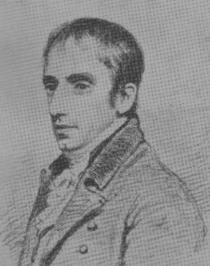
"The cautious good sense of the bulk of Englishmen, their love of order and law, their distaste for violent changes and for abstract theories, as well as their reverence for the past, were rousing throughout the country a dislike of the revolutionary changes which were hurrying on across the channel; and both the political sense and the political prejudice of the nation were being fired by the warnings of Edmund Burke. ... [Burke hated] a revolution founded on scorn of the past, and threatening with ruin the whole social fabric which the past had reared; the ordered structure of classes and ranks crumbling before a doctrine of social of social equality; a state rudely demolished and reconstituted; a church and a nobility swept away in a night."16
There were, of course, people in England, while regretting the blood and destruction of the French Revolution, nonetheless supported the principles for which it stood. These principles were best summed up in Rousseau's expression: "Man is born free; and everywhere he is in chains!" And, the Rousseauish cry: "Liberty, Equality, Fraternity." Most all of the young intelligentsia of the age (for that matter of any age) were for change; after all, was not the existing state, unfair; where is the justice in the existing system; things need be set right. These notions were meat and drink to all of the young poets of the age, including William Wordsworth.
In England, in 1793, a political book, like no other, before or since, was to come off the presses. It was Enquiry Concerning the Principles of Political Justice, or, more simply, Political Justice by William Godwin. It burst upon the scene as a major piece of sedition.17 It was an attack on aristocracy, property, religion, and even the sacrament of marriage. In 1793, the trials of the "Reform-martyrs," one of whom was Thomas Muir (1765-99) were to unfold. The lot of them were convicted and transported to Botany Bay. In 1794, there was to be the "Trial of the 12 Reformers": Thomas Holcroft, Horne Tooke, Thomas Hardy, John Thelwall and others were brought to trial on the charge of high treason, and, acquitted amid much excitement. These trials were part of the larger government effort to prosecute editors, nonconformists and radicals who were arguing for Parliamentary reform. England, however, was at war; and reform, indeed, even the liberties of the people18 were to take second place to the grand effort of making England victorious. And, victorious she was to be, due mainly to her superiority upon the oceans of the world.
[TOP]
[TOC]
A Literary Collaboration -- Wordsworth and Coleridge:-
As the year 1794 passed, Wordsworth was to be with his family, and, I should think with his mother's family, the Cooksons at Penrith. (See map.) It was at Penrith, as the year closed, that he came to find himself nursing a dying friend who had been at Cambridge with him, Raisley Calvert. In January, 1795, Calvert died and left an inheritance to Wordsworth, an inheritance which enabled Wordsworth to set out on his life's career which otherwise would not have been possible.19 He determined, too, at this point, that in life's journey his sister Dorothy was to be his fellow traveler.
It was during the years, 1794-5, that a very close relationship was to spring up between William Wordsworth and his sister, a relationship unique in the literary world, one that continued until Wordsworth's death, in 1850. For many long hours, at this point, in 1794, William (then 24) and Dorothy (then 22) were to discuss what it was that William was to do with his life. What was clear to Wordsworth was that, "All professions are attended with great inconveniences."20 With the Calvert legacy Wordsworth was able to put off his decision as to what he should do to make a living. The decision that William and Dorothy made, now that they could afford to do so, was to live together in a secluded country cottage. As it happened, a friend offered them just such a place, Racedown Lodge, near the Dorset coast. In September of 1795 the Wordsworths took up their residence at Racedown. There William Wordsworth turned to what was to be his life long activity: the writing of poetry.
One of the most famous literary collaborations, ever, was that of Wordsworth and Samuel Taylor Coleridge. When these two first met is a question21 which likely cannot be answered; by 1797, we are able to see that Coleridge was paying a visit to the Wordsworths at Racedown. Upon meeting Coleridge, the Wordsworths were electrified. We are not to be surprised by this, as Coleridge charmed everyone, at least at first. Henry Crabb Robinson was to write in his diary, "On politics, metaphysics and poetry, more especially on the Regency, Kant, and Shakespeare he was astonishingly eloquent." Concerning this first meeting, Dorothy was to get a letter off to her friend Mary Hutchinson. The first thing, as Dorothy was to explain was William's reading of his new poem The Ruined Cottage, with which Coleridge was much delighted, and, "after tea he [Coleridge] repeated to us two acts and a half of his tragedy Osorio. The next morning William read his tragedy The Borderers."22
The Wordsworths were enthralled with Coleridge; and so he with them. There were, during the spring of 1797, two or three visits back and forth.23 Coleridge was then living at Nether Stowey, a Somerset village, under the patronage of the local tanner and literary enthusiast, Tom Poole (1765-1837). Coleridge returned from one his trips to the Wordsworths on June 28th. There, at Nether Stowey, he was to tell his friends, with much enthusiasm, about the Wordsworths; such, that he returned travelling the fifty mile distance to Racedown and reappeared back to Nether Stowey on July 2nd with the Wordsworths in tow. Now, as it happened, Charles Lamb was to come up from London to pay his old school chum, Coleridge a visit. So, within days of the Wordsworths' arrival at Nether Stowey in came Charles Lamb and his sister. Thus there was to be quite a crowd in the little cottage occupied by the Coleridge family (Coleridge, Sara and their one year old Hartly), the Wordsworths, Charles Lamb and his sister. They were all somehow fitted in to the small Coleridge cottage at Nether Stowey. There was to be some relief when the Lambs returned to London, as they had intended to do. The Wordsworths seemed to have little reason to return to Racedown and were quite happy to continue on at Nether Stowey. What the Wordsworths wanted were new accommodations, somewhere near the Coleridges at Nether Stowey. Through the good offices of Tom Poole24, benefactor and friend to this growing clutch of literary luminaries, a large home was to be rented. It was located nearby at Holford Glen, a Queen Anne mansion which was known as Alfoxden. The Wordsworths, who likely still had a sizable portion of the Calvert legacy left, signed a one year lease for the sum of £23 and during July of 1797, the Wordsworths moved to Alfoxden: As Dorothy Wordsworth was to describe, "a large mansion with furniture enough for a dozen families like ours."
[TOP]
[TOC]
The Alfoxden Days:-
With the new year, 1798, the English were feeling glum. Napoleon had successfully invaded Italy, and Spain had joined sides with France. The Austrians, who had stood up to France, retired from the field. France was left without an enemy on the continent, and England without an ally. England, fearing an invasion, withdrew her ships from the Mediterranean, which was thus to become a "French Lake" from January 1797 to May 1798. These were dark times, and the average Englishmen could see French spies everywhere. The regular sort of person that lived around or at Nether Stowey were sure that they had some in their midst. It was that strange group at Alfoxden as headed up by the newcomers: they had to be spies! Soon there was to be a surreptitious, but close watch on the Wordsworths and those who came to visit. The mansion, apparently came with a few servants; one of them was a female by the name of Mogg who was very suspicious of the new tenants. They talked differently, and to Mogg, this Somerset servant, unfamiliar as she apparently was with the manner and speech of those from the north of England, concluded these tenants must be from France. And they certainly behaved like Papists; why, they cleaned their clothes on Sunday; and, they had the morals of the Continentals, viz., "the master of the house had no wife with him, but only a woman that he tried to pass off as his sister." The Wordsworths and their friends also had this habit of going about in the countryside with their friends, making observations and writing in notepads which each had ready at hand.25 Something very sinister was going on here, as, Mogg dutifully reported.26 Word was to get back to the authorities in London about this bunch at Alfoxden and the report was not taken lightly, as there was sent out from London a government agent by the name of Walsh, who, during these times was to keep a watch on these strange people, viz., Wordsworth, Coleridge and friends who were gathered there together at Nether Stowey.27 All of this did not much bother these Rousseauan romantics28; the "Alfoxden Circle" "passed the wonderful summer of 1797, with almost ceaseless laughter and high spirits, constant visits, talk and sociability, love and warm happiness, excitement and buoyancy."29
The "Alfoxden Circle" was to lose one of its more illustrious members for a time, as Coleridge, desperate for money to support himself and his family had determined to take up a position as a Unitarian minister. A position opened up for him at Shrewsbury, so, there he went to take up his ministry. Coleridge, however, was not to spend much time at Shrewsbury, as, not too long after he left Nether Stowey, a gift of money was to be made to him. The Wedgwoods, in their continuing effort to support the arts, gave a life annuity to Coleridge of £150 per year with no conditions. Such a gift however was not to keep Coleridge at Nether Stowey, as he longed to travel to Germany for further studies. Doubtlessly these plans were discussed with the Wordsworths and a determination was made; all three would travel together to Germany, once the one year lease30 of Alfoxden was up, viz., the end of June, 1798. It was during this time, it hardly needs to be mentioned, that the two poets collaborated on their work, Lyrical Ballads, the manifesto of English Romanticism.
Before leaving for Germany, Wordsworth and Coleridge saw to the final arrangements in respect to the publication of Lyrical Ballads. These arrangements required, for the most part, their attendance at Bristol where a Bristol bookseller, Joseph Cottle (1770-1853) was putting the book through the presses. (They did, during that summer, make a trip to Wales at which time Wordsworth wrote one of his most popular poems, "Tintern Abbey," written on July 13th, 1798.) By late August the party headed for London there to make their final preparations for their trip to Germany. On September 16th, Dorothy and William, together with Coleridge and a friend of theirs, John Chester, set sail for Germany from Yarmouth arriving at Hamburg on the 19th.31
[TOP]
[TOC]
Dove Cottage (1799-1808):-
Within 10 days of their arrival at Germany the Wordsworths decided to separate from their companions. We know more about Coleridge's stay in Germany (he stayed until July, 1799); but, as for the Wordsworths, we know little of their travels in Germany. As mentioned they had arrived in September, 1798, and it would appear they were quite prepared to leave before the year was out, but a severe winter on the continent encumbered travelers. The Wordsworths were to spend a number of weeks at Goslar. There, at Goslar, few "books were accessible, and the result was a period of great activity in composition."32 Upon the winter breaking up the Wordsworths were on the move again and were to eventually find their way to the coast and then back to England, arriving there, it is thought, in April of 1799.33
It is well, now, to consider events on the continent. Napoleon had managed to slip back from Egypt (autumn of 1799). France was then to make him First Consul (dictator) and the little general re-energized her. Italy was then taken which led to the "Second Coalition" (England, Austria, and Russia) to break up; with this, England was once again left, alone, to deal with France. Indeed, for a few months during the winter of 1800-01, there was formed a league against England; the league consisted of Prussia, Sweden, Denmark and Russia. This "was caused partly by the whim of the Czar Paul [and] partly by two feelings then prevalent in the Courts of Europe, fear of France and jealousy of English naval power."34 With Nelson's capture of the Danish fleet at Copenhagen in April, 1801, this league against England shortly came to an end.
Once in England, in April of 1799, William and Dorothy, having apparently no particular plan in mind, headed north to Stockton-on-Tees, six miles from Darlington to a farm run by Tom Hutchinson, Mary's brother; Mary was staying there. That October, at William's invitation, Coleridge was to arrive at the Hutchinson farm. Plans were soon laid for a trip west, to the Lake District, to the countryside known by Wordsworth in his youth. "From Temple Sowerby they made their way to Bampton, from Bampton along Hawes Water to Windermere and Hawkshead."35 From Hawkshead, Wordsworth and Coleridge wondered to Rydal and then to Grasmere. (See map.) At Grasmere they discovered, on the coaching road descending from Ambleside into Grasmere, a cottage for rent, formally an inn, "The Dove and Olive Bough." Wordsworth, then and there, made the determination that should be his new home.36 Having left Coleridge earlier in his travels, Wordsworth returned to the Stockton farm to tell Dorothy of his find.37 Travelling mostly by foot in December, Dorothy and William made their way to Grasmere, arriving there on the 20th. They then moved into Dove Cottage; a place that was to be their home for better than eight years.
Catherine Macdonald Maclean of University College, Cardiff, in her book on Dorthy Wordsworth, takes up the subject of Dove Cottage, Professor Maclean:

"The cottage, which was only a few feet off the road, stood above the lake. Behind it were the towering masses of Nab Scar. The orchard itself was but a slip of the mountain, enclosed and cultivated. It sloped upwards from the house so that from the top of it they could look right over the roof and see the lake. They had a view of the church and Helm Crag and more than two-thirds of the vale. Dorothy instantly built in her imagination a seat and a summer hut in this lofty and gracious place. She clothed the front of the cottage with honey-suckle and roses.38 ...
Dorothy found that much had to be done before the cottage would be comfortable. One of the rooms upstairs smoked like a furnace; some of the doors had to be mended; most of the rooms needed painting and papering; there was endless sewing to be done. ...
Soon the cottage was made neat and comfortable within-doors. To Dorothy it seemed to have only two serious disadvantages. It was very near the road, and it was so built that sounds passed very distinctly from one part of the house to another."39
A more contemporary description of Dove Cottage is that which was given by de Quincey in his reminiscences. He was to first view it when he met the Wordsworths in August of 1807. De Quincey, incidently, was to become intimately acquainted with Dove Cottage, as, after the Wordsworths left it in 1808, it was to become his home for a period of time.
"A little semi-vestibule between the two doors prefaced the entrance into what might be considered the principal room of the cottage. It was an oblong square, not above eight and a half feet high, sixteen feet long, and twelve broad; very prettily wainscoted from the floor to the ceiling with dark polished oak, slightly embellished with carving. One window there was -- a perfect and unpretending cottage window, with little diamond panes, embowered at almost every season of the year with roses; and, in the summer and autumn, with a profusion of jasmine and other fragrant shrubs. From the exuberant luxuriance of the vegetation around it, and from the dark hue of the wainscoting, this window, though tolerably large, did not furnish a very powerful light to one who entered from the open air."40
De Quincey was to also give us a glimpse into Wordsworth's diminutive studio as was located upstairs in Dove Cottage. "I was ushered up a little flight of stairs, fourteen in all, to a little drawing-room, or whatever the reader chooses to call it." In it, like most living rooms of the day, there was to be found a fireplace. This upstairs room, itself, "was not fully seven feet six inches, and, in other respects, pretty nearly of the same dimensions as the rustic hall below. There was, however, in a small recess, a library of perhaps three hundred volumes, which seemed to consecrate the room as the poet's study and composing room; and such occasionally it was."41
The taking up of his residence at Dove Cottage heralded a new stage in Wordsworth's poetry writing. It was to be during these days at Dove Cottage that Wordsworth was to write some of his most charming poems of flowers, birds, and butterflies. On April 6th, 1800, Coleridge arrived at Dove Cottage. He had come back from Germany arriving some months after the Wordsworths (July, 1799). By this time Coleridge's family problems were becoming more serious; and, it seems, when the heat was on, one of the places to which Coleridge would run, was, of course, the Wordsworth's; who, always welcomed him and were to make little or no reference to his problems, the principle one being, of course, Coleridge's long standing opium habit. The main reason Coleridge was to spend some time with the Wordsworths, that spring of 1800, was to assist Wordsworth in the putting together of the 2nd edition of Lyrical Ballads.42 So, too, at Dove Cottage, there was to be found William's brother, John, who was then there for a visit. So, too, Mary Hutchinson was there for a period of time.43 By May 4th, Coleridge left the Lake District in order to see the publishers at Bristol. After Bristol, Coleridge went back to his family, still, I believe at Nether Stowey. Things were patched up sufficiently, such that, on June 29th, Coleridge arrived in the Lake District with his family -- Sara (seven months pregnant with Derwent) and four year old Hartley. On July 23rd, the Coleridges were to take up residence at Greta Hall, Keswick, locate some thirteen miles or so from Grasmere. (See map.)
[TOP]
[TOC]
Wordsworth's Feminine Devotees -- Dorothy And Mary:-
Dorothy was 21 months younger than William. She was to lose her mother at age six, her father at eleven. She was separated from her brothers and sent to live with her mother's relatives. Many women of the age, of the ages, share the desires and impulses of the male head of their household. The effect of leaving the business of raising a young impressionable girl by a maiden aunt, Elizabeth Threlkald, is a question we must leave for the psychologists to answer, supposing that they would have enough information to go on. With no father and having been separated from her brothers since the age of six, at the age of fifteen, now a young woman, Dorothy was reintroduced to her brother, William: she fell in love with him, it was to be a deep and an abiding love which was to last a lifetime.44 William, as we have seen, was off to university (Cambridge) in 1787; and, beginning in 1790, was traveling around quite a lot, including being in France for a year in 1792. After wondering around England, in particular through Wales, it will be recalled that William returned, in 1794, to the lands he knew as a boy. It is at this point that we may see the beginnings of the close and lifelong relationship as did exist between William and Dorothy. In September of 1795, they determined to live with one another, moving into their first little cottage at Racedown, Dorset. They continued to live together until William's death in 1850. The Wordsworth relationship, became a threesome, when, in 1802, William married Mary Hutchinson.
William likely first met Mary when she was but young, at dame school, at Penrith.45 It seems, however, that the childhood friendship was more between Dorothy and Mary, a friendship that was to continue throughout their lives. As has been seen, during their adulthood, Mary and Dorothy were to pay regular visits with one another; and, because of the distances and the difficulty of travelling in those days, these visits would last for weeks on end. When Dorothy and William took up living with one another, these long visits continued, with Mary spending considerable periods of time with both William and Dorothy, beginning in 1795, at Racedown and then, after that, at Dove Cottage at Grasmere. In 1802 -- likely inspired by the delightful Coleridge children that now lived nearby -- William and Mary married. Thereafter, brother/husband, sister and wife lived together, first at Dove Cottage and then at Allan Bank (1808) and then, for the balance of their years at Rydal Mount (1813): this arrangement worked wonderfully for all three of them.
Earlier we set forth de Quincey's description of Dove Cottage. Just after giving such a description, he was to move along to then describe how he was to meet two ladies in the cottage. One, "a tallish young woman, with the most winning expression of benignity upon her features ... so frank in air" and, as de Quincey was to observe, "the native goodness of her manner." De Quincey is here describing Wordsworth's wife, Mary. She was "neither handsome nor even comely ... nay, generally ... very plain --
... compensatory charms of sweetness all but angelic, of simplicity the most entire, womanly self-respect and purity of heart speaking through all her looks, acts, and movements. Words I was going to have added; but her words were few. ... In complexion she was fair, and there was something peculiarly pleasing even in this accident of the skin, for it was accompanied by an animated expression of health, a blessing which, in fact, she possessed uninterruptedly."46
Coleridge adored Mary, his "beautiful green willow." Keats described her as Wordsworth's beautiful wife. De Quincey concluded his remarks by describing Mary Wordsworth as having, "a sunny benignity -- a radiant graciousness -- such as in this world I never saw surpassed" -- such glowing praise. Wordsworth's biographer, Burra, writes: "[Mary] ... served him and protected him, urged him to his poetry, and attended its labour through nearly fifty years of their lives. Writing his letters, copying his poems, nursing Dorothy, keeping the house, she served him with absolute devotion yet lost nothing of her own character, and gave him equally the wit and the criticism which was almost as useful as her love."47
As for Dorothy: well, de Quincey sung her praises, too. Dorothy, in the physical comparison, was “shorter, slighter.” Unlike most English women, she was of dark complexion, her “face was of Egyptian brown.” There was something about her eyes. There was for de Quincey something in them, wild and startling, and hurried in their motion. As for Dorothy’s personal characteristics, well, they were quite different from that which de Quincey observed in Mary.
"Her manner was warm and even ardent; her sensibility seemed constitutionally deep; and some subtle fire of impassioned intellect apparently burned within her, which, being alternately pushed forward into a conspicuous expression by the irrepressible instincts of her temperament, and then immediately checked, in obedience to the decorum of her sex and age, and her maidenly condition, gave to her whole demeanour, and to her conversation, an air of embarrassment, and even of self-conflict, that was almost distressing to witness."48
Coleridge was to write of Dorothy just shortly after he met her in 1797, in the following terms:
"She is a woman indeed! -- in mind, I mean, and heart -- for her person is such, that if you expected to see a pretty woman you would think her ordinary -- if you expected to find an ordinary woman you would think her pretty! -- But her manners are simple, ardent, impressive ... and her taste a perfect electrometer -- it bends, it protrudes, and draws in at subtlest beauties and most recondite faults."49
During the summer of 1810, Henry Crabb Robinson, on a visit back to his home town, Bury, was to meet Dorothy Wordsworth, who at the time was staying with the Clarksons. This meeting led to an invitation to Rydal Mount which Robinson took up visiting the Wordsworths in November of that year. Of Dorothy Wordsworth, Robinson was to write: "Miss W. without her brother's genius or productive power, had all his tastes and feelings, and he was in his youth and in middle age as warmly attached to her as late in life he became attached to his daughter, no one rivalling them in his affections except his admirable wife."50
With the signing of the Treaty of Amiens on May 25th, 1802, the hostilities between France and England were brought to an end, albeit, only temporarily.51 The Wordsworths were to take advantage of this lull so to make their way to France and to visit Annette and Caroline. Leaving Grasmere on July 9th they were to stop by for a visit with Coleridge (Greta Hall) and the Hutchinsons (Gallow Hill). William and Dorothy were to stay in France for a month.52 The purpose of the trip, plainly, was to get Annette's blessing on an intended marriage.53 The Wordsworths arrived back at London on August 30th. On October 4th, 1802, William Wordsworth married Mary Hutchinson, at Brompton. By October the 6th the three Wordsworths were settled in at Dove Cottage: William, Mary and Dorothy. Coleridge was to observe of Wordsworth, it seems somewhat enviously: "living wholly among Devotees -- having every minutest Thing, almost his very Eating & Drinking, done for him by his sister, or Wife."54 The following year, on June 18th, Wordsworth's first child, a son, John is born.
[TOP]
[TOC]
A Growing Family & Sorrow:-
Thus we see William Wordsworth in a happy state; he has income and leisure; and two women, Devotees who attend to his minutest requirements. This state was to generally continue for the rest of his days, days which were broken up into two principal activities: the one, wondering the pathways overseen by the imposing hills of his beloved Lake Country; and the other, in composing poetry about that which he sees around him.
The Wordsworth household, consisting of brother, sister and wife was soon to grow.55 On June 18th, 1803, the first child came along, John. Richard (William's older brother) and Dorothy were to stand together as godparents at the little church nearby in what was rather an insular ceremony. Before the summer was out, on August 14th, leaving mother and child at home, Dorothy and William, were off for a tour of Scotland.56 Their bosom friend, Coleridge, was to join them. All went well for a couple of weeks, when Coleridge left his companions and returned on foot by himself to his home (Greta Hall) arriving there on September 15th. It seems that it was during this trip that Wordsworth was to finally let go at Coleridge for his opium habit.57 The Wordsworths knew of Coleridge's weakness for drugs, but they said nothing; I guess they might have thought that Coleridge's wife, Sarah said enough for all. But for some reason, Wordsworth, on the first part of their Scottish trip, lost his patience with Coleridge. It was the first real rent in the Coleridge/Wordsworth friendship; it was downhill thereafter; by 1812 this rupture was to become "profound and complete."
Coleridge's problem was known to family and close friends. Coleridge excused himself, saying simply that he was not well and needed the opium for pain relief. His wife was beside herself, and, was at this point making appeals to her brother-in-law, Southey. (Coleridge and Southey had married two of five beautiful sisters, the Fricker sisters. Coleridge married Sara (1770-1845) and Southey married Edith (1774-1837).) In any event, on September 7th, 1803, the Southeys moved into Greta Hall. Robert Southey, thereafter, was to be the principal support of Sara Coleridge and her children. But these events I take up in greater detail when I come to my biographical sketch of Coleridge.
On February 6th, 1804, Wordsworth's younger brother, John, age 33, a captain of an India Merchant Ship, Earl of Abergavenny, who had spent a considerable amount of time with William and Dorothy, especially in 1800, much loved, lost his life when his ship was wrecked off the south coast of England, Weymouth. All on board were lost. John was to be described as "a poet in everything but words." He was "the adored friend of everyone who knew him."58
Though the sad news of John's death shocked them all, the normal state of happiness of the Wordsworth household was to soon return. On August 16th, 1804, the very year they were to lose John, Wordsworth's second child, Dora was born. Dora was followed, on June 16th, 1806, by Thomas, the third child born to the Wordsworths, so to join three year old John and two year old Dora. Notwithstanding that parts of the household, at times, were noisy, William continued on with what was his occupation, the writing of poetry. His inventory of poems had built up considerably, such that, in May of 1807, Wordsworth's poems are published in two volumes. Things were looking much better, and, needing more room for their growing family, in June of 1808, the Wordsworths moved into their new home, Allan Bank, Grasmere.59 Another reason that they took a larger place is that it was expected that Coleridge would come to live with them; which, apparently, he did. During the weekends, Allan Bank was to become a very busy abode, indeed. At times there was as many as seven children (three visiting Coleridges and four Wordsworths). Sara Hutchinson, who was now, it would appear part of the Wordsworth household (Mrs. Wordsworth's sister, a lady whom Coleridge was much interested in), was to remark that when Coleridge played with the children, S.T.C. made "enough racket for twenty."60 By June 1810, however, Coleridge, fond of his comforts left Allen Bank (the Wordsworth residence, apparently, was usually in a bit of a rough state; though it never seem to bother them). Coleridge's principal interest, however, it seems plain, while at the Wordsworths, was that he was to be in the good company of Sara Hutchinson. Sara, for her own reasons (I suggest that it was simply because she just could not take Coleridge anymore) had left Allan Bank to return, I think, to her brother's farm in Yorkshire. Coleridge was thus to move back in with his wife at Greta Hall; it was a cohabitation which was to last only about five months. Coleridge took advantage of an offer coming from friends of his, the Montagus -- who were just then visiting -- to return to London in their carriage and reside with them. Though we will never know exactly what transpired, Coleridge in his conversations on the long ride to London with Montagu determined that Wordsworth had been bad-mouthing him (Coleridge) behind his back. Thus, the breach in the Coleridge/Wordsworth relationship that can be traced back to 1803 when they had travelled to Scotland together, in 1810, opened up, such that their relationship was never thereafter to be the same. Over the next two years, the quarrel between the two poets became a cause célèbre.61
The year 1812 was to prove to be another sad year for the Wordsworths. First off they came to hear that Coleridge actually was back in the Lake District, for what was to be a rare visit with his family. Greta Hall was but thirteen miles from Allan Bank. Surely, Coleridge would come down to pay them a visit and renew their relationship. The Wordsworths waited expectantly at Grasmere; but Coleridge did not show. The sorrow to the Wordsworths that the relationship that they had with Coleridge had come to an end, was, however, totally eclipsed, when two of the Wordsworth children, that year, in 1812, were to die: four year old Catherine62 on June 4th, and six year old Thomas on December 1st. There were then left, at this point, to recount, three children: nine year old John, eight year old Dora, and two year old William.

In March of 1813, Wordsworth, through the influence of the powerful Lowther family receives an appointment as the Collector of Stamps for Westmorland; with it came £400 per year.63 This additional money allowed the Wordsworths to make a move that they had contemplated since they first took up residence at Allan Bank five years earlier. They had continually complained about the smoking chimneys at Allan Bank to its landlord but nothing apparently was done about the problem. The very month that Wordsworth received his appointment as the Collector of Stamps, the family moved to Rydal Mount64. It was "two miles away on the Ambleside road, [and] which he rented from the widowed Lady Fleming. The house had superb views, was surrounded by a magnificent wild garden of the kind Dorothy loved, and was a "gentleman's house." It remained Wordsworth's home until his death 38 years later in 1850."65
Throughout these years, Wordsworth continued to write poetry. Indeed, in March of 1815, Wordsworth's "first collected Edition of his works" was to appear. The Wordsworth home was always open to friends and admirers. Thomas de Quincey, would have been a regular visitor66, for, as of 1809, he was a resident of Grasmere, indeed he was to move into "Dove Cottage."67 With his growing popularity, visitors would regularly come up from London. Charles Lamb together with his sister, would come up on holidays. So, too, would Crabb Robinson (Robinson and Wordsworth were to become the best of friends). Other luminaries of the age arrived at Rydal Mount, including Walter Scott and William Godwin. One memorable visit made by Godwin, was that made during April 27th & 28th, 1816. While there at Rydal Mount, Wordsworth and Godwin were to have "a fearful quarrel about Waterloo." Godwin, like his followers (Hazlitt, Byron and Shelley), saw it as a catastrophe for progress: whereas Wordsworth and Southey saw it as the putting down of the monstrous ambitions of one man and his deluded supporters) -- Godwin quit Wordsworth, as Robinson was to report, "with very bitter and hostile feelings."68
As we have seen Wordsworth began his continental travels early. Leaving university behind, but twenty years of age, he made a tour of the continent with his friend Robert Jones. Wordsworth loved to travel and did so throughout the whole of his life. He made a number of trips to Scotland, there to visit Scott. He traveled to the continent during the years: 1820, 1823, and 1828. His trip of 1820 was to run on for three or four months (July-November). On this trip he had with him: Dorothy, Mary, Mr. and Mrs Monkhouse, and Crabb Robinson. When in Paris Wordsworth paid a visit to Annette and Caroline (by then married). His 1828 trip, Wordsworth was to tour the Rhine with Dora (then 24 years of age) and, interestingly, with Coleridge. During 1837, Wordsworth was to make his last continental tour. He was then to travel, again, with his friend, Crabb Robinson. In Italy they paid a visit to the graves of Keats who died at age 26, and Shelley who died at age 30. Keats and Shelley were very much alive to the social and political questions of the time, and, dying young, were to do so with Rousseauian beliefs yet in their hearts. Like Wordsworth and Coleridge, in their time, Keats and Shelley made imagination the supreme gift so that "what the Imagination seizes as beauty must be truth." There, stood Wordsworth and Robinson, in an Italian grave yard, Wordsworth 67 years of age, Robinson, 62. While Keats and Shelley died with romantic hopes; Wordsworth and Robinson, growing old had gradually traded their romantic beliefs for the practical realities of the world. A retrospective story of the romantic poets of the early 19th century might be told with this grave side scene. But I must break away from this sad reverie and write a few words about the relationship of these two men: Wordsworth and Robinson.
[TOP]
[TOC]
Wordsworth's Relationship With Crabb Robinson:-
Henry Crabb Robinson's biographer, Edith Morley:
"Crabb Robinson became a familiar friend of the whole Wordsworth household, a constant visitor to Rydal, and an intimate with all who frequented the Mount. He travelled with Wordsworth on various occasions - in Wales, in Scotland, in Switzerland, Germany, and Italy. The friends met in Herefordshire at the home of Miss Fenwick's relatives, and in London, where they visited in the same houses. They heard frequently from each other by letter when they were separated, and their respect and love for each other increased year by year."69
Morley continues and points out that Wordsworth owes, in no small measure, his fame to the tireless promotional activities of Crabb Robinson. The fact of the matter is that Wordsworth's poems in the early days were not read at all. "At home and abroad, in writing and in conversation, by gifts of the poems, by quotation and by exposition, Robinson did what could be done by heart-felt praise to make converts to the poetry he was among the first to estimate justly." Robinson's message to all who would listen was the same: Wordsworth was "the greatest man now living in this country." Robinson's admiration was not, however, uncritical. "He saw the weaknesses of Wordsworth's work just as he saw faults and his narrowness as a man."70 The two men were "fundamentally opposed in their religious outlook and in their political views," subjects which both men took very seriously. Wordsworth was an orthodox member of the Church of England, "who could not tolerate talk of church reform"; Robinson was a Unitarian.71 Robinson was part of emerging liberal movement, a Whig; Wordsworth, while very much a revolutionary in his younger days came around to be very much the Tory and supported the aristocratic establishment: to Wordsworth: "Rash experiments in such serious matters as government, education and religion were the most dangerous modes of proceeding that could possibly be adopted."72
Edith Morley was to make a most interesting comparison: Robinson to Wordsworth:
"Wordsworth instinctively revolted against the unknown; Robinson was attracted to it. The subject of 'animal magnetism,' or 'mesmerism' as it is now called, is a case in point. Of an entirely different order was the poet's typically insular attitude to foreigners, their habits, and their strange tongues. Crabb Robinson suffered on more than one occasion, when they were fellow-travellers, from Wordsworth's bad manners and British insolence when he was abroad. Thus he provoked rudeness from a waiter or a guide, or incurred retaliation from a landlord, who made him pay for his unreasonableness when the bill was presented. On the other hand, Wordsworth intensely disliked Robinson's habit of entering into conversation with strangers, in a foreign language, at table d'hôte or in the diligence. The poet liked getting up and going to bed early, and he was not particularly fond of town sight-seeing. As he grew older, Crabb Robinson hated Wordsworth's country hours, and he could not bear to leave unseen any sort of curiosity - old buildings, pictures, sculpture, attracted him as much as the beauties of nature, which were his companion's preponderating interest. The long Italian journey became towards the close somewhat of a trial to both men, and though Crabb Robinson never suffered anything comparable with Wordsworth's moodiness, yet there were occasions when even he was hard put to it to maintain his normal equilibrium and cheerful spirits. Not too much should be made of passing breezes: that neither man was unduly ruffled is sufficiently proved by the fact that, after a very short interval at home, they set out again together for another tour of England. There is, besides, the warm and obviously heartfelt praise of Crabb Robinson in Wordsworth's dedication to him of the Italian poems, to show that disagreement was not serious. That it existed is added testimony to the mutual love and respect which rendered the friendship genuine, and unspoilt by anything approaching insincere adulation or toadying on the part of Crabb Robinson.73
[TOP]
[TOC]
The Contemporary Critics:-

Leigh Hunt was a member of the "seditious press," and, for his ferocious attack on the Prince Regent, was to spend time in an English prison. In one of Hunt's articles74, he held up Wordsworth to ridicule; not so much for his poetical judgments, but for his political ones. "Mr Southey," he had said, "and even Mr Wordsworth, have both accepted offices under government, of such a nature as absolutely ties up their independence. ... and yet they shall all tell you that they have not diminished their free spirit a jot. In like manner they are as violent and intolerant against their old opinions, as ever they were against their new ones, and without seeing how far the argument carries, shall insist that no man can possess a decent head or respectable heart who does not agree with them. ... The persons of whom we have been speaking have been always in extremes, and perhaps the good they are destined to perform in their generation, is to afford a striking lesson of the inconsistencies naturally produced by so being. Nothing remains the same but their vanity."75
In his autobiography, written in 1859, Hunt was to come again to the subject of Wordsworth:
"[Wordsworth] ... had a dignified manner, with a deep and roughish but not unpleasing voice, and exalted mode of speaking. He had the habit of keeping the left hand in the bosom of his waistcoat; and in this attitude, except when he turned round to take one of the subjects of his criticism from the shelves (for his contemporaries were there also) he sat dealing forth his eloquent but hardly catholic judgments."76
William Hazlitt wrote:
"Mr Wordsworth, in his person, is above the middle size, with marked features, and an air some what stately and Quixotic. ... He has a peculiar sweetness in his smile, and great depth and manliness and rugged harmony in the tones of his voice. His manner of reading his own poetry is particularly imposing; and in his favourite passages his eye beams with preternatural lustre, and the meaning labours slowly up from his swelling breast. ... In company, even in a tête-à-tête, Mr. Wordsworth is often silent, indolent, and reserved. If he is become verbose and oracular of late years, he was not so in his better days. He threw out a bold or an indifferent remark without either effort or pretension, and relapsed into musing again."77