![]()
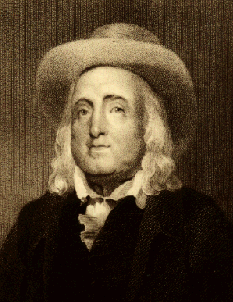
Jeremy Bentham (1748-1832)
|
|
| ||||||
|
The story is1 that Jeremy Bentham was obliged to seek a date to meet with the Master in Chancery. Presumably Bentham got what he was looking for, or not (likely not); but, and the point is, that Bentham came away from one of his first court appearances with the view that it took three times the trouble and three times the money that it should: the law in Bentham's view was in dire need of revision and he set out, in his life's work, to reform it.2
During 1776, Bentham brought out his first major work, A Fragment on Government.3 It was about this time, too, that Bentham was to become a friend with a powerful lord, Lord Shelburne (1737-1805). Apparently, through the auspices of Lord Shelburne, Bentham was able to take time, to travel and to write.
A number of years were to pass before Jeremy Bentham came to the attention of the juridic thinkers of the time (it was to be 1808 before Bentham was to meet James Mill). Bentham was thought to be more European in his views than English, but in time "a knot of able thinkers gathered round him."4 These included James Mill (the father of John Stuart Mill) and David Ricardo. The 'Benthamites' were to gradually gain ascendancy in political matters. Bentham, himself, in time, was to go on and be the founder of University College, at London.5
"He [Bentham] has lived for the last forty years in a house in Westminster, overlooking the Park, like an anchoret in his cell, reducing law to a system, and the mind of a machine. ... His eye is quick and lively; but it glances not from object to object, but from thought to thought. He is evidently a man occupied with some train of fine and inward association. He regards the people about him no more than the flies of summer. He meditates the coming age. He hears and sees only what suits his purpose, or some 'foregone conclusion'; and looks out for facts and passing occurrences in order to put them into his logical machinery and grind them into the dust and powder of some subtle theory, as the miller looks out for grist to his mill!" (William Hazlitt.)6
Hazlitt was to describe Jeremy Bentham as a person who had "an unconscious neglect of his own person," "good-humoured, placid intelligence," one who "is a beneficent spirit, prying into the universe, ... a thoughtful spectator of the scenes of life, or ruminator on the fate of mankind ..."
"Mr. Bentham relieves his mind sometimes, after the fatigue of study, by playing on a fine old organ, and has a relish for Hogarth's prints. He turns wooden utensils in a lathe for exercise, and fancies he can turn men in the same manner."7
[TOP]
[TOC]
Bentham's Philosophy:-
Jeremy Bentham figured that laws should be socially useful and not merely reflect the status quo; and, that while he believed that men inevitably pursue pleasure and avoid pain, Bentham thought it to be a "sacred truth" that "the greatest happiness of the greatest number is the foundation of morals and legislation." Bentham supposed that the whole of morality could be derived from "enlightened self-interest," and that a person who always acted with a view to his own maximum satisfaction in the long run would always act rightly.
Bentham is to be compared to William Godwin: they resembled one another in their "blind contempt for the past." While each preached the need for nonviolent revolution, each had a different following. Bentham's revolution was to be effected by legislation, Godwin's by argument.
Jeremy Bentham was critical of the approach taken by Blackstone in his Commentaries (1765-9). Commentaries was written by Blackstone (university teacher; lawyer; and, in time, a judge); he meant it to be a concise and clear statement of the common law, ordered and elucidated, to be used by the busy practitioner. Bentham thought it deficient, as it did not consider the social impact of the law (however, I should say here, that it was not Blackstone's purpose to make any statement about the consequences of the law, one way or the other; Blackstone was not a law reformer.)
It was in his book,8 Introduction to the Principles of Morals and Legislation
(1789), Bentham strove "to cut a new road through the wilds of jurisprudence." In it he was to develop the idea that the greatest happiness of the greatest number should govern our judgment of every institution and action.9 This simplified view, viz., we proceed with legislative action which will bring the greatest happiness to the greatest number, was, apparently, to be the only extent of Bentham's thought. Jeremy Bentham was not, according to William Hazlitt, an original thinker; he was, a compiler.
"But Mr. Bentham's forte is arrangement; and the form of truth, though not its essence, varies with time and circumstance. He has methodized, collated, and condensed all the materials prepared to his hand on the subject of which he treats, in a masterly and scientific manner; but we should find a difficulty in adducing from his different works (however elaborate or closely reasoned) any new element of thought, or even a few fact or illustration. His writing are, therefore, chiefly valuable as books of reference, as bringing down the account of intellectual inquiry to the present period, and disposing the results in a compendious, connected, and tangible shape; but books of reference are chiefly serviceable for facilitating the acquisition of knowledge, and are constantly liable to be superseded and to grow out of fashion with its progress, as the scaffolding is thrown down as soon as the building is completed.
"...
"There is a technicality of manner, which renders his writings of more value to the professional inquirer than to the general reader. Again, his style is unpopular, not to say unintelligible. He writes a language of his own that darkens knowledge. His works have been translated into French - they ought to be translated into English. People wonder that Mr. Bentham has not been prosecuted for the boldness and severity of some of his invectives. He might wrap up high treason in one of his inextricable periods, and it would never find its way into Westminster Hall. He is a kind of Manuscript author - he writes a cypher-hand, which the vulgar have no key to. The construction of his sentences is a curious frame-work with pegs and hooks to hang his thoughts upon, for his own use and guidance, but almost out of the reach of everybody else. It is a barbarous philosophical jargon, with all the repetitions, parentheses, formalities, uncouth nomenclature and verbiage of law-Latin; and what makes it worse, it is not mere verbiage, but has a great deal of acuteness and meaning in it, which you would be glad to pick out if you could."10
"... a very powerful influence in the political and legal sphere, but that as a thinker he was not very original, not even very profound, a trifle confused on ultimate philosophical issues and prone to over simplify complex problems ... pedantic and opinionated systematizer, overrated by his radical contemporaries ..."11Sydney Smith12, a contemporary, and who might be counted as one of Bentham's supporters, saw the difficulty with Bentham's methodology:
"Mr. Bentham is long; Mr. Bentham is occasionally involved and obscure; Mr. Bentham invents new and alarming expressions; Mr. Bentham loves division and subdivision - and he loves method itself, more than its consequences."13I might add that if any of the 'Benthamites' had any knowledge of the theory of evolution (Darwin was to came along later in the 19th century) they might have admitted that tradition had a role.
We have already referred to Hazlitt and Hazlitt's views on Bentham as a writer; what did Hazlitt think of Bentham's view of legislation and its place in the guidance of men's activity:
"The gentleman is himself a capital logician; and he has been led by this circumstance to consider man as a logical animal. We fear this view of the matter will hardly hold water. If we attend to the moral man, the constitution of his mind will scarcely be found to be built up of pure reason and a regard to consequences: if we consider the criminal man (with whom the legislator has chiefly to do), it will be found to be still less so."14
Hazlitt points out that criminals and legislators are quite a different species, and continues:
"Mr Bentham, in adjusting the provisions of a penal code, lays too little stress on the co-operation of the natural prejudices of mankind ... The laws of the country are therefore ineffectual and abortive, because they are made by the rich for the poor, by the wise for the ignorant, by the respectable and exalted in station for the very scum and refuse of the community."15
People value the good opinion of others and of their place in their family and in their society. It is for shame, not fear, that people obey laws. Hazlitt continues:
"You tell a person [a drunk, an idler, a gambler, a culprit, or a criminal] of this stamp what is his interest; he says he does not care about his interest, or the world and he differ on that particular. But there is one point on which he must agree with them, namely, what they think of his conduct, and that is the only hold you have of him. A man may be callous and indifferent to what happens to himself; but he is never indifferent to public opinion or proof against open scorn and infamy.
There have been many, through the years, that envisaged a perfect and well ordered society;17 Bentham was one, and he felt it might be achieved through legislation. Jeremy Bentham like many had an optimistic view that the nature of man might be changed. As Hazlitt observed, "Miracles never cease, to be sure; but they are not to be had wholesale, or to order."18
Shame, then, not fear, is the sheet-anchor of the law ... It is the apprehension of being stigmatized by public opinion, the fear of what will be thought and said of them, that deters men from the violation of the laws, while their character remains unimpeached; but honour once lost, all is lost. The man can never be himself again! A citizen is like a soldier, a part of a machine, who submits to certain hardships, privations, and dangers, not for his own ease, pleasure, profit, or even conscience, but - for shame."16
[TOP]
[TOC]
Conclusions:-
While he did much to lay the ground work for the English legislative reform which was to take place in the 19th century, Bentham's conclusions on how law came about, his lack of understanding of the process which was more fully understood subsequent to his passing (Darwinian evolution), led his followers, in subsequent years, to apply unworkable positive law to the problems of social and industrial development. The fact is that no one mind, no group of minds in a collective, can devise laws for society, and certainly not within a single human generation. Jeremy Bentham was right to this extent: we are capable and it is right that we continue to examine the reasons for the various happy and sad conditions of man; and, in certain limited circumstances, we should pass restrictive laws to better guide the natural development of the voluntary rules which are part of that which we know as natural law.19
_______________________________
![]()
A featured sketch in a book
![]()
NOW AVAILABLE
![]()
Biographical Sketches: The Thinkers
![]()
_______________________________
Found this material Helpful?_______________________________
[TOC]
Dates & Events During Bentham's Life:-
_______________________________
Found this material Helpful?_______________________________
Quotes:-
(All are from Bentham's Introduction to the Principles of Morals and Legislation, 1789.]
_______________________________
1 See C. K. Ogden's introduction to Bentham's work, The Theory of Legislation (1789) (London: Paul, Trench, Trubner; 1931).
2 According to Augustine Birrell, Bentham had an "abhorrence of attorneys and our absurd juridical system." [See Birrell's William Hazlitt (1902) (London: MacMillan, 1902) at p. 93.]
3 My copy: Oxford University Press, 1951.
4 However, John Stuart Mill, in his autobiography was to write: "The notion that Bentham was surrounded by a band of disciples who received their opinions from his lips, is a fable ... The influence which Bentham exercised was by his writings."
5 As a founder of University College at London, Bentham's skeleton is there, I understand, at the University, preserved, dressed up in his clothes.
6 Hazlitt's essay, "Jeremy Bentham," being one of a compilation of his essays published in a book, in 1825, The Spirit of the Age. Hazlitt rented his house (19 York Street, Westminster) and rented it from Bentham; and, Bentham lived "in a mansion with a large garden just behind." (See Birrell's William Hazlitt, op. cit., p. 93.)
7 Hazlitt's "Jeremy Bentham," op. cit..
8 My soft covered copy came from Buffalo, N.Y.: Prometheus, 1988.
9 Compare the utiltarian theory with the views of the great 20th century philosopher, Karl Popper. In his work, The Open Society and Its Enemies (1945), Popper suggests what the guiding public policy should be: "Minimize avoidable suffering," this in contradistinction to the Utilitarian maxim, "Maximize happiness."
10 Hazlitt's essay, "Jeremy Bentham."
11 See pp. x-xi of Ogden's introduction to Bentham's work, The Theory of Legislation, op. cit.
12 Sydney Smith (1771-1845), with Jeffrey, Horner & Brougham, founded the Edinburgh Review. Smith was of the view that there "are a vast number of absurd and mischievous fallacies, which pass readily in the world for sense and virtue while in truth they tend only to fortify error and encourage crime." With thoughts like this we can readily see that Smith was a reformer of the Bentham bent. [See Smith's "Fallacies of Anti-Reformers" (1824).]
13 Ibid.
14 Hazlitt's essay, "Jeremy Bentham."
15 Ibid.
16 Ibid.
17 Beginning with Sir Thomas More's (1478-1535) Utopia.
18 Hazlitt's essay, "Jeremy Bentham."
19 It was in his Principles of Legislation (1780) that Bentham thought: "Instead of the phrase, Law of Nature, you have sometimes Law of Reason." A statement, which betrays, of course, a complete misunderstanding of the notion, natural law.
20 See Chambers.
22 The Minutes of the Plinian Society.
_______________________________
_______________________________
1999-2006