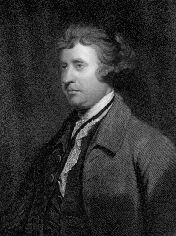
Edmund Burke
STUCK IN A FRAME
(1729-97)
-- CLICK HERE --

The cords of man:
"Man acts from adequate motives relative to his interest,
and not on metaphysical speculations."

("Speech on Conciliation with the Colonies," 1775.)

-

[TOC]
Lawyer/Writer/Politician:-
Burke was the son of a Dublin attorney.1 In 1750, he entered the Middle Temple, London, but Burke soon abandoned law for literary work. In 1756 he published, anonymously, A Vindication of Natural Society. In 1765 he became the private secretary to Marquis of Rockingham, who at that time, but only for a year thereafter, was premier. Burke soon entered parliament, as a Whig,2 through a pocket borough, Wendover. During most of his years as a parliamentarian, Burke was to sit in the opposition benches as a critic to the ruling Tories. These were times of great historical importance, marked by the unsuccessful coercion of the American colonies. The event, which was to unfold over a number of years, was, accompanied by corruption, extravagance, and reaction. Against this, Burke and his Whig friends could only raise a strong protest. "The best of Burke's writings and speeches belong to this period, and may be described as a defence of sound constitutional statesmanship against prevailing abuse and misgovernment."3
After the British colonies were lost, still yet in opposition, Burke turned his great talents in the support of the Irish cause, viz., to eliminate trade restrictions and the laws which then existed against Catholics.
Chambers' observed that Burke "never systematized his political philosophy" and that there were "inconsistencies" in his writings and speeches.4 This maybe so, and if so, then is was because of Burke's passion and love of order. Liberty is an essential right -- and, Burke was for liberty; but, "a liberty connected with order." Tranquility was the greatest state for man, one which according to Burke was a normal state, which was to be preserved.5 Having a profound veneration for the accumulated wisdom of centuries of experience, Burke held that the bounds of liberty should be enlarged with great caution and very gradually. Burke was especially concerned with the political movements of his day: the king's party (Tory) or the people's party (Whig): the one attacking liberty; the other attacking order.
Because Burke was against hasty reform, it should be no surprise, to find out that the reformers of the early 19th century were only too happy to cut Burke up, if they could. Hazlitt, if he is to be put in a camp, was a reformer, however, Hazlitt did admire Burke; he thought him to be "an admirable reasoner and a close observer of human nature."6
"He did not agree with some writers, that mode of government is necessarily the best which is the cheapest. ... He took his idea of political society from the pattern of private life, wishing, as he himself expresses it, to incorporate the domestic charities with the orders of the state, and to blend them together. He strove to establish an analogy between the compact that binds together the community at large, and that [habit] which binds together the several families that compose it."
Hazlitt continued:
"... that it is no objection to an institution, that it is founded in prejudice, but the contrary, if that prejudice is natural and right... On this profound maxim he took his stand. Thus he [Burke] contended, that the prejudice in favour of nobility was natural and proper.
... The inequality of the different orders of society did not destroy the unity and harmony of the whole. The health and well-being of the moral world was to be promoted by the same means as the beauty of the natural world; by contrast, by change, by light and shade, by variety of parts, by order and proportion. To think of reducing all mankind to the same insipid level, seemed to him the same absurdity as to destroy the inequalities of surface in a country, for the benefit of agriculture and commerce." (Hazlitt's Political Essays.)
Hazlitt then proceeded to write that Burke's arguments were "profound and true," but they did not go far enough. Hazlitt, for example, thought that Burke misrepresented history. In his, Burke's, effort to embolden the evils of the French Revolution "represented the French priests and nobles under the old regime as excellent moral people, very charitable and very religious" -- this "in the teeth of notorious facts." To Hazlitt there were abuses in the old system, and, for that matter, there were to be abuses in a reformed system as there are in every possible system. I suppose -- as an editorial aside -- it is a matter (assuming that such can be done, or that larger forces at work should ever allow such a thing), of picking a system which contains the least disruptive abuses, or which brings the most welfare to the largest group.
Burke knew that what was necessary was to sell his thoughts to the people (and thus to the parliamentarians), and to do so in a practical manner.7 He did not expound on the learned theories concerning human nature and of government. His thoughts on these subjects were more poetic in nature, for instance, take his idea of nation as was described by the historian, John Richard Green:
"A nation was to him a great living society, so complex in its relations, and whose institutions were so interwoven with glorious events in the past, that to touch it rudely was a sacrilege. Its constitution was no artificial scheme of government, but an exquisite balance of social forces which was itself a natural outcome of its history and development. ... To touch even an anomaly seemed to Burke to be risking the ruin of a complex structure of national order which it had cost centuries to build up."8
Burke thought that only madmen and pedants would disturb this beautiful naturally evolved society as, he conceived, existed in England during the latter half of the 18th century. Green continued to describe Burke's views:
"What statesman had to do was to take this structure as it was, and by cautious and delicate adjustment to accommodate from time to time its general shape and the relations of its various parts to the varying circumstances of their natural development."9
What was desired in society was stability and we need to do that which is necessary to achieve that goal and to avoid that which would bring on discord. In his Speech, On Conciliation with the American Colonies, he said: "I am resolved this day to have nothing to do with the right of taxation ... my consideration is narrow, and wholly limited to the policy of the question." Edmund Burke was a pragmatic and practical man. Yet, when his feelings were stirred, he would put on a splendid oratorical display, as was evidenced on the impeachment of Warren Hastings or when he furiously denounced the French Revolution. In the final analysis, though he was both excessive and inconsistent at times, there can be no question as to the place of Burke's sympathies, they had always been with those who were suffering misfortune, or injustice.
_______________________________

A featured sketch in a book

NOW AVAILABLE

Biographical Sketches: The Thinkers

_______________________________
Found this material Helpful?
_______________________________
[TOC]
Quotes:-
- Art:-
§ "The more deeply we penetrate into the labyrinth of art, the further we find ourselves from those ends for which we entered it." (A Vindication of Natural Society, 1756.)
- Beauty:-
§ "An air of robustness and strength is very prejudicial to beauty. An appearance of delicacy and even of fragility, is almost essential to it." (Sublime & Beautiful, 1756.)
- Calamity:-
§ "Calamity is unhappily the usual season of reflection." (Letter to Sheriffs of Bristol, 1777.)
- Competition:-
§ "He that wrestles with us strengthens our nerves, and sharpens our skill. Our antagonist is our helper." (Reflections on the Revolution in France, 1790.) 
- Constitution:-
§ "Our constitution is a prescriptive constitution; it is a constitution, whose sole authority is, that it has existed time out of mind." (1782.)
§ "I set out with a perfect distrust of my own abilities, a total
renunciation of every speculation of my own, and with a profound reverence for the wisdom of our ancestors, who have left us the inheritance of so happy a Constitution and so flourishing an empire, and, what is a thousand times more valuable, the treasury of the maxims and principles which formed the one and obtained the other." (On Conciliation with the American Colonies.) 
- Democracy:-
§ "Despotism of the multitude ... [however] democracy is the only tolerable form into which human society can be thrown, that a man is not permitted to hesitate about its merits, without the suspicion of being a friend to tyranny, that is, of being a foe to mankind?"
§ "The human mind is often in a state neither of pain nor pleasure, which I call a state of indifference." (Sublime & Beautiful, 1756.)
§ "In a democracy, the majority of the citizens is capable of exercising the most cruel oppressions upon the minority." (Reflections on the Revolution in France, 1790.)
§ "The publick is the theatre for mountebanks and impostors." (1796.)
- Equality:-
§ "That doctrine of the equality of all men, which has been preached by knavery, and so greedily adopted by malice, envy, and cunning." (1778.)
- Family:-
§ "To love the little platoon we belong to in society, is the first principle (the germ as it were) of publick affections." (Reflections on the Revolution in France, 1790.)
§ "A man that breeds a family without competent means of maintenance, encumbers other men with his children." (Speech on the Repeal of the Marriage Act, 1781.)
- Fear:-
§ "No passion so effectually robs the mind of all its powers of acting and reasoning as fear."
§ "In the fog and haze of confusion all is enlarged." (1797.)
- Government:-
§ "Parliament is not a congress of ambassadors from different and hostile interests; which interests each must maintain, as an agent and advocate, against other agents and advocates; but parliament is a deliberative assembly of one nation, with one interest, that of the whole; where, not local purposes, not local prejudices ought to guide, but the general good, resulting from the general reason of the whole. You choose a member indeed; but when you have chosen him, he is not a member of Bristol, but he is a member of parliament." And further: "Your representative owes you, not his industry only, but his judgment; and he betrays instead of serving you if he sacrifices it to your opinion." (Speech to the Electors of Bristol, November 3, 1774.)
§ "The objects of society are of the greatest possible complexity." (Reflections on the Revolution in France, 1790.)
§ "All government, indeed every human benefit and enjoyment, every virtue, and every prudent act, is founded on compromise and barter we give and take; we remit some rights, that we may enjoy others." (Speech, Conciliation with America, 1775.)
§ "The government is a juggling confederacy of a few to cheat the prince and enslave the people." (A Vindication of Natural Society, 1756.)
§ "It is one of the finest problems in legislation, What the state ought to take upon itself to direct and what it ought to leave, with as little interference as possible, to individual discretion." (1795.)
§ "Popular remedies must be quick and sharp, or they are very ineffectual." (1774.)
- Happiness:-
§ "Philosophical happiness is to want little. Civil or vulgar happiness is to want much, and to enjoy much." (1795.)
- History:-
§ "History is a preceptor of prudence, not of principles." (1771.)
- Interest Groups:-
§ "It is a general popular error to suppose the loudest complainers for the public to be the most anxious for its welfare."
§ "It would be well if gentlemen, before they joined in a cry against any establishment, had well considered for what purpose that cry is raised." (1799.)
§ "No rational man ever did govern himself, by abstractions and universals." (1794.)
- Law:-
§ "... a science [the law] which does more to quicken and invigorate the understanding, than all the other kinds of learning put together ..." (1774.)
§ "The law is wiser than cabal or interest." (1794.)
§ "All punishments are for example towards the conservation of the people at large." (Reflections on the Revolution in France, 1790.)
§ "It is not, what a lawyer tells me I may do; but what humanity, reason, and justice, tell me I ought to do." (Second Speech, Conciliation with America, March 22, 1775.)
§ "Even a failure in it [law] stands almost as a sort of qualification for other things." (1779.)
- Liberty:-
§ "Liberty without wisdom, and without virtue is folly, vice, and madness, without tuition or restraint." (Reflections on the Revolution in France, 1790.)
- Medicine:-
§ "Medicine was always joined with magick; no remedy was administered without mysterious ceremony and incantation." (English History, 1757.)
- Politicians:-
§ "Those who have been once intoxicated with power, and have derived any kind of emolument from it, even though but for one year, can never willingly abandon it."
§ "A king is not to be deposed by halves." (Reflections on the Revolution in France, 1790.)
§ "They who make a man an idol, when he is off his pedestal will treat him with all the contempt with which blind and angry worshippers treat an idol that is fallen." (1797.)
§ "We do not sufficiently distinguish, in our observations upon language, between a clear expression, and a strong expression." (Sublime & Beautiful.)
§ "A politician, to do great things, looks for a power, what our workmen call a purchase; and if he finds that power, in politics as in mechanics, he cannot be at a loss to apply it." (Reflections on the Revolution in France, 1790.)
§ "I always distinguish between a man's talkative and writative character." (1746.)
§ "All which a man without authority can give, -- his unbiased opinion, his honest advice, and his best reasons." (1791.)
- Prejudice:-
§ "You think you are combating prejudice, but you are at war with nature." (Reflections on the Revolution in France, 1790.)
§ "That the critical taste does not depend upon a superior principle in men, but upon superior knowledge." (Sublime & Beautiful, 1756.)
- Professions, The:-
§ "The degree of estimation in which any profession is held becomes the standard of the estimation in which the professors hold themselves." (Reflections on the Revolution in France, 1790.)
- Prosperity:-
§ "Prosperity is not apt to receive good lessons, nor always to give them." (1795.)
- Power:-
§ "Power is a very corrupting thing, especially low and jobbish power." (1792.)
§ "The operation of opinion being in the inverse ratio to the number of those who abuse power." (Reflections on the Revolution in France, 1790.)
- Property:-
§ "If prescription be once shaken, no species of property is secure, when it once becomes an object large enough to tempt the cupidity of indigent power." (Reflections on the Revolution in France, 1790.)
§ "Property, left undefended by principles, became a repository of spoils to tempt cupidity." (Letter to W. Elliot, 1795.)
§ "Property was not made by government, but government by and for it. The one is primary and self-existent; the other is secondary and derivative." (Speech, 1779.)
- Reason:-
§ "We begin to think and to act from reason and from nature alone." (A Vindication of Natural Society, 1756.)
- Revolution:-
§ "A populace never rebels from passion for attack, but from impatience of suffering."
§ "[Re: French Revolution] I thought that ten thousand swords would have leaped from their scabbards to avenge even a look that threatened her [Marie Antoinette] with insult. But the age of chivalry is gone. That of sophisters, economists, and calculators has succeeded." (Reflections on the Revolution in France, 1790.)
§ "The Revolution which is resorted to for a title, on their system, wants a title itself." (Reflections on the Revolution in France, 1790.)
§ "A revolution will be the very last resource of the thinking and the good." (Reflections on the Revolution in France, 1790.)
§ "... all that wise men ever aim at is to keep things from coming to the worst. Those who expect perfect reformations, either deceive or are deceived miserably." (1770.)
§ "Your mob can do this [pulling down and destroying social institutions] as well at least as your assemblies. The shallowest understanding, the rudest hand is more than equal to that task. Rage and frenzy will pull down more in half an hour than prudence,
deliberation, and foresight can build up in a hundred years. The errors and defects of old establishments are visible and palpable. It calls for little ability to point them out ... No difficulties occur in what has never been tried. Criticism is almost baffled in discovering the defects of what has not existed; and eager enthusiasm and cheating hope have all the wide
field of imagination in which they may expatiate with little or no opposition." (Reflections on the Revolution in France, 1790.)
- Solitude:-
§ "It required an unbroken attention, to form a true judgment." (1783.)
- The Nature of the State: A Contract Between Generations:-
§ "Society is indeed a contract. Subordinate contracts for objects of
mere occasional interest may be dissolved at pleasure -- but the state
ought not to be considered as nothing better than a partnership
agreement in a trade of pepper and coffee, calico, or tobacco, or some
other such low concern, to be taken up for a little temporary
interest, and to be dissolved by the fancy of the parties. It is to be
looked on with other reverence, because it is not a partnership in
things subservient only to the gross animal existence of a temporary
and perishable nature. It is a partnership in all science; a
partnership in all art; a partnership in every virtue and in all
perfection. As the ends of such a partnership cannot be obtained in
many generations, it becomes a partnership not only between those
who are living, but between those who are living, those who are
dead, and those who are to be born." (Reflections on the Revolution in France, 1790.)
- Superstition:-
§ "Superstition is the religion of feeble minds." (Reflections on the Revolution in France, 1790.)
- Taxation:-
§ "The most unjust and impolitick of all things, unequal taxation." (1797.)
- Trade:-
§ "All government, indeed every human benefit and enjoyment, every virtue, and every prudent act, is founded on compromise and barter. ... Man acts from motives relative to his interests; and not on metaphysical speculations." (On the Causes of the Present Discontents, 1770.)

§ "The cause of humanity would be far more benefited by the continuance of the trade." (In a letter, 1792.)
§ "Before men can transact any affair, they must have a common language to speak otherwise all is cross-purpose and confusion." (1797.)
§ "I act almost always from my present impulse, and with little scheme or design." (1763.)
§ "The value of money must be judged, like every thing else, from it's rate at market." (1797.)
- Tradition:-
§ "We owe an implicit reverence to all the institutions of our ancestors." (A Vindication of Natural Society, 1756.)
- Vanity:-
§ "When full grown, it [vanity] is the worst of vices, and the occasional mimic of them all. It makes the whole man false." (1791.)
- Wealth:-
§ "It is the interest of the commercial world that wealth should be found everywhere."
_______________________________
Found this material Helpful?
_______________________________
- [TOC]
- Dates:-
- 1729:
§ January: Burke is born.
- 1750:
§ Burke starts his study of the law by entering the Middle Temple.
§ Dr. Johnson is busy writing his dictionary.
- 1754:
§ Start of The Seven Years War.
- 1756:
§ Published A Vindication of Natural Society.
- 1757:
§ March: Marries Jane Nugent of Bath.
§ Published Sublime & Beautiful.
- 1759:
§ Wolfe takes Quebec.
§ Burke begins a six year political apprenticeship by becoming the private secretary and political advisor to William Gerald Hamilton (1729-96), "single-speech Hamilton."
- 1760:
§ George III becomes the king.
- 1763:
§ End of The Seven Years War and The Treaty Of Paris.
- 1765:
§ In July, Burke becomes the private secretary to the Marquis Rockingham (Charles Wentworth; 1730-1782). [A Whig, Rockingham was called in 1763 to form a government. "He repealed the Stamp Act and he would have done more for progress but for court intrigues ... he resigned in 1766 and opposed Lord North and his ruinous American policy. He [Rockingham] became premier in March 1782, but died four months later." (Chambers.)] Though most always on the opposition benches, on entering parliament, Burke was, for a short time, on the government side; "his first speech in the house of commons was on the Stamp Act, which Lord Rockingham had brought in a bill to repeal."
§ December, 23rd: The electors of Wendover chose Burke as their representative in Parliament.
- 1768:
§ Burke purchases his estate, "Gregories" near Beaconsfield.
- 1769:
§ Observations on the Present State of the Nation, a reply to George Grenville (1712-70). Two events which occurred during Grenville's administration was the prosecution of Wilkes and the passing of the American Stamp Act.
§ At around this time, Blackstone brings out his Commentaries on the Law of England.
- 1770:
§ On the Causes of the Present Discontents, re the Wilkes controversy. Incidently, it was in this piece that we see Burke, the first to do so, to argue there is value in having political parties.
§ The members of the "Long Parliament" take their seats, it sat for 15 years, until 1785.
- 1771:
§ Burke is chosen by the New York assembly as their London agent (just as Benjamin Franklin was that of Massachusetts.)
- 1773:
§ Burke loses his seat at Wendover, but through some contrivance manages to get the nod in Malton, but from which resigned in October for the seat at Bristol (From what I can determine, Burke was thus to represent three constituencies during the course of 1773?).
- 1774:
§ April 19th: Speech on American Taxation.
§ Quebec Act.
- 1775:
§ On Conciliation with the American Colonies.
- 1776:
§ This is the year, 1776, that Gibbon gives forth with his first volume of The Decline and Fall of the Roman Empire; Adam Smith, The Wealth of Nations; Jeremy Bentham, Fragments on Government; and Thomas Paine, Common Sense.
§ March 17th, British evacuate Boston.
§ July 2nd, The Continental Congress carries a motion for the independence of the 13 states on the east coast of America. Two days later the Declaration of Independence is adopted.
- 1777:
§ Letter to the Sheriff of Bristol.
- 1780:
§ Speech to the Electors of Bristol: In spite of his brilliant speech made Bristol Guildhall on September 6th, 1780, Burke loses his seat. Burke's loss came about as a result of his Irish support, both for trade and the Catholics. The Rockingham interests then found him a seat, the pocket borough of Malton, a seat Burke kept until 1794.
- 1781:
§ October 19th, British troops under Cornwallis surrender at Yorktown.
- 1783:
§ Mr Fox's East India Bill which took away governing power away from the East India Company.
§ December 13th, penal laws against Roman Catholics repealed.
- 1784:
§ Pitt defeats Fox and North at the polls. [Charles James Fox (1749-1808) was a supporter of Lord North up until 1775 when the two quarreled. Pitt described Fox as "the greatest debater the world was to ever saw." Lord North (1732-92) was the prime minister in 1770. History lays the American Revolution at his feet, in that, "he was too ready to surrender his judgment to the king's" in adopting policies that were repugnant to the English colonials.]
- 1785:
§ On October 20th, having sat for 15 years, the "Long Parliament" is dissolved.
§ The Big Bang of the Industrial Revolution occurs in England when, for first time, steam engines are used to power spinning machinery.
- 1788:
§ Impeachment of Warren Hastings, governor general of India, on corruption charges. Burke instigated the impeachment and made several speeches, "masterpieces of English eloquence."
- 1789:
§ The French court, the envy of and model for foreign courts, was, both literally and figuratively, - bankrupt; States General (like our parliament) is called into session, it had not assembled since 1610 (France, in the intervening years, was ruled by an absolute monarch). The French Revolution ensued; the absolute monarchy and its attending aristocratic order collapses. Through metamorphic leadership: - States General, the National Assembly, the Jacobins, the Revolutionary tribunal, the guillotine, Napoleon - in these years (between the execution of Louis XVI, 1793; and the Battle of Waterloo, 1815) blood, death and misery flow over France, and over onto the neighboring countries, and into every other part of the world that had been tainted by European "colonizers."
- 1790:
§ Burke publishes (November 1st) Reflections on the French Revolution, which his biographer, Kirk, describes as "the most brilliant work of English political philosophy."
- 1791:
§ To a member of the National Assembly, On The French Revolution, a public letter where Burke sets out his further views.
- 1792:
§ Paine's reply, The Rights of Man.
§ September massacres in Paris.
- 1793:
§ In January Louis XVI is beheaded.
§ Godwin's Political Justice appears.
§ As the French armies move in to "liberate" Holland, it seems clear that England and France are moving towards war.
§ Austria, Prussia, Spain, and Britain form an alliance against France (the "First Coalition.") Prussia retires after gobbling up Poland; Spain makes peace (July 1795); large parts of Holland and Belgium receive France as friends.
§ The trials of the "Reform-martyrs," Thomas Muir (1765-99) was one, who, with others, was transported to Botany Bay. These trials were part of the larger government effort to prosecute editors, nonconformists and radicals who were arguing for Parliamentary reform.
- 1794:
§ Burke retires; he is in debt; and, the government and the king rescue him by granting a pension. Burke and his wife were thus able to maintain their home, "Gregories," where Burke was able to live out the last of the few years left to him.
§ Howe's victory of the First of June with a French fleet shows the world that Britain continues to hold its old superiority at sea.
§ A simple device for separating cotton lint from seeds is patented by Eli Whitney (1765-1825).
- 1796:
§ A Letter ... To a Noble Lord. [Lord Bedford had objected to the pension which had been granted to Burke. This piece, consisting of 40 pages, as literature, as Hazlitt was to write "probably unsurpassed in the language for lofty and scornful invective." (Hazlitt thought it to be the most remarkable of all his writings.)]
§ The French conquer Italy and Austria deserts Britain in her struggle against France.
§ Jenner discovers vaccination.
- 1797:
§ In January, with Bonaparte having successfully invaded Italy and Spain coming in on the side of France, Britain withdrew her ships from the Mediterranean, which was to become a "French Lake" from January 1797 to May 1798.
§ By a parliamentary statute of Britain the torture of suspects and criminals was abolished.
§ John Adams (1735-1826) replaces George Washington (1732-1799) as the President of the United States.
§ Edmund Burke dies at Beaconsfield.
_______________________________
[UP]
NOTES:
1 It was a "mixed marriage." Burke's father was an Anglican, whereas his mother was a Catholic. Burke was raised as an Anglican; his sister, a Catholic.
2 "Although himself a Whig, Burke's political thought has become, with Disraeli's, the philosophy of modern Conservatives." (Chambers.)
3 See generally Chambers Biographical Dictionary (Edinburgh), often referred to in these pages simply as Chambers.
4 This much is clear: Burke "dissented from the a priori systems of the French philosopes." (Kirk, Edmund Burke: A Genius Reconsidered (Arlington House, 1967) p. 32.) Thus he was an empiricist and not a rationalist.
5 Burke's view is to be compared to that of Goethe's: that a state of tranquility, as desirable as it is, is one that is not achievable; man's lot in life, according to Goethe, was to be in a perpetual state of dissatisfaction, and, he is to spend it endlessly striving.
6 Hazlitt, Political Essays (1819). Hazlitt had difficulty pinning down Burke's style of writing, he tried a number of times and came up short, but he did say that it was extravagant and bold with matter-of-fact hyperbole. Burke, incidently was a member of Samuel Johnson's literary circle.
7 In this, selling his thoughts to the people, he was not always successful. His Speech to the Electors of Bristol, in 1780, is, and will always be, a monument in the landscape of political history. Burke argued that he should be elected notwithstanding that he would vote against their wishes. Burke thought that there should be freer trade with the Irish and that the Irish Catholics should be liberated. The electors of Bristol did not: he was right: they were wrong. But, no matter, he lost his seat. It is one of the most profound questions in political "science": does an elected representative vote on a parliamentary measure on the basis of her conscience; or, does the representative vote the will of the people who elected her. It is clear in history where Burke stood on the question.
8 Green, History of the English People, vol. X, p. 59.
8 Ibid, p. 60.